
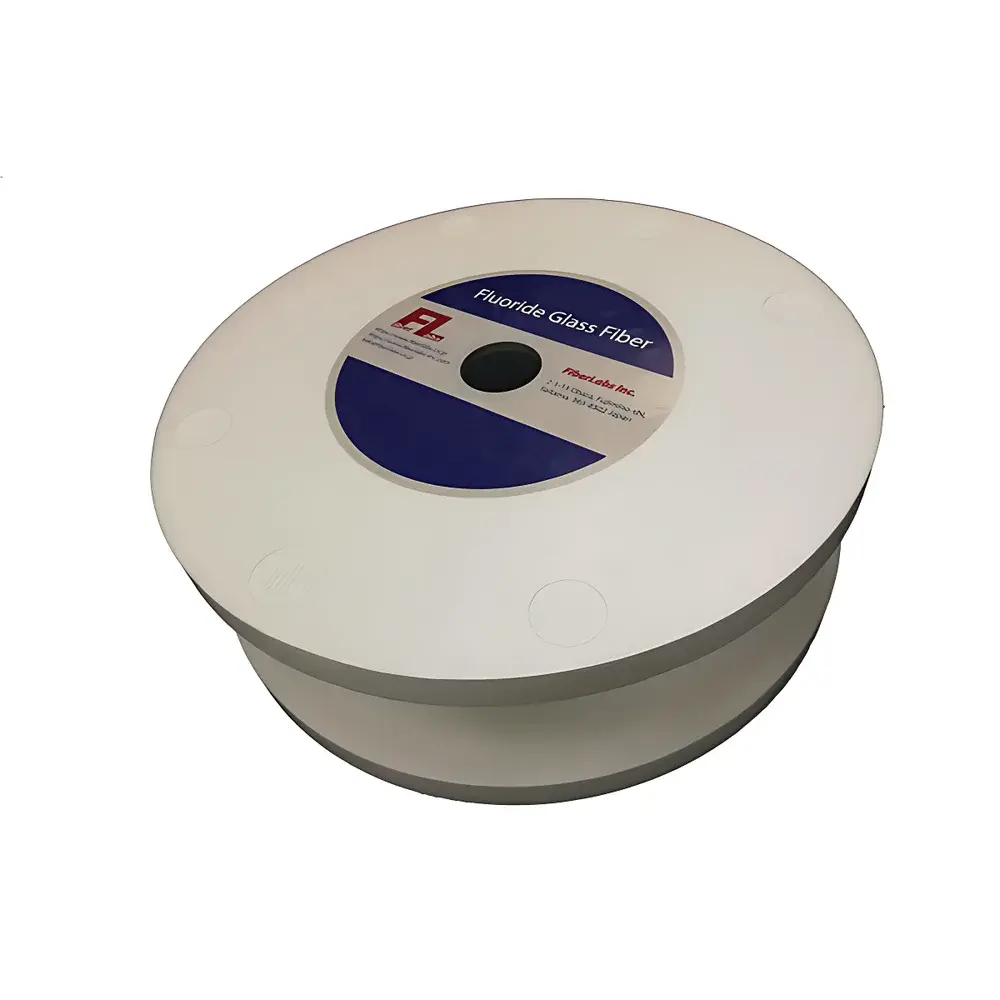
Fiberlabs ZBLAN Fluoride Fiber and Patch Cables
| Key | Brand: Fiberlabs |
|---|---|
| Origin | Japan |
| Product Type | ZBLAN Fluoride Optical Fiber |
| Operating Wavelength Range | 400–4000 nm |
| Core Diameter Options | 6.0–400 µm |
| Numerical Aperture Options | 0.12–0.29 |
| Attenuation | < 0.1 dB/m @ 1500–2500 nm |
| Cladding Material | Fluoride glass (ZrF₄–BaF₂–LaF₃–AlF₃–NaF) |
| Coating | Dual-layer acrylate or polyimide (customizable) |
| Compliance | RoHS-compliant, ISO 9001-manufactured raw materials |
| Customization | Cut-to-length, connectorized (FC/PC, SMA-905), splicing-ready ends |
Overview
Fiberlabs ZBLAN Fluoride Fibers are heavy-metal fluoride-based multimode and single-mode optical waveguides engineered for high-fidelity transmission and amplification in the mid-infrared (MIR) spectral region. Composed of a precise stoichiometric blend of zirconium, barium, lanthanum, aluminum, and sodium fluorides (ZrF4–BaF2–LaF3–AlF3–NaF), ZBLAN exhibits exceptionally low intrinsic attenuation—below 0.1 dB/m between 1.5–2.5 µm—and extended transparency from 0.35 µm to 4.0 µm. This broad transmission window surpasses silica’s practical limit (~2.2 µm) and enables applications inaccessible to conventional fused-silica fibers, including MIR spectroscopy, quantum cascade laser (QCL) delivery, upconversion laser pumping, and rare-earth-doped fiber amplifier development. Unlike silica, ZBLAN’s low phonon energy (~500 cm−1) suppresses non-radiative decay pathways, yielding high quantum efficiency in Er3+, Tm3+, Ho3+, and Dy3+-doped configurations—critical for efficient 2.7–3.5 µm laser sources.
Key Features
- Extended Infrared Transmission: Certified transmission range from 350 nm to 4000 nm, with minimal OH⁻ absorption and negligible multiphonon edge up to 4.5 µm under optimized fabrication conditions.
- Low Propagation Loss: Attenuation consistently < 0.1 dB/m at 1500 nm and < 0.2 dB/m at 2500 nm across standard single-mode and multimode variants; loss values validated per IEC 60793-1-40 (cutback method).
- Precision Geometric Control: Core diameters available from 6.0 µm (single-mode) to 400 µm (high-power multimode), with ±0.5–1.0 µm tolerance and NA tightly controlled within ±0.01.
- Rare-Earth Doping Capability: Homogeneous incorporation of Er, Tm, Ho, Pr, Dy, and co-dopants at ppm-level concentrations (e.g., 10,000–60,000 mol ppm Er) for active fiber devices; dopant distribution verified via EPMA and micro-PL mapping.
- Mechanical Robustness: Knoop hardness of 2.2 GPa and Young’s modulus of 53 GPa—optimized for draw-tower processing and coilable packaging; tensile strength > 200 MPa (proof-tested at 100 kpsi).
- Custom Termination & Packaging: Available as bare fiber, jacketed fiber (polyimide or acrylate), connectorized patch cables (FC/PC, SMA-905, ST), and spliced pigtails with fusion-compatible end finishes.
Sample Compatibility & Compliance
ZBLAN fibers are compatible with standard fiber handling protocols—including cleaving (diamond scribe), fusion splicing (with fluorozirconate-specific arc parameters), and mechanical splicing—provided ambient humidity remains below 30% RH during processing to mitigate hydrolytic degradation. All fibers meet RoHS Directive 2011/65/EU restrictions on hazardous substances. Raw material synthesis and preform fabrication occur in ISO 9001-certified cleanrooms (Class 1000) under inert-gas purged environments. While ZBLAN itself is not FDA-listed, fiber assemblies intended for medical laser delivery (e.g., Er:YAG at 2.94 µm) comply with IEC 60601-2-22 requirements when integrated into Class 4 laser systems. Documentation packages include full material traceability, spectral attenuation reports (200–4000 nm), and mechanical test summaries (tensile, bend, crush).
Software & Data Management
Fiberlabs provides comprehensive technical documentation—not software-driven control—for passive fiber products. Each shipment includes a Certificate of Conformance (CoC) with lot-specific spectral loss curves, dimensional verification reports, and refractive index profile data (measured via near-field scanning). For system integrators developing active components, Fiberlabs supplies dopant concentration profiles and thermal expansion coefficients (α = 200 × 10−7/°C) to support thermal modeling in COMSOL Multiphysics® or Lumerical MODE™. All data files adhere to ASTM E2918-20 standards for optical material characterization reporting and are archived for ≥10 years to support GLP/GMP audit trails.
Applications
- Mid-Infrared Spectroscopy: Light delivery for FTIR, photoacoustic, and cavity-enhanced absorption spectrometers operating at 2.5–3.5 µm (e.g., CH4, CO2, NOx detection).
- Laser Power Delivery: Flexible beam transport for Er:YAG (2.94 µm), Er:YSGG (2.79 µm), and Fe:ZnSe (3.7–5.0 µm) lasers in dental, dermatological, and surgical systems.
- Upconversion Fiber Lasers: Host medium for Tm3+/Ho3+ co-doped systems generating visible emission (e.g., 480 nm, 650 nm) via two-photon excitation at 1150–1200 nm.
- Nonlinear Frequency Conversion: High peak-power delivery for supercontinuum generation in ZBLAN photonic crystal fibers (PCFs), extending coherence beyond 4.5 µm.
- Sensing Probes: Chemically inert waveguides for in situ process monitoring in corrosive or high-temperature industrial environments (up to 200°C continuous operation with polyimide coating).
FAQ
What is the maximum recommended bending radius for ZBLAN fiber?
For 125 µm cladding fibers with acrylate coating, minimum long-term bend radius is 30 mm; for polyimide-coated variants, 15 mm is permissible at room temperature.
Can ZBLAN fiber be spliced to silica fiber?
Yes—using mode-field adapters or tapered transitions; however, direct fusion splicing requires specialized fluorozirconate-compatible electrodes and post-annealing at 250°C to relieve interfacial stress.
How does humidity affect ZBLAN fiber longevity?
Uncoated ZBLAN exhibits measurable hydrolysis above 40% RH; all commercially supplied fibers feature hermetic dual-layer coatings that extend operational lifetime to >10 years under typical lab conditions (23°C, 40–60% RH).
Is there a difference in numerical aperture between ZBLAN and AlF3 fibers?
Yes—ZBLAN typically achieves NA ≈ 0.26–0.29 for multimode grades, while AlF3 is limited to NA ≈ 0.22 due to lower core-cladding index contrast.
Do you provide cut-off wavelength measurements for single-mode ZBLAN?
Yes—cut-off wavelengths are measured per IEC 60793-1-44 using the multi-point bending method; reported values reflect 95% confidence intervals across three independent samples.



