
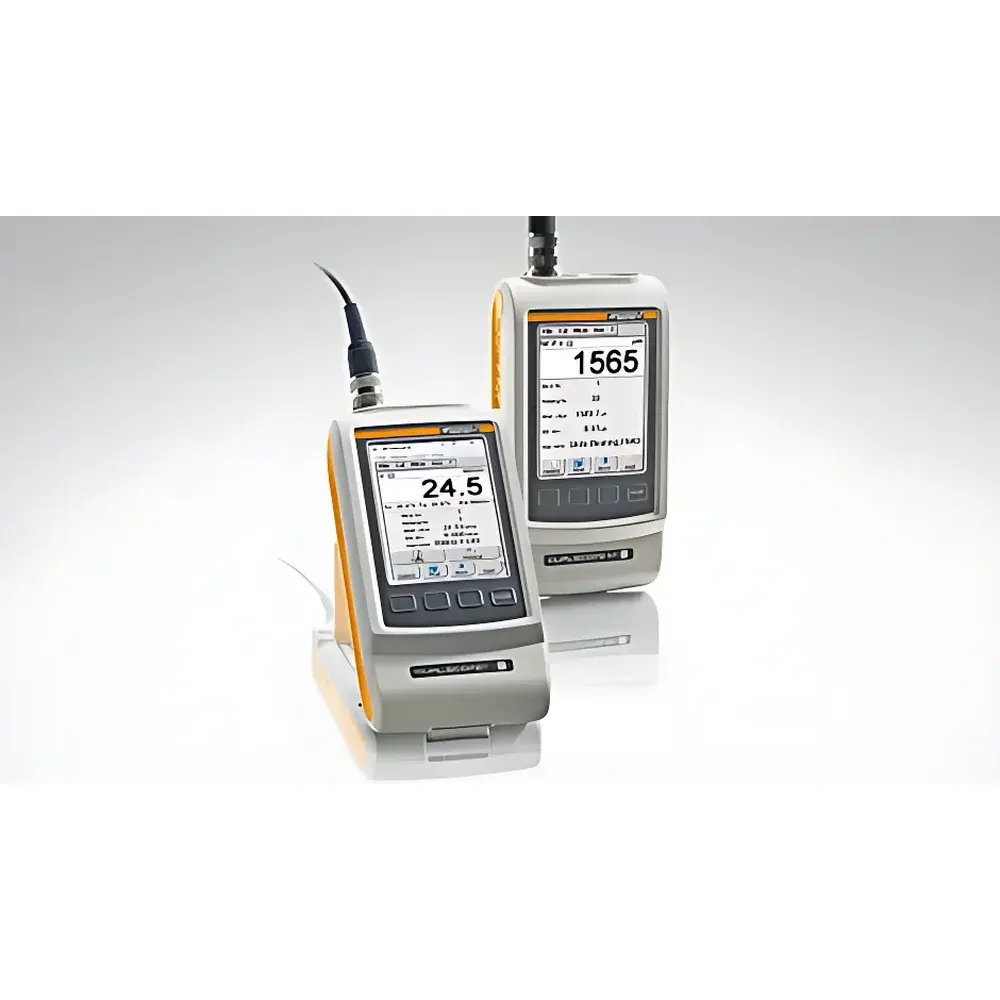
Fischer FMP100 / FMP150 Dual-Mode Electromagnetic Eddy Current & Magnetic Induction Coating Thickness Gauge
| Brand | Fischer |
|---|---|
| Origin | Germany |
| Model | FMP100 / FMP150 |
| Measurement Principle | Magnetic Induction (for ferrous substrates) & Eddy Current (for non-ferrous substrates) |
| Operating System | Windows CE |
| Display | High-Resolution Graphical Touchscreen |
| Onboard Memory | Supports >10,000 measurements |
| Compliance Modes | IMO PSPC, SSPC-PA2, QUALANOD, QUALICOAT |
| Probe Interface | Interchangeable probe design |
| Data Management | Compatible with DataCenter IP inspection planning software |
| Regulatory Context | Designed for GLP/GMP-aligned workflows |
Overview
The Fischer FMP100 and FMP150 are dual-mode handheld coating thickness gauges engineered for high-precision, non-destructive measurement of metallic and non-metallic coatings on conductive substrates. These instruments operate on two complementary electromagnetic principles: magnetic induction for ferromagnetic base materials (e.g., steel, iron), and eddy current for non-ferromagnetic conductors (e.g., aluminum, copper, stainless steel, brass). This dual-sensor architecture eliminates the need for instrument swapping when transitioning between substrate types—a critical advantage in multi-material production environments such as shipbuilding, aerospace component finishing, architectural cladding, and automotive OEM paint shops. Both models feature a rugged industrial enclosure rated for field use, integrated temperature compensation, and real-time signal stabilization to ensure repeatability under variable ambient conditions. The devices comply with ISO 2178 (magnetic induction), ISO 2360 (eddy current), ASTM B499, and DIN EN ISO 1461, forming the technical foundation for traceable quality control in certified manufacturing systems.
Key Features
- Dual-principle measurement engine supporting simultaneous calibration and verification on ferrous and non-ferrous substrates without hardware reconfiguration
- High-resolution graphical touchscreen interface running Windows CE 6.0, enabling intuitive navigation through layered measurement menus, calibration wizards, and statistical dashboards
- Expandable internal memory capable of storing over 10,000 measurement records with timestamp, location tag (via optional GPS module), substrate ID, and operator code
- Interchangeable probe system—compatible with Fischer’s full range of miniature, angled, and high-temperature probes (e.g., SHS, PHA, FTA series)—to accommodate complex geometries including curved surfaces, narrow gaps, and elevated-temperature applications up to 150 °C
- Built-in statistical analysis suite: calculates mean, standard deviation, min/max, Cp/Cpk indices, histogram generation, and trend charts directly on-device
- Preconfigured compliance modes for industry-specific standards—including IMO PSPC (Protective Coating Performance Standard for Ballast Tanks), SSPC-PA2 (Procedure for Determining Conformance to Dry Film Coating Thickness Requirements), QUALANOD (anodized aluminum), and QUALICOAT (powder-coated aluminum)—with automatic pass/fail flagging based on user-defined tolerance bands
Sample Compatibility & Compliance
The FMP100 and FMP150 support measurement of non-conductive coatings (e.g., paint, enamel, plastic, ceramic) on conductive metallic substrates, as well as non-magnetic metallic coatings (e.g., chromium, nickel, zinc) on non-ferrous bases. Typical applications include epoxy primers on ship hulls, polyurethane topcoats on aluminum aircraft skins, anodized layers on architectural extrusions, and electroplated nickel on copper busbars. All measurement protocols adhere to internationally recognized metrological frameworks: ISO/IEC 17025–accredited laboratories routinely validate these instruments using NIST-traceable reference standards (e.g., Fischer-certified foil sets, step wedges, and coated calibration plates). Device firmware includes configurable reporting templates aligned with ASME BPE, ISO 9001, and IATF 16949 documentation requirements.
Software & Data Management
DataCenter IP is Fischer’s enterprise-grade inspection planning and reporting platform, fully interoperable with the FMP100/150 via USB or Bluetooth. It enables users to define hierarchical inspection plans—including sampling frequency, measurement point mapping (X/Y/Z coordinates), acceptance criteria per zone—and deploy them as executable scripts onto the gauge. Post-measurement, raw data—including individual readings, statistical summaries, and annotated screenshots—is exported in CSV, PDF, or XML formats. Audit trails record every calibration event, parameter change, and user login, satisfying FDA 21 CFR Part 11 electronic record integrity requirements. Optional integration with MES/SCADA systems allows automated upload of thickness data into SPC dashboards for real-time process control.
Applications
- Marine & Offshore: Verification of DFT (Dry Film Thickness) in ballast tank coatings per IMO PSPC Clause 3.2.2.1
- Aerospace: Measurement of chromate conversion coatings on aluminum alloys (AMS 2410) and thermal barrier coatings on turbine blades
- Automotive: In-line QC of e-coat thickness on stamped steel body panels and powder coat uniformity on alloy wheels
- Construction: Compliance testing of anodized layer thickness (AA-M12 per QUALANOD) on curtain wall systems
- Energy: Monitoring of protective zinc-aluminum alloy coatings on transmission tower steel structures (ASTM A780)
FAQ
Can the FMP100 measure nickel plating on copper?
Yes—the FMP100 uses eddy current mode for non-ferrous substrates and is calibrated for nickel-on-copper measurements within its specified range (typically 0.1–100 µm, depending on probe selection and surface condition).
Does the FMP150 support measurements on insulated substrates like fiberglass-reinforced polymer (FRP)?
No—eddy current and magnetic induction methods require electrically conductive base materials. FRP is non-conductive; alternative techniques such as ultrasonic or beta-backscatter would be required.
Is calibration traceable to national standards?
Yes—Fischer provides factory calibration certificates traceable to PTB (Physikalisch-Technische Bundesanstalt) and NIST, with uncertainty budgets documented per ISO/IEC 17025.
Can measurement data be synchronized across multiple devices in a plant network?
Yes—DataCenter IP supports centralized configuration management, firmware updates, and batch data aggregation from distributed FMP units via secure LAN or cloud-based deployment.
What environmental conditions affect measurement accuracy?
Extreme temperatures (>50 °C), strong electromagnetic fields (e.g., near welding equipment), and surface roughness exceeding Ra 3.2 µm may degrade signal-to-noise ratio; temperature-compensated probes and surface preparation guidelines are provided in the operating manual.



