
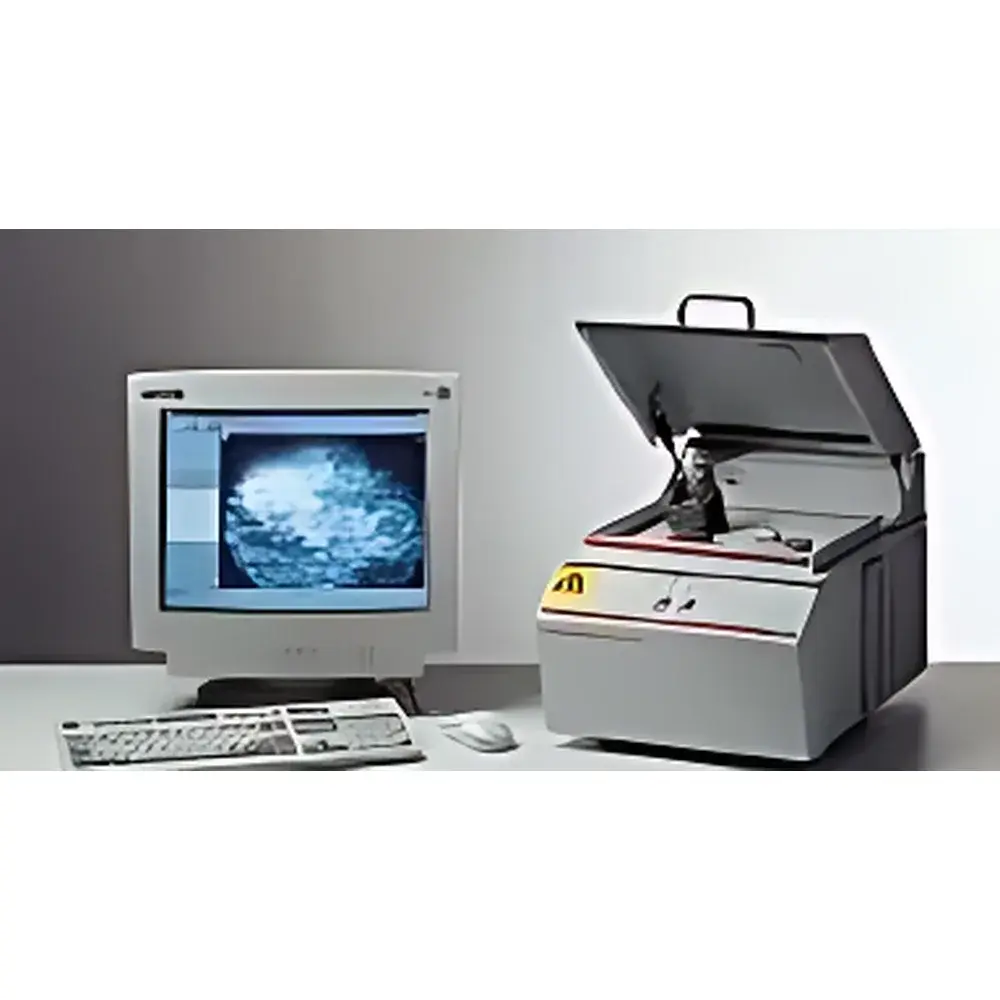
Fischer XAN-DPP Energy Dispersive X-Ray Fluorescence Spectrometer
| Brand | Fischer |
|---|---|
| Origin | Germany |
| Model | XAN-DPP |
| Configuration | Benchtop/Free-standing |
| Excitation Source | Rhodium anode X-ray tube |
| Detector | Peltier-cooled Si-PIN diode (≈ −30 °C) |
| Energy Resolution | 180 eV (Mn Kα) |
| Elemental Range | Al (Z=13) to U (Z=92) |
| Collimators | Motorized, programmable: Ø0.2 mm, Ø0.6 mm, Ø1.0 mm, Ø2.0 mm |
| Measurement Chamber Internal Dimensions (incl. sloped door) | W 318 mm × D 307 mm × H 29–86 mm |
| Usable Height Zone (full-height region) | W 318 mm × D 203 mm × H 86 mm |
| Distance Compensation | Patented DCM (Distance Controlled Measurement) algorithm |
| Calibration | Standardless quantitative analysis enabled via fundamental parameters method |
| Simultaneous Output | Elemental concentration (ppm–wt%) and substrate thickness (µm) |
Overview
The Fischer XAN-DPP is a benchtop energy dispersive X-ray fluorescence (EDXRF) spectrometer engineered for precise, non-destructive quantification of regulated hazardous substances in electronic components, plating layers, polymers, and coated materials. It operates on the principle of X-ray fluorescence spectroscopy: a high-stability Rh-target X-ray tube excites characteristic secondary X-rays from elements in the sample; these emitted photons are resolved by a thermoelectrically cooled Si-PIN detector and processed using fundamental parameters (FP)-based algorithms. Designed explicitly for compliance verification against RoHS (2011/65/EU), WEEE (2012/19/EU), ELV (2000/53/EC), and China’s SJ/T 11364-2014, the XAN-DPP delivers trace-level detection (down to low ppm) for Cd, Pb, Hg, Cr(VI), Br (as PBB/PBDE surrogates), and other priority elements without requiring physical reference standards.
Key Features
- Standardless Quantitative Analysis: Implements a physics-based fundamental parameters method with matrix correction, eliminating dependency on certified reference materials for routine screening and pass/fail testing.
- Peltier-Cooled Si-PIN Detector: Maintains stable operation at ≈ −30 °C without liquid nitrogen, ensuring long-term detector performance, reduced maintenance, and lower total cost of ownership.
- Motorized Multi-Collimator System: Four programmable apertures (Ø0.2 mm, Ø0.6 mm, Ø1.0 mm, Ø2.0 mm) enable spatially resolved analysis—critical for small components, solder joints, or heterogeneous surfaces.
- Patented DCM (Distance Controlled Measurement): Compensates automatically for sample height variation and surface topography, enabling reliable quantification on recessed, curved, or uneven substrates without mechanical repositioning.
- Integrated Thickness & Composition Output: Simultaneously reports elemental mass fractions (wt% or ppm) and underlying substrate thickness (µm), leveraging Fischer’s proprietary coating metrology algorithms calibrated for multi-layer EDXRF response.
- RoHS-Optimized Workflow: Pre-configured measurement templates, automated reporting (PDF/CSV), and limit-checking logic aligned with EU Annex II thresholds streamline audit-ready documentation per ISO/IEC 17025 and IEC 62321-5:2013 requirements.
Sample Compatibility & Compliance
The XAN-DPP accommodates samples up to 318 mm wide × 307 mm deep × 86 mm tall (full-height zone), with variable-height support for irregular geometries. Its open-chamber design allows direct placement of PCBs, connectors, housings, cables, and molded parts—no vacuum or helium purge required. The instrument meets CE marking requirements and complies with IEC 61000-6-3 (EMC) and IEC 61000-6-4. Analytical validity is traceable to NIST SRM standards and validated per IEC 62321-5:2013 (EDXRF screening) and ASTM E1621–22 (standardless FP calibration). Full audit trails—including operator ID, timestamp, measurement parameters, and raw spectra—are retained for GLP/GMP environments supporting FDA 21 CFR Part 11 readiness.
Software & Data Management
Fischer’s WinFTM® software provides intuitive workflow control, spectral deconvolution, and real-time quantification. It supports customizable report generation (including RoHS-compliant summary tables), batch processing, and database export (SQL-compatible). All measurement data—including full spectra, peak integration parameters, and DCM correction logs—are stored in a structured binary format with SHA-256 checksum integrity verification. Audit mode enforces electronic signatures, change logging, and role-based access control (RBAC), satisfying ISO/IEC 17025 clause 7.11 and internal quality system requirements for accredited laboratories.
Applications
- Routine RoHS/WEEE screening of incoming raw materials and finished goods in electronics manufacturing
- Quantitative analysis of Cd, Pb, and Cr in electroplated fasteners, connectors, and shielding components
- Br content assessment in flame-retardant plastics (as PBDE/PBB proxy)
- Multi-layer coating analysis: simultaneous determination of Sn over Cu, Ni over steel, or Zn-Ni alloy composition
- Failure analysis of non-conforming lots during QC/QA release testing
- Supporting due diligence documentation for REACH SVHC and SCIP database submissions
FAQ
Does the XAN-DPP require annual recalibration with certified reference materials?
No—its standardless FP engine enables traceable quantification without physical standards. However, periodic verification using NIST-traceable check standards (e.g., NIST SRM 2582) is recommended for ISO/IEC 17025 compliance.
Can it measure Cr(VI) directly?
EDXRF detects total chromium. Cr(VI) speciation requires complementary techniques (e.g., UV-Vis after leaching per EN ISO 3613). The XAN-DPP identifies total Cr content and flags samples exceeding 1000 ppm for downstream speciation testing.
Is the DCM function applicable to curved or angled surfaces?
Yes—the DCM algorithm dynamically adjusts excitation geometry and intensity normalization based on real-time distance feedback from integrated laser triangulation sensors, maintaining accuracy across ±5 mm vertical deviation.
What is the typical detection limit for lead in PVC?
Under optimized conditions (600 s count time, Ø0.6 mm collimator), typical 3σ detection limits are ~15–25 ppm Pb in polymer matrices, consistent with IEC 62321-5:2013 validation criteria.
Does WinFTM® support automated report generation for regulatory submission?
Yes—predefined templates generate PDF reports with embedded spectra, pass/fail status, uncertainty estimates, and compliance statements aligned with EU Commission Guidance Document SANCO/11350/2014.
Related Products




