
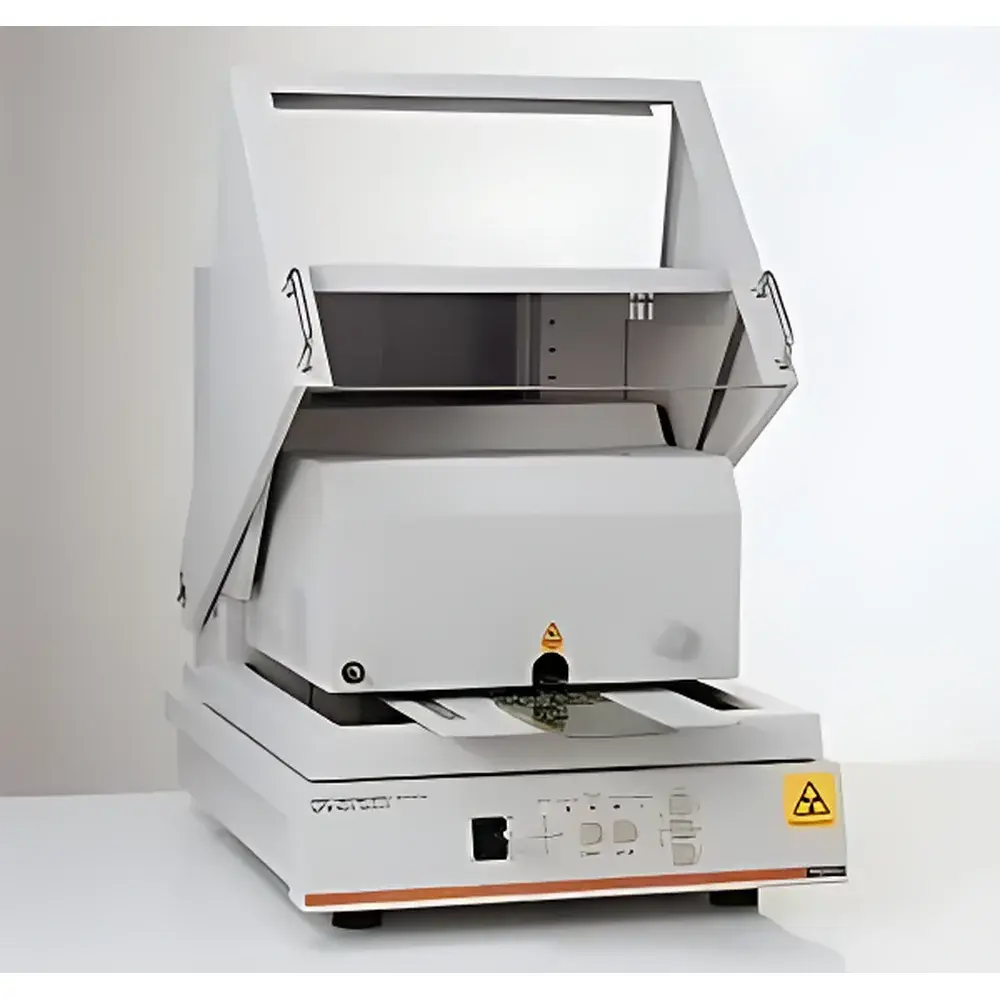
Fischer XDLM Series X-Ray Fluorescence Coating Thickness Analyzer
| Brand | Fischer |
|---|---|
| Origin | Germany |
| Model | XDLM Series |
| Measurement Principle | Energy-Dispersive X-Ray Fluorescence (ED-XRF) |
| Standards Compliance | DIN 50987, ISO 3497, ASTM B568 |
| X-Ray Tube | Microfocus, adjustable high voltage (30/40/50 kV) |
| Collimator Set | Circular (0.1 / 0.2 / 0.3 mm) and rectangular (0.05 × 0.3 mm) |
| Sample Chamber Dimensions (W×D×H) | 570 × 740 × 650 mm |
| Internal Chamber Volume (W×D×H) | 460 × 500 × 300 mm |
| Z-Axis Travel Range | 144 mm (motorized) |
| Camera System | Integrated color CCD camera with live imaging and on-screen crosshair overlay |
| Beam Spot Visualization | Real-time X-ray beam size indicator synchronized with focal distance |
| Distance Correction Method | DCM (Distance Control Measurement), effective up to 80 mm |
| Software Platform | WinFTM® v6 (Windows-based, 32-bit), multilingual UI (EN/DE/FR/IT/ES/ZH) |
| Data Interface | RS-232, Ethernet-compatible remote command protocol |
| Reporting & SPC | Embedded statistical engine with control charts (X̄/R, X̄/S), probability plots, histogram analysis, and customizable PDF/Excel report generation |
| Regulatory Support | Audit trail, user access levels, electronic signature readiness per FDA 21 CFR Part 11 and GLP/GMP requirements |
Overview
The Fischer XDLM Series X-Ray Fluorescence Coating Thickness Analyzer is a precision-engineered ED-XRF (Energy-Dispersive X-Ray Fluorescence) instrument designed for non-destructive, quantitative measurement of metallic coating thicknesses and elemental composition across complex multi-layer systems. Operating on the fundamental principle of characteristic X-ray emission following primary X-ray excitation, the system detects and resolves fluorescence photons emitted from atoms in the sample—enabling simultaneous quantification of layer thickness, elemental mass fraction, and alloy stoichiometry. Its vertical top-down beam geometry, microfocus X-ray tube (adjustable at 30/40/50 kV), and motorized collimator turret ensure optimal excitation efficiency and spatial resolution for industrial QA/QC applications. The instrument complies fully with internationally recognized metrological standards—including DIN 50987, ISO 3497, and ASTM B568—ensuring traceable, repeatable results suitable for certification and regulatory submission.
Key Features
- DCM (Distance Control Measurement) technology automatically compensates for spectral intensity variations caused by changes in sample-to-detector distance—enabling reliable measurements on curved, recessed, or irregularly shaped components without manual recalibration.
- Motorized Z-axis stage (144 mm travel) precisely positions the X-ray head relative to the sample surface, supporting consistent focus and reproducible geometry across batch testing.
- Four interchangeable collimators (circular: 0.1/0.2/0.3 mm; rectangular: 0.05 × 0.3 mm) allow optimization of measurement spot size for fine features (e.g., watch springs, PCB pads) or larger areas (e.g., fasteners, stamped parts).
- Integrated color CCD camera provides real-time, high-contrast imaging with overlaid calibrated crosshairs and dynamic X-ray beam size indication—supporting precise targeting and documentation.
- Dual-mode analytical capability: supports both single/multi-layer thickness determination (up to three layers) and compositional analysis of binary/ternary alloys—including karat gold assay via WinFTM® Gold Assay module.
- Robust mechanical architecture includes a hinged upward-opening chamber (internal volume: 460 × 500 × 300 mm), removable support plate for oversized samples, and vibration-damped base assembly for stable long-term operation.
Sample Compatibility & Compliance
The XDLM Series accommodates a broad range of conductive and non-conductive substrates—including steel, Cu, Zn, Al, plastics, and ceramics—with no requirement for electrical contact or vacuum environment. It measures coatings such as Ni, Cr, Sn, Zn, Ag, Au, Pd, Rh, and their alloys on diverse base materials. Applications span electroplated fasteners, automotive brake components, printed circuit board finishes, jewelry articles, and aerospace hardware. All measurement protocols adhere to ISO/IEC 17025-aligned uncertainty estimation practices. The system’s software enforces role-based access control, audit-trail logging, and electronic signature workflows—meeting foundational requirements for FDA 21 CFR Part 11, EU Annex 11, and GLP/GMP environments where data integrity is mandated.
Software & Data Management
WinFTM® v6 serves as the embedded analytical platform—delivering a fully graphical Windows-native interface with drag-and-drop method creation, live spectrum visualization, and automated peak deconvolution using fundamental parameter (FP) algorithms. Users can define custom calibration curves using certified reference standards (e.g., Fischer Gold Assay standards), store application-specific parameters on removable media (“Application Toolbox”), and deploy preconfigured icons for rapid test selection. Statistical process control (SPC) tools include X̄/R and X̄/S charts, capability indices (Cp/Cpk), probability plots, and histogram-based distribution analysis. Reports embed annotated sample images, spectra, and metadata—and export natively to PDF, CSV, or Excel formats. Network-enabled remote operation supports centralized fleet management via TCP/IP commands.
Applications
- Quality assurance of electroplated screws, nuts, bolts, and connectors in automotive and electronics manufacturing.
- Thickness verification of decorative and functional coatings (e.g., Ni/Cr on ABS plastic, Sn on Cu leads) per IPC-4552 and JIS H 8601.
- Karat gold analysis in jewelry production and precious metal recycling—validated against certified bullion standards.
- Electrolyte bath monitoring: quantification of major cations (e.g., Ni²⁺, Cu²⁺) in plating solutions using standard addition methodology.
- R&D characterization of diffusion barriers, nanolaminates, and functional thin-film stacks in semiconductor packaging and MEMS fabrication.
- Regulatory compliance testing for RoHS, REACH, and ELV directives—particularly Pb, Cd, Cr(VI), Hg, and Br screening in coated consumer goods.
FAQ
What coating systems can the XDLM Series measure?
It supports single-layer, dual-layer, and triple-layer metallic systems—including cases where an alloy layer resides as the outermost, intermediate, or substrate-adjacent layer. Thickness and composition are resolved simultaneously.
Is vacuum required for analysis?
No—measurements are performed in ambient air. Optional helium purge kits are available for light-element enhancement (e.g., Mg, Al, Si) when required.
How does DCM improve measurement accuracy on uneven surfaces?
DCM dynamically adjusts spectral integration time and applies distance-dependent matrix correction factors derived from real-time camera-based distance feedback—eliminating systematic bias from height variation.
Can the system be integrated into a factory automation line?
Yes—via RS-232 serial or Ethernet-based command protocols, the XDLM supports PLC-triggered measurement cycles, barcode-driven method selection, and automated pass/fail flagging.
What validation documentation is provided with the instrument?
Each unit ships with a factory calibration certificate traceable to NIST SRMs, full DIN EN ISO/IEC 17025-compliant performance verification report, and installation qualification (IQ) / operational qualification (OQ) templates for GxP environments.



