
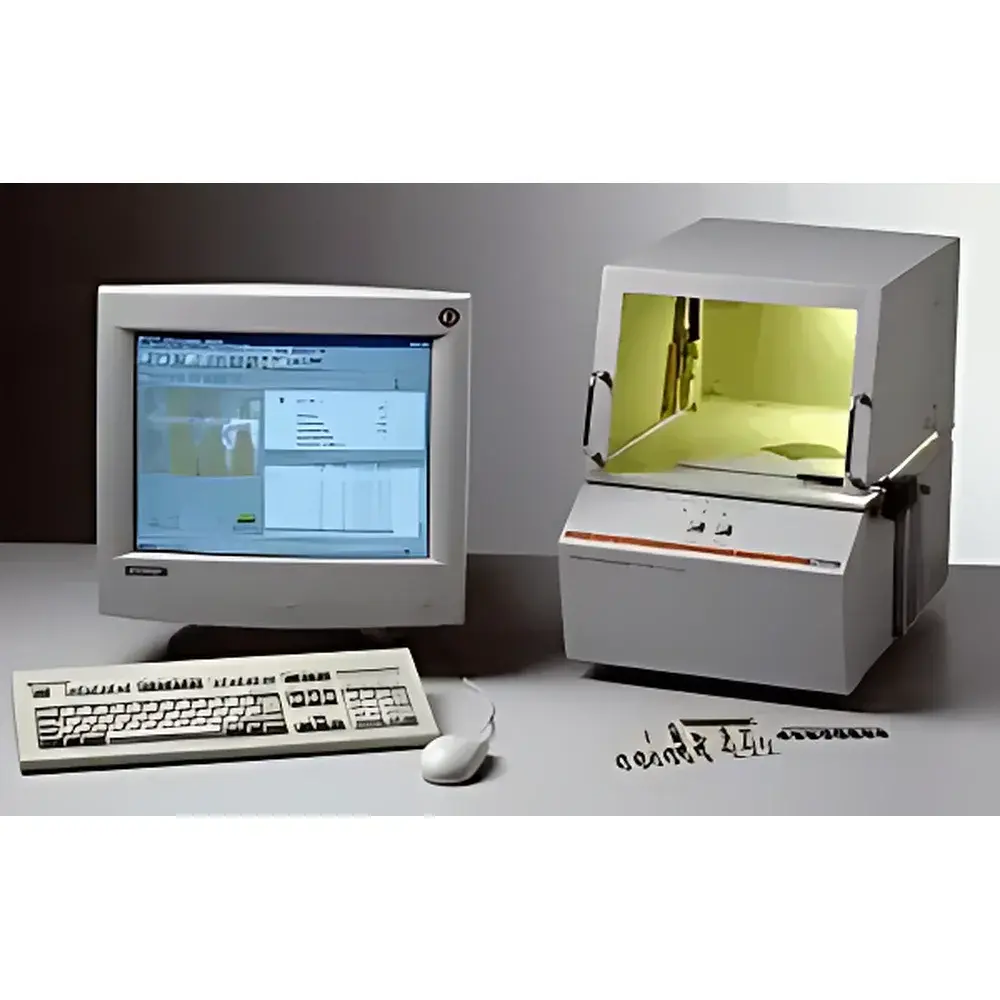
Fischer XULM Series X-Ray Fluorescence Coating Thickness Analyzer
| Brand | Fischer |
|---|---|
| Origin | Germany |
| Model | XULM Series |
| Measurement Principle | Energy-Dispersive X-Ray Fluorescence (ED-XRF) |
| Standards Compliance | DIN 50987, ISO 3497, ASTM B568 |
| X-Ray Tube | Microfocus, adjustable high voltage (30/40/50 kV) |
| Collimator Options | Ø0.1 mm / Ø0.2 mm circular |
| Sample Chamber Dimensions (W×D×H) | 375 × 580 × 480 mm |
| Internal Chamber Dimensions (W×D×H) | 360 × 460 × 240 mm |
| Manual X-Y Stage Travel | 50 mm (X) × 50 mm (Y) |
| Stage Platform Size | 360 × 240 mm |
| Viewing System | Integrated color CCD camera with real-time zoom and auto-focus |
| Beam Alignment | On-screen calibrated crosshair + dynamic X-ray beam size indicator |
| Software Platform | WinFTM® v6 (Win32 native, multilingual UI) |
| Reporting | Embedded sample image capture, SPC charts (X̄/R, X̄/S), probability plots, histogram analysis |
| Regulatory Support | Audit trail, user access levels, electronic signature readiness per FDA 21 CFR Part 11 & GLP/GMP requirements |
Overview
The Fischer XULM Series X-Ray Fluorescence Coating Thickness Analyzer is an energy-dispersive X-ray fluorescence (ED-XRF) instrument engineered for non-destructive, quantitative measurement of metallic coating thicknesses and elemental composition on solid substrates. Unlike conventional top-down XRF systems, the XULM features a unique bottom-up irradiation geometry: the microfocus X-ray tube and Si-PIN or SDD detector are positioned beneath the sample stage, enabling vertical upward excitation. This architecture eliminates dependency on precise stand-off distance adjustment — critical for irregular, miniature, or high-aspect-ratio components such as PCB vias, lead frames, connector pins, and fine-pitch solder bumps. The system operates in full compliance with international standards including DIN 50987, ISO 3497, and ASTM B568, ensuring metrological traceability and inter-laboratory comparability for quality assurance in electronics, automotive plating, jewelry assay, and precision electroplating industries.
Key Features
- Bottom-up X-ray excitation geometry minimizes positional sensitivity and enables direct placement of complex-shaped parts onto the stage without height calibration
- Adjustable microfocus X-ray tube (30/40/50 kV) optimized for excitation of elements from titanium (Ti, Z=22) to uranium (U, Z=92)
- Multi-aperture collimator set (0.1 mm / 0.2 mm circular; 0.05 × 0.05 mm² square; 0.03 × 0.2 mm² rectangular) for spatially resolved analysis down to sub-100 µm measurement areas
- Integrated high-resolution color CCD camera with real-time digital zoom and autofocus, synchronized with beam position visualization
- On-screen calibrated crosshair overlay and dynamic beam-size indicator tied to focal distance — essential for method validation and operator training
- WinFTM® v6 software platform with native Win32 architecture, supporting multilingual UI (English, German, French, Italian, Spanish, Chinese) and role-based access control
- Application Toolbox concept: pre-configured parameter sets stored on removable media, paired with certified reference standards for rapid method deployment
Sample Compatibility & Compliance
The XULM accommodates a broad range of industrial samples — from flat foils and stamped metal parts to 3D connectors, wire terminals, and multi-layer printed circuit boards. Its upward-beam design allows unobstructed access to recessed features and undercuts that cannot be measured reliably in overhead configurations. The instrument supports single-, dual-, and triple-layer metallic coatings (e.g., Ni/Cu/Fe, Sn/Cu/Brass), binary and ternary alloy layers (e.g., SnPb, NiCoFe), and composite stacks where alloy layers reside either at the surface or interstitially. For precious metal analysis, integration with Gold Assay reference standards and WinFTM® GOLDLINE modules enables certified Au fineness determination per ISO 11426 and ASTM B962. All measurement data records include timestamped metadata, operator ID, instrument configuration logs, and raw spectral files — fulfilling documentation requirements under ISO/IEC 17025, FDA 21 CFR Part 11, and EU GMP Annex 11.
Software & Data Management
WinFTM® v6 provides a fully integrated environment for method development, measurement execution, statistical process control (SPC), and regulatory reporting. It supports automated batch processing, customizable report templates (PDF/Excel), embedded image annotation, and full spectral library management. Statistical functions include control charting (X̄/R, X̄/S), capability indices (Cp/Cpk), normal probability plots, and histogram-based distribution analysis. Audit trails record all user actions — method edits, calibration events, result overrides — with immutable timestamps and digital signatures. User permissions can be assigned by function (e.g., operator, supervisor, administrator), restricting access to calibration parameters or report export settings. Raw spectra and processed results are stored in vendor-neutral formats compatible with LIMS and MES integration via ODBC or RESTful API extensions.
Applications
- Thickness verification of electroplated Ni, Cr, Zn, Sn, Ag, Au, Pd, and Rh layers on steel, Cu, Al, and plastic substrates
- Composition analysis of solder alloys (SnPb, SAC305, SnBi) and electroless Ni-P deposits
- Quality control of decorative and functional coatings in automotive trim, fasteners, and consumer electronics
- GOLDLINE assay of karat gold, platinum group metals, and silver alloys in jewelry manufacturing and refining
- In-process monitoring of plating bath metal ion concentration (Cu²⁺, Ni²⁺, Sn⁴⁺) via calibration against standard solutions
- Failure analysis of delamination, intermetallic growth, or contamination in microelectronic interconnects
FAQ
How does the bottom-up X-ray geometry improve measurement repeatability for small or irregular parts?
The upward beam path eliminates dependence on precise sample-to-source distance. Parts rest directly on the stage; the focal point is inherently fixed relative to the detector geometry, reducing operator-induced positioning error and enabling consistent signal collection across heterogeneous geometries.
Can the XULM measure coatings on non-conductive substrates such as plastics or ceramics?
Yes — ED-XRF is inherently substrate-agnostic. However, for very thin coatings (<10 nm) or low-Z matrices, matrix correction models must be validated using certified reference materials representative of the actual production substrate.
Is WinFTM® v6 compliant with FDA 21 CFR Part 11 for electronic records and signatures?
The software supports full audit trail logging, role-based access control, electronic signatures with biometric or token-based authentication, and data integrity safeguards required for regulated environments — subject to site-specific validation per internal SOPs.
What collimator option is recommended for measuring 50 µm-diameter solder balls on a BGA substrate?
The 0.05 × 0.05 mm² square collimator provides optimal spatial resolution and photon flux balance for such micro-feature applications, minimizing scatter from adjacent pads while maintaining sufficient count rate for statistical confidence.
Does the system support automated stage movement or require manual positioning?
The standard configuration includes a manually operated X-Y stage with 50 mm travel in both axes. Motorized XYZ stages and programmable pattern scanning are available as factory-installed options for high-throughput or multi-point mapping workflows.



