
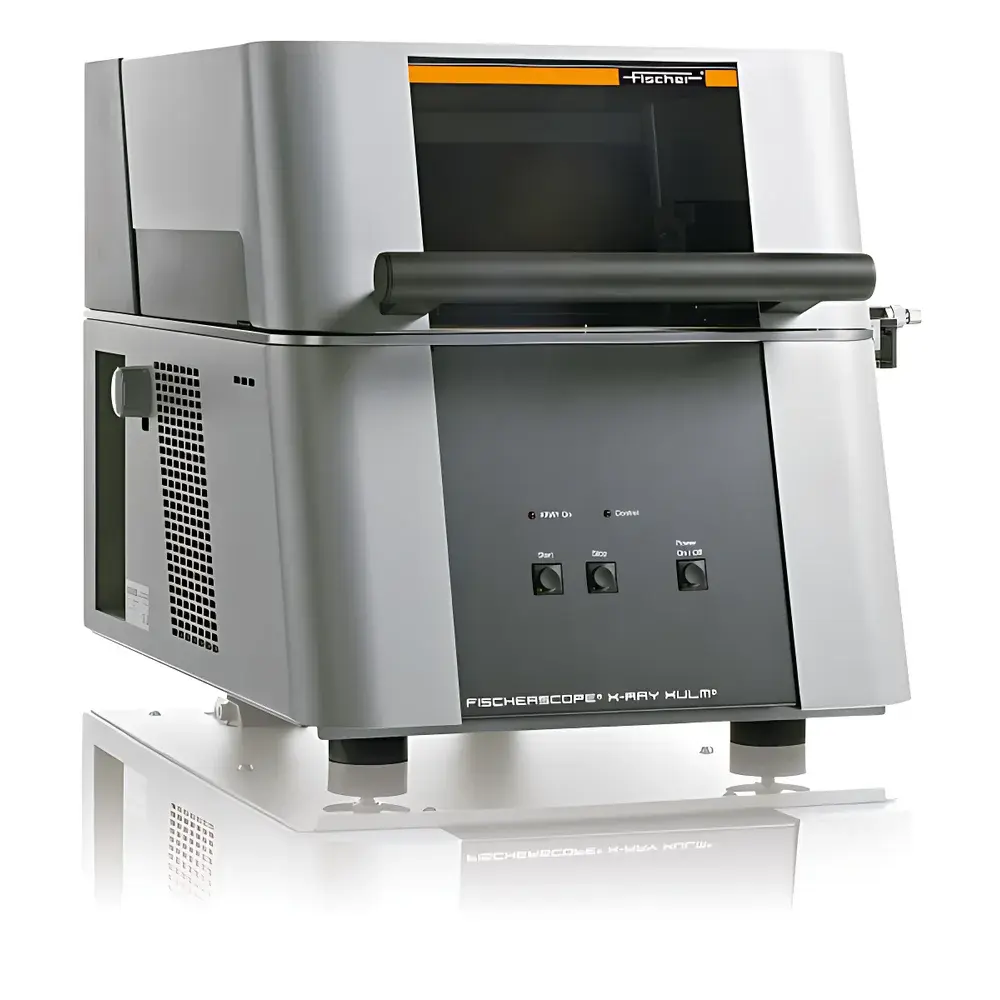
FISCHERSCOPE X-RAY XUL220 X-Ray Fluorescence Coating Thickness Analyzer
| Brand | Fischer |
|---|---|
| Origin | Germany |
| Model | XUL220 |
| Measurement Principle | Energy-Dispersive X-Ray Fluorescence (ED-XRF) |
| Detector Type | Proportional Counter |
| Count Rate Capability | High |
| Imaging System | High-Resolution Color CCD Camera with Manual Focus and Adjustable LED Illumination |
| Sample Chamber Dimensions | Extra-Large (Enabling Large-Part Measurement) |
| Stage | Manual XY Translation Stage |
| Operating Temperature | 10–40 °C |
| Relative Humidity | ≤95% RH (Non-Condensing) |
| Compliance | Designed for ISO 3497, ASTM B568, DIN 50982, and RoHS/WEEE Screening Applications |
Overview
The FISCHERSCOPE X-RAY XUL220 is a benchtop energy-dispersive X-ray fluorescence (ED-XRF) analyzer engineered for non-destructive, quantitative measurement of metallic and alloy coating thicknesses—ranging from nanometer-scale thin films to multi-layer electroplated systems—as well as elemental composition analysis of bulk materials and plating bath solutions. Its core measurement principle relies on excitation of characteristic X-ray fluorescence emissions from sample atoms under primary X-ray irradiation, followed by spectral deconvolution of emitted photon energies to determine layer mass per unit area (µg/cm²), which is then converted to thickness (nm or µm) using matrix-specific calibration models. Designed for industrial metrology environments, the XUL220 delivers high reproducibility in production line quality assurance, incoming material inspection, and process control laboratories where traceability, repeatability, and compliance with international standards are critical.
Key Features
- Compact, robust benchtop architecture with an extra-large measurement chamber—accommodating parts up to 300 × 300 × 150 mm (W × D × H)—enabling full-field analysis of large connectors, stamped components, PCBs, and assembled subassemblies without disassembly.
- Proportional counter detector optimized for high count rate performance, ensuring statistically reliable spectra acquisition even for low-Z elements (e.g., Al, Si, P) and thin coatings (<10 nm Au/Ni/Cu systems) with minimal measurement time.
- Integrated high-resolution color CCD camera with manual focus and continuously adjustable LED ring illumination—supporting precise positioning, visual documentation, and automated region-of-interest (ROI) definition prior to analysis.
- Manual XY translation stage with vernier scale and fine-motion controls—providing repeatable sample alignment for multi-point measurements across heterogeneous surfaces or batch sampling.
- Thermally stable housing and environmental monitoring circuitry—ensuring consistent spectral response across ambient operating conditions (10–40 °C, ≤95% RH non-condensing), minimizing drift-related recalibration frequency.
Sample Compatibility & Compliance
The XUL220 supports direct analysis of conductive and non-conductive substrates—including steel, Cu, Zn, Al, plastics, and ceramics—without conductive coating or vacuum requirements. It is routinely deployed for measuring single- and multi-layer systems such as Ni/Cr, Sn/Cu, Au/Ni/Cu, Zn/Fe, and Pb-free solder finishes. The instrument meets technical requirements referenced in ISO 3497 (Metallic coatings — Measurement of coating thickness — X-ray spectrometric methods), ASTM B568 (Standard Test Method for Measurement of Coating Thicknesses by X-Ray Spectrometry), and DIN 50982 (Coating thickness measurement by X-ray fluorescence). Its analytical workflow supports GLP-compliant documentation when integrated with Fischer’s WinFTM® software, including audit-trail-enabled user access logs and result archiving aligned with FDA 21 CFR Part 11 readiness protocols.
Software & Data Management
Controlled exclusively via Fischer’s WinFTM® software (v7.x or later), the XUL220 provides intuitive method setup, spectrum visualization, peak identification, and calibration management. Software features include multi-layer modeling with fundamental parameters (FP) algorithm, automatic background subtraction, inter-element correction (e.g., matrix effects between Cr and Fe), and customizable reporting templates exportable to PDF, CSV, or XML. All measurement data—including raw spectra, acquisition parameters, operator ID, timestamp, and environmental metadata—are stored in a relational database with version-controlled method files. Optional network deployment allows centralized calibration management and remote diagnostics for multi-instrument facilities.
Applications
- Quality control of fasteners (screws, bolts, nuts) coated with Zn, Cr, Ni, or decorative Au/Pd layers.
- In-process verification of connector plating integrity in automotive and aerospace electronics manufacturing.
- Quantitative monitoring of electrolyte bath composition (e.g., Ni²⁺, Co²⁺, Cl⁻ equivalents via Cl Kα intensity) to support predictive maintenance of electroplating lines.
- Failure analysis of delamination or interdiffusion in diffusion-barrier stacks (e.g., TiW/Cu, TaN/Cu) used in semiconductor packaging.
- RoHS-compliant screening of restricted substances (Pb, Cd, Hg, Cr⁶⁺, Br) in finished goods and component-level assemblies.
FAQ
Does the XUL220 require vacuum or helium purge for light element analysis?
No—the instrument operates in air and achieves reliable detection of elements from sodium (Na, Z=11) upward without gas purging; however, enhanced sensitivity for Mg–Al may benefit from optional He-flush configuration.
Can it measure coating thickness on curved or irregular surfaces?
Yes—via manual stage repositioning and ROI selection using the integrated CCD camera; curvature-induced geometric effects are compensated during FP-based quantification if substrate geometry is known.
Is method transfer possible between different Fischer XRF instruments?
Calibration methods built in WinFTM® are instrument-family compatible (e.g., XUL series), though detector-specific spectral response corrections require validation upon migration.
What maintenance intervals are recommended?
Annual verification of X-ray tube output stability and detector resolution (Mn Kα FWHM) is advised; no routine consumables other than standard electrical safety checks and optical lens cleaning.
Does the system support automated batch measurement?
Not natively—the XUL220 is manually loaded and positioned; for high-throughput automation, Fischer offers the XAN500 or XDLM series with robotic sample handling.



