
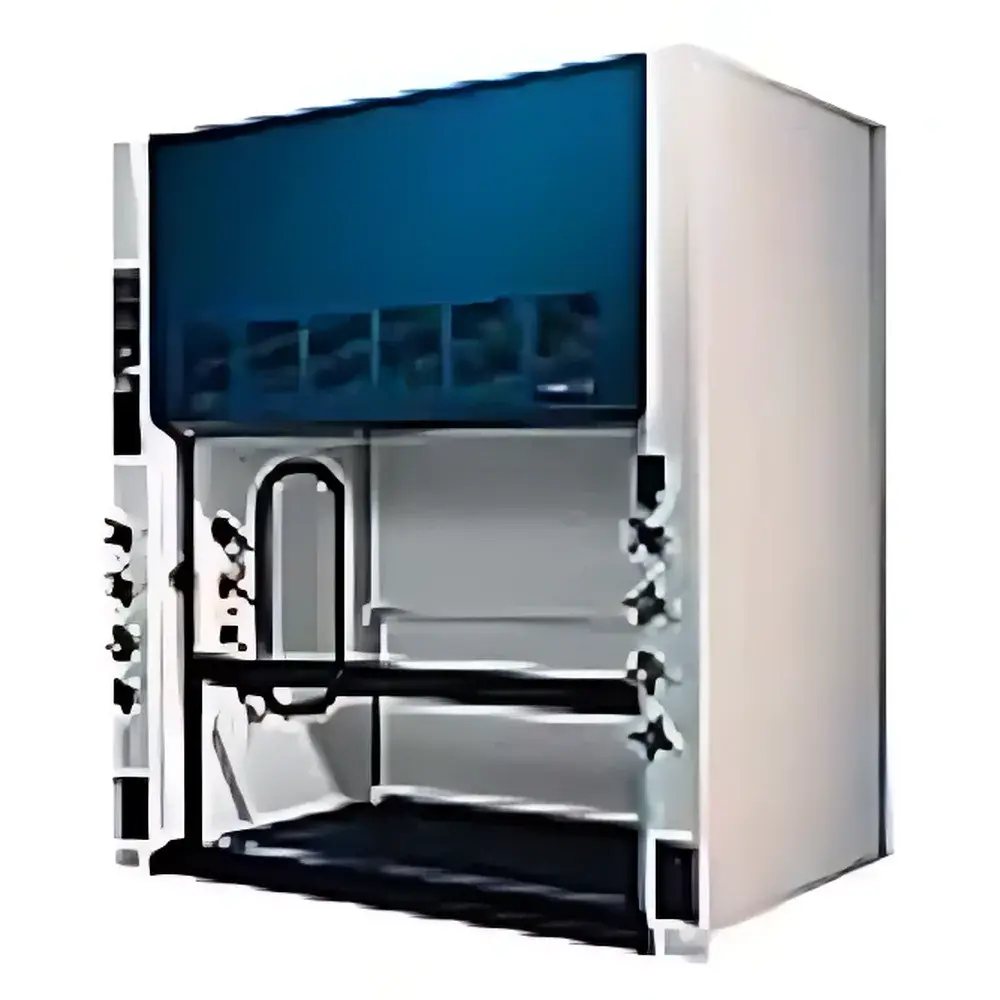
Fisher Scientific Integrated Laboratory Furniture System
No specifications available.
Overview
The Fisher Scientific Integrated Laboratory Furniture System represents a modular, ergonomically engineered infrastructure solution designed for modern research laboratories, clinical testing facilities, and academic teaching labs. Unlike standalone workbenches or cabinetry, this system integrates structural support, utility distribution (electrical, gas, vacuum, data, and compressed air), ergonomic workstation design, and chemical resistance into a unified architectural framework. Engineered to comply with ANSI/Z9.5–2012 (Laboratory Ventilation) and ISO 14644–1 (Cleanroom classification compatibility), the system supports seamless integration with fume hoods, biosafety cabinets, and analytical instrumentation. Its load-bearing steel frame—coated with epoxy-polyester hybrid finish—ensures long-term dimensional stability under continuous operational loads up to 150 kg/m², while phenolic resin or high-pressure laminate (HPL) work surfaces meet ASTM E662 for smoke density and NFPA 255 for flame spread index.
Key Features
- Modular construction with standardized 300 mm grid spacing for rapid reconfiguration of benching, storage, and service modules
- Integrated utility raceways accommodating dual-voltage (120/208 VAC), low-voltage data (Cat 6A), inert and reactive gas lines (with pressure-rated shutoffs), and vacuum manifolds (–85 kPa typical)
- Ergonomic height adjustability: fixed-height (860 mm), sit-stand (720–920 mm motorized), and ADA-compliant configurations (minimum 710 mm clearance)
- Chemical-resistant surface options including 25 mm thick phenolic resin (tested per ASTM D543 against 37% HCl, 98% H₂SO₄, and 50% NaOH), stainless steel (304/316), and epoxy-coated steel
- Structural anchoring system compatible with concrete, raised access floor, and seismic-rated lab environments (designed per IBC 2021 Appendix Chapter A117.1)
- Pre-certified compliance documentation package available for GLP/GMP facility validation (including IQ/OQ templates and material traceability records)
Sample Compatibility & Compliance
The Fisher Scientific Integrated Laboratory Furniture System is not a sample-processing instrument; rather, it serves as the foundational physical platform upon which analytical, biological, and chemical workflows are executed. As such, its compatibility is defined by mechanical, environmental, and regulatory interoperability—not sample type. It accommodates standard laboratory equipment footprints (e.g., electrophoresis rigs ≤ 500 × 300 mm, PCR cyclers ≤ 280 × 240 mm, microscopes with base dimensions up to 450 × 400 mm) and supports vibration-sensitive instruments via optional isolated mounting subframes (transmissibility < 0.2 at 10 Hz). All materials undergo third-party verification per UL 94 V-0 (flammability), EN 438–2 (laminate durability), and REACH Annex XIV (SVHC screening). Documentation aligns with FDA 21 CFR Part 11 requirements for audit trails in digitally managed installation records.
Software & Data Management
While the furniture system itself contains no embedded firmware or control software, Fisher Scientific provides the LabSpace™ Digital Configuration Suite—a browser-based BIM-integrated tool enabling real-time spatial planning, utility load simulation, and compliance gap analysis. Users import AutoCAD DWG or Revit RVT files to auto-generate equipment interference reports, calculate total connected electrical load per circuit, and validate ventilation clearance zones relative to hood face velocity standards. Exportable outputs include ISO 15189-aligned commissioning checklists, ISO 55001-aligned asset tagging matrices, and PDF-based as-built documentation packages suitable for regulatory audits. All configuration data is stored in encrypted cloud repositories compliant with SOC 2 Type II and GDPR Article 32 security controls.
Applications
- Genomics core facilities requiring coordinated placement of NGS sequencers, centrifuges, and cold storage within validated temperature gradients
- Pharmaceutical QC labs implementing ASTM E2500–13 risk-based qualification of analytical workspaces
- University teaching laboratories needing rapid reconfiguration between wet chemistry, microbiology, and instrumentation modules
- Biosafety Level 2+ containment suites integrating negative-pressure zoning, decontamination pass-throughs, and HEPA-filtered exhaust routing
- Contract development and manufacturing organizations (CDMOs) validating facility infrastructure per ICH Q5E and EU GMP Annex 15
FAQ
Is the Fisher Scientific Integrated Laboratory Furniture System manufactured in the United States?
Yes. Primary fabrication, powder coating, and final assembly occur at Thermo Fisher Scientific’s ISO 9001:2015–certified facility in Pittsburgh, PA.
Does the system support integration with existing fume hoods from other manufacturers?
Yes. Standardized mounting interfaces (per SEMI F21–0204) and adjustable depth compensation allow mechanical and utility coupling with hoods from Erlab, Labconco, and Cambridge Environmental.
Can utility raceways be modified post-installation without compromising structural integrity?
Yes. Modular raceway segments use captive-thread fasteners and non-permanent bonding agents, enabling field modifications verified via on-site load-testing protocols outlined in the Installation Qualification (IQ) document.
What documentation is provided for regulatory submissions?
Full validation support package includes Material Certificates (EN 10204 3.1), Fire Test Reports (UL 94, ASTM E84), and a Traceability Matrix linking each component to its CoC, CoA, and supplier audit summary.



