
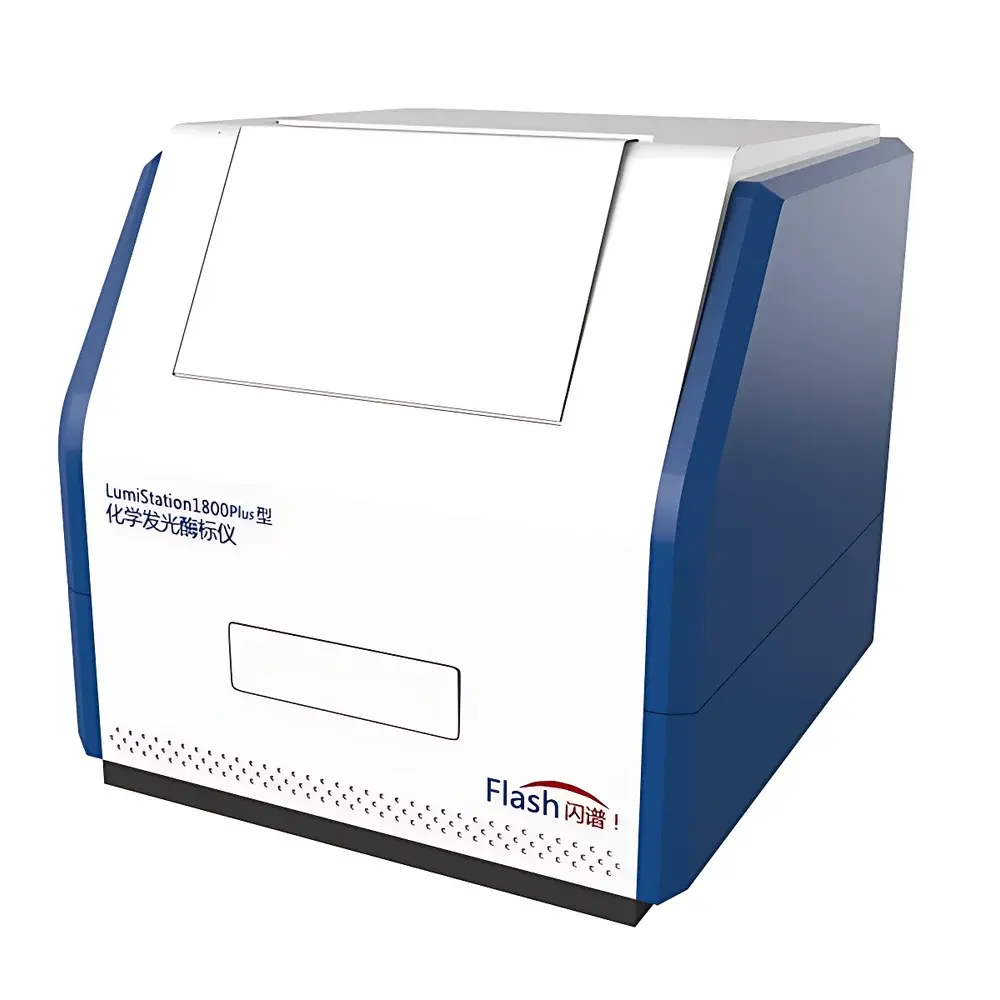
Flash Spectrum LumiStation 1800Plus Chemiluminescence Microplate Reader
| Brand | Flash Spectrum |
|---|---|
| Origin | Shanghai, China |
| Manufacturer Type | Authorized Distributor |
| Product Category | Domestic |
| Model | LumiStation 1800Plus |
| Price Range | USD 7,000–14,000 |
| Function Type | Dedicated Chemiluminescence Detection |
| Automation Level | Fully Automated |
| Assay Modes | Endpoint, Dual-Read, Kinetic |
| Curve Fitting | Linear Regression |
| Detector | Photon-Counting Photomultiplier Tube (PMT) |
| Wavelength Range | 300–650 nm |
| Absorbance Range | 0.000–4.000 Abs |
| Absorbance Linearity | 0.000–2.000 Abs |
| Single-Wavelength Kinetic Read Time | 6 sec |
| Sensitivity | 7 amol ATP per well |
| Microplate Formats | 96-well & 384-well |
| Incubation Range | Ambient +2 °C to 65 °C |
| Shaking Modes | Linear, Orbital, Cross |
| Data Interface | USB 2.0 |
| Software Compliance | FDA 21 CFR Part 11, GLP/GMP Audit Trail, IQ/OQ/PQ Ready |
Overview
The Flash Spectrum LumiStation 1800Plus is a dedicated, fully automated chemiluminescence microplate reader engineered for high-sensitivity, low-noise detection in life science and pharmaceutical R&D environments. Unlike absorbance or fluorescence readers, the LumiStation 1800Plus employs photon-counting photomultiplier tube (PMT) technology to quantify ultra-low-intensity light emissions resulting from enzymatic or chemical reactions—such as luciferase-based reporter assays, ATP bioluminescence, immunoassays, and enzyme activity profiling. Its optical architecture incorporates an integrated light-trap system to minimize well-to-well crosstalk, ensuring high signal fidelity across 96- and 384-well microplates. Designed for reproducibility under regulated conditions, the instrument supports kinetic acquisition with sub-second temporal resolution and built-in temperature control (ambient +2 °C to 65 °C), enabling on-board incubation for time-resolved assays without external hardware.
Key Features
- Photon-counting PMT detector with optimized quantum efficiency across 300–650 nm, delivering single-photon sensitivity and >6-decade dynamic range
- Dedicated chemiluminescence optics—no excitation source or wavelength selection components—maximizing signal-to-noise ratio and eliminating spectral bleed-through artifacts
- Integrated incubation module with precise PID-controlled heating and uniform thermal distribution across the plate surface
- Triple-mode shaking: linear, orbital, and cross-pattern agitation—programmable pre-read and post-read, with adjustable amplitude and duration
- Time-integration capability for extended exposure durations, essential for weak or transient luminescent signals
- Fully automated assay protocols including endpoint, dual-read (e.g., firefly/Renilla dual-luciferase), and kinetic modes with user-defined interval sampling
- Hardware-level audit trail logging: all parameter changes, user logins, plate reads, and calibration events are timestamped and immutable
- USB 2.0 interface for direct instrument control, real-time data streaming, and secure local data export without network dependency
Sample Compatibility & Compliance
The LumiStation 1800Plus is validated for standard ANSI/SLAS-compliant 96-well and 384-well microplates—including white opaque, black, and clear-bottom formats—ensuring optimal reflectivity and minimal background. It supports common chemiluminescent substrates such as D-luciferin, coelenterazine, luminol, and enhanced luminol derivatives used in ELISA, reporter gene assays, and cell viability testing. The system meets critical regulatory requirements for quality-controlled environments: software architecture conforms to FDA 21 CFR Part 11 (electronic signatures, role-based access control, audit trail integrity), and operational documentation supports IQ/OQ/PQ validation protocols required by GMP and GLP laboratories. All firmware and software updates undergo version-controlled release cycles with traceable change logs.
Software & Data Management
The LumiStation Workstation software is a standalone Windows application providing full instrument control, protocol configuration, real-time monitoring, and integrated data analysis. It includes linear regression curve fitting, kinetic trend visualization, multi-plate comparison tools, and customizable report templates compliant with ISO/IEC 17025 reporting standards. Raw luminescence counts (RLU), normalized values (e.g., RLU/mg protein), and statistical summaries (CV%, Z’, signal-to-background ratios) are exported in CSV, Excel, or PDF formats. Audit trail records are stored separately in encrypted binary format and can be exported for regulatory review without modification. User management supports up to 16 permission tiers, with configurable session timeouts and forced password rotation policies.
Applications
- Dual-luciferase reporter assays for transcriptional regulation studies
- ATP quantification in cell viability, cytotoxicity, and microbial load assessment (detection limit: 7 amol ATP/well)
- Luminescent ELISA and immunocapture assays for high-sensitivity cytokine or biomarker detection
- Kinase and phosphatase activity profiling using luminescent ADP/ATP conversion substrates
- β-galactosidase, β-glucuronidase, and alkaline phosphatase reporter systems in promoter analysis
- Antibiotic susceptibility testing via metabolic luminescence endpoints
- High-throughput screening of compound libraries in drug discovery pipelines
FAQ
Does the LumiStation 1800Plus support fluorescence or absorbance measurements?
No—it is a dedicated chemiluminescence reader. It lacks excitation sources, emission filters, or reference beams required for fluorescence or absorbance detection.
Can the instrument perform simultaneous dual-luciferase readings?
Yes—its dual-read mode enables sequential firefly and Renilla luciferase measurements within a single well, with programmable delay intervals to accommodate substrate kinetics.
Is remote instrument control supported?
Remote operation is not natively supported; however, the USB interface allows integration into lab automation networks via third-party middleware (e.g., LabVantage, STARLIMS) using COM/ActiveX APIs.
What validation documentation is provided?
A comprehensive validation package—including IQ/OQ test scripts, factory calibration certificates, software verification reports, and 21 CFR Part 11 compliance statements—is supplied with each unit.
How is background noise minimized during low-signal acquisition?
Through a combination of thermoelectrically stabilized PMT cooling (reducing dark current), mechanical light shielding, active light-trap geometry, and software-based baseline subtraction algorithms applied during time-integrated reads.




