
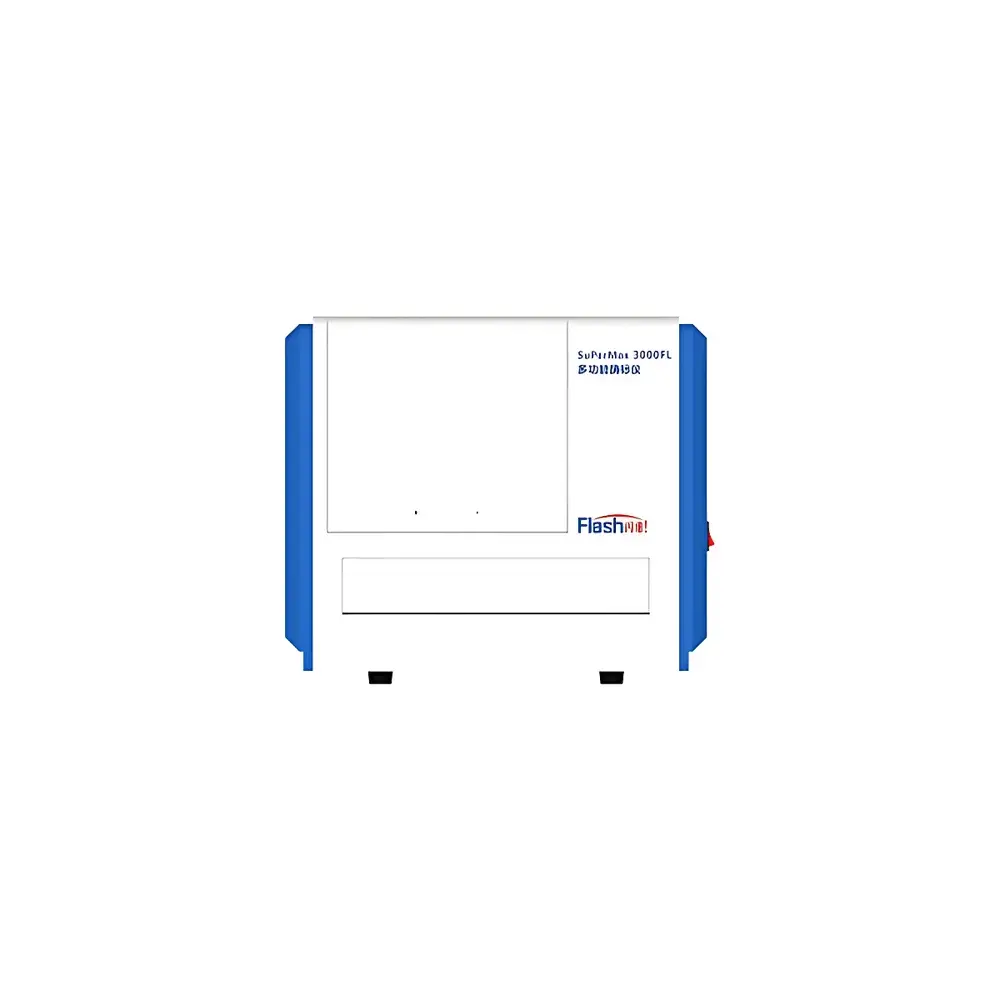
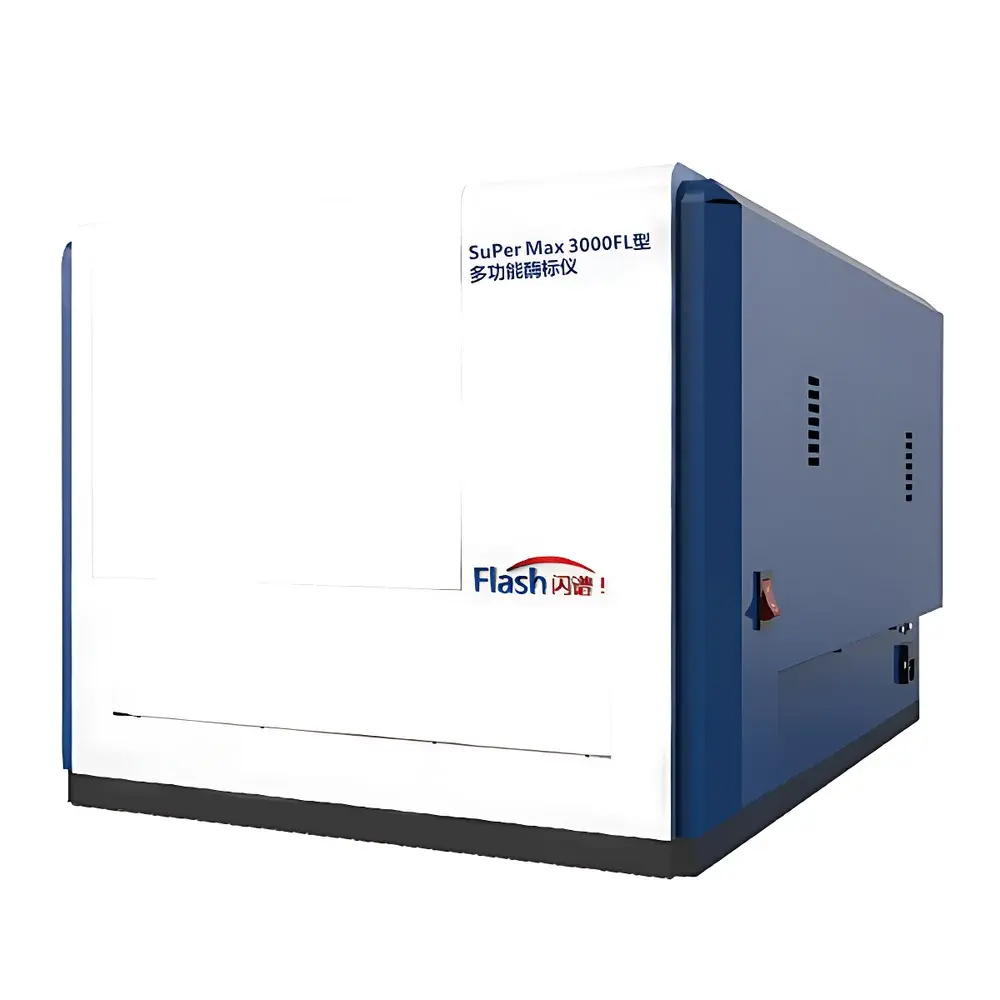
Flash Spectrum SuPerMax 3000FL Multimode Microplate Reader
| Brand | Flash Spectrum |
|---|---|
| Origin | Shanghai, China |
| Model | SuPerMax 3000FL |
| Automation Level | Fully Automated |
| Assay Modes | Endpoint, Kinetic, Spectral Scan |
| Curve Fitting | Linear, Log-Log, Four-Parameter Logistic (4PL), Five-Parameter Logistic (5PL), Quadratic, Cubic, Spline |
| Detection Modes | Fluorescence (Top/Bottom Read), Luminescence (Photon-Counting PMT) |
| Wavelength Range | 190–1000 nm (Monochromator-Based) |
| Absorbance Range | 0.000–2.000 OD |
| Absorbance Linearity | ±0.01 OD (0.000–2.000 OD) |
| Wavelength Accuracy | < ±0.2 nm |
| Wavelength Resolution | 1 nm |
| Excitation Range | 190–1000 nm |
| Emission Range | 270–850 nm |
| Fluorescence Sensitivity | < 0.5 fmol FITC/well (Top Read, 384-well) |
| Luminescence Sensitivity | < 7 amol ATP/well (Flash Reaction) |
| Dynamic Range | > 6 decades (Fluorescence, Top Read) |
| Temperature Control | Ambient +2°C to 65°C |
| Plate Formats | 96-, 384-well standard |
| Shaking Modes | Linear, Orbital, Dual-Axis |
| Light Source | Xenon Flash Lamp |
| Data Interface | USB 2.0 |
| Software Compliance | Audit Trail (optional), User Access Control, Electronic Signature Support (21 CFR Part 11-ready configuration) |
Overview
The Flash Spectrum SuPerMax 3000FL is a high-performance, monochromator-based multimode microplate reader engineered for quantitative and kinetic analysis across life science research, drug discovery, and quality control laboratories. Utilizing a xenon flash lamp coupled with dual-grating monochromators, it delivers precise excitation and emission wavelength selection from 190 nm to 1000 nm—enabling broad-spectrum compatibility with common fluorophores (e.g., FITC, TRITC, Cy3/Cy5), luminescent substrates (e.g., luciferin, coelenterazine), and absorbance-based assays (e.g., ELISA, MTT, BCA). Its optical architecture incorporates separate sample and reference photomultiplier tube (PMT) detectors, ensuring high signal fidelity and long-term measurement stability. Designed for reproducibility under regulated environments, the system supports GLP- and GMP-aligned workflows through optional audit trail logging, role-based user permissions, and electronic signature capability compliant with FDA 21 CFR Part 11 requirements.
Key Features
- Fully automated operation with integrated plate handling, temperature-controlled incubation (up to 65°C), and programmable shaking (linear, orbital, or dual-axis modes) eliminates manual intervention during kinetic or multi-step assays.
- Dual-detection capability: top- and bottom-read fluorescence with independently optimized optics, plus photon-counting luminescence detection for ultra-low-light applications such as luciferase reporter assays and ATP quantification.
- High-resolution monochromator system offering 1 nm wavelength resolution and < ±0.2 nm accuracy—critical for spectral deconvolution, FRET pair validation, and multiplexed probe characterization.
- Flexible assay programming supporting endpoint, kinetic, and full-spectrum scanning protocols—including time-resolved fluorescence (TRF) and luminescence kinetics with configurable integration times and delay intervals.
- Onboard thermal regulation with ±0.3°C uniformity across 96- and 384-well plates ensures consistent enzymatic reaction conditions for cell-based assays, kinase profiling, and real-time metabolic monitoring.
- USB 2.0 interface enables direct connection to Windows-based workstations; firmware updates and method transfers are performed without proprietary hardware dongles or network dependencies.
Sample Compatibility & Compliance
The SuPerMax 3000FL accommodates standard microplate formats (96-, 384-well) and supports custom plate geometries upon request. Its optical path design minimizes well-to-well crosstalk (< 0.2% in white plates) and accommodates opaque, clear, black, and white-bottom plates for diverse assay chemistries. The instrument meets IEC 61010-1 safety standards for laboratory equipment and operates within ISO/IEC 17025-aligned environmental specifications (temperature: 15–30°C; humidity: 30–80% RH, non-condensing). Optional audit trail module records all user actions—including parameter changes, data exports, and calibration events—with timestamps and operator IDs, satisfying traceability requirements under USP , ISO 13485, and EU Annex 11.
Software & Data Management
The SuPerMax 3000FL is operated via a dedicated Windows-native software suite featuring intuitive workflow builders, real-time data visualization, and built-in statistical analysis tools. It supports linear, log-log, 4PL, 5PL, quadratic, cubic, and spline curve fitting for dose-response modeling, IC50/EC50 calculations, and standard curve interpolation. Raw data files are saved in vendor-neutral CSV and XML formats; export options include PDF reports with embedded metadata (instrument ID, date/time stamp, operator name, protocol version). When configured with audit trail and electronic signature modules, the software enforces ALCOA+ principles (Attributable, Legible, Contemporaneous, Original, Accurate) and maintains immutable records for regulatory submissions.
Applications
This platform is routinely deployed in academic and industrial settings for applications including but not limited to: ATP quantification in cell viability studies; luciferase-based gene expression profiling; ROS and cAMP signaling assays; SNP genotyping via melting curve analysis; microbial growth kinetics; enzyme activity profiling (e.g., proteases, kinases, phosphatases); immunoassays (ELISA, CLIA); and molecular probe development requiring spectral characterization. Its broad dynamic range (>6 decades in fluorescence top-read mode) and low background noise make it suitable for both high-throughput screening and low-abundance target detection.
FAQ
Does the SuPerMax 3000FL support time-resolved fluorescence (TRF) measurements?
Yes—the instrument’s xenon flash lamp and gated PMT detection allow configurable delay and integration windows, enabling TRF assays using europium and terbium chelates.
Can the system perform simultaneous dual-wavelength excitation or emission scans?
No—it performs sequential monochromatic scans; however, rapid wavelength switching (<6 sec per wavelength in kinetic mode) enables pseudo-simultaneous ratiometric measurements.
Is the software validated for use in FDA-regulated environments?
The base software is 21 CFR Part 11-ready when deployed with optional audit trail, electronic signature, and user access control modules—full validation documentation is provided upon request.
What plate types are supported for bottom-read fluorescence?
Black or clear-bottom plates with ≤1 mm well-bottom thickness are recommended; performance validation data for specific plate brands (e.g., Corning, Greiner) is available in the technical appendix.
Is service and calibration support available outside mainland China?
Global field service and ISO/IEC 17025-accredited calibration services are offered through authorized Flash Spectrum partners in North America, Europe, and APAC regions.




