
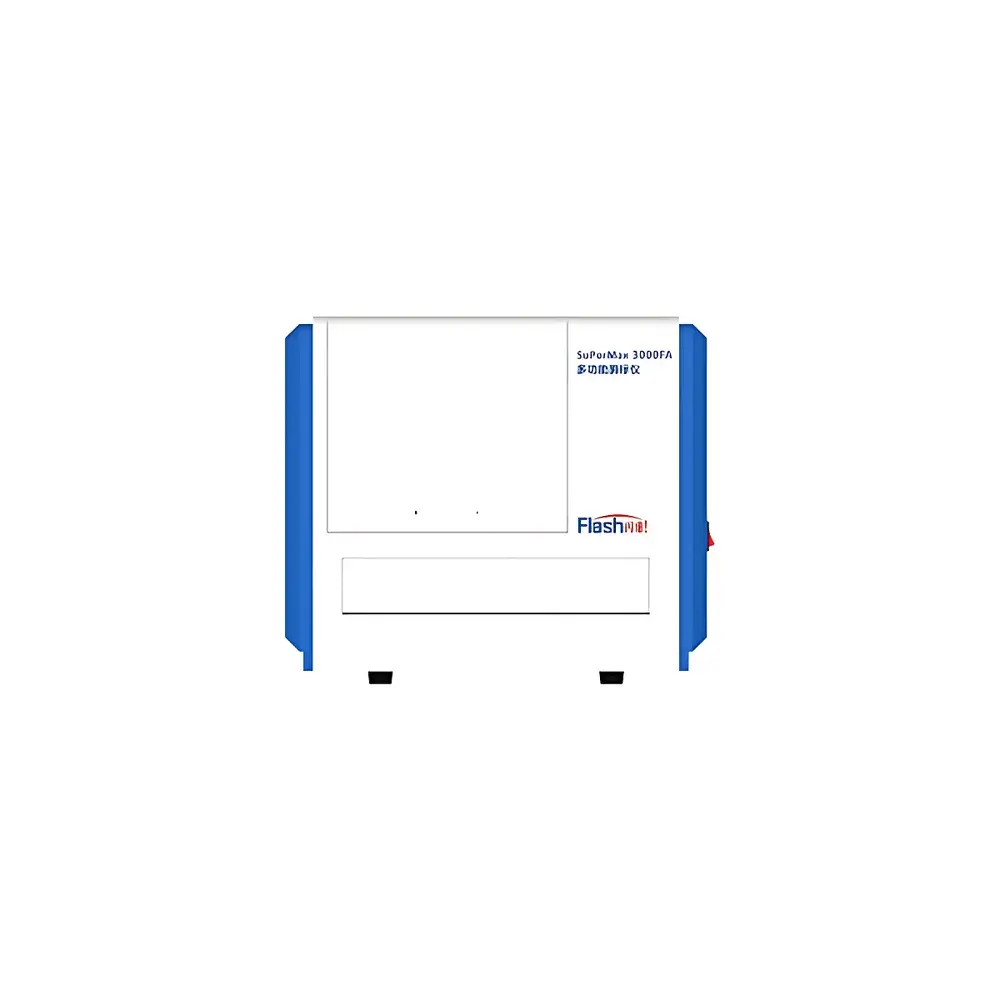
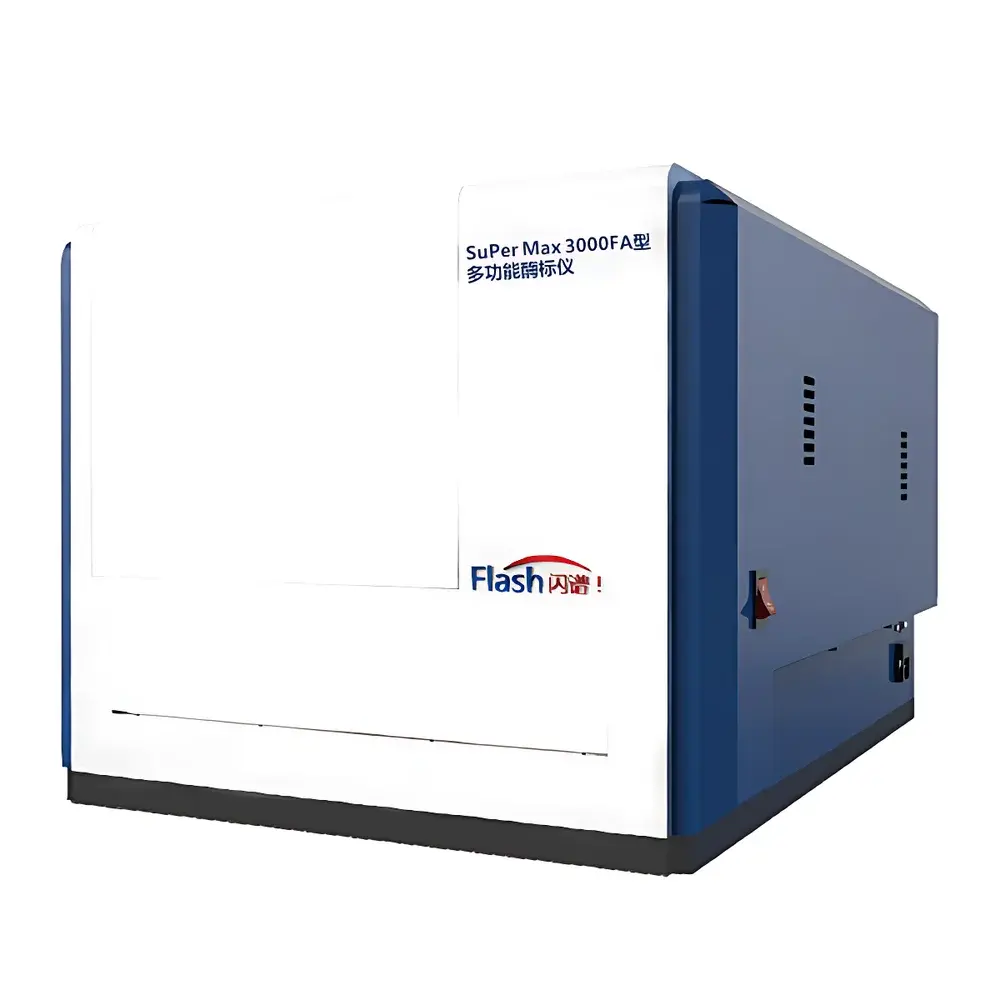
Flash Spectrum SuPerMax 3000FA Multimode Microplate Reader
| Brand | Flash Spectrum |
|---|---|
| Origin | Shanghai, China |
| Model | SuPerMax 3000FA |
| Automation Level | Fully Automated |
| Assay Modes | Endpoint, Kinetic, Scanning |
| Curve Fitting | Linear regression |
| Detection Modes | Fluorescence (top/bottom read), UV-Vis Absorbance |
| Wavelength Range | 190–1000 nm (monochromator-based) |
| Absorbance Range | 0–4 Abs (96-well, 450 nm) |
| Absorbance Linearity | ±2% (0–4 Abs, 96-well, 450 nm) |
| Kinetic Read Speed | 6 sec per wavelength (single-wavelength) |
| Fluorescence Sensitivity | Top-read < 0.5 fmol FITC/well (384-well plate) |
| Dynamic Range | >6 decades (top-read), >5.5 decades (bottom-read) |
| Wavelength Resolution | 1 nm |
| Wavelength Accuracy | < ±0.2 nm (fluorescence), ±1.0 nm (absorbance) |
| Excitation Range | 190–1000 nm |
| Emission Range | 270–850 nm |
| Bandwidth Options | 10 nm or 20 nm |
| Light Source | Xenon flash lamp |
| Temperature Control | Ambient +2°C to 65°C |
| Plate Formats | 96-well and 384-well standard (custom formats available) |
| Shaking Modes | Linear, orbital, circular with adjustable amplitude |
| Detector Configuration | Dual PMT (sample + reference) for fluorescence |
| Data Interface | USB 2.0 |
| Software | SuPerMax Workstation (with audit trail option) |
Overview
The Flash Spectrum SuPerMax 3000FA is a fully automated, monochromator-based multimode microplate reader engineered for high-precision, high-throughput quantification in life science laboratories. It employs dual optical paths—top- and bottom-reading fluorescence detection using photomultiplier tubes (PMTs), and UV-Vis absorbance measurement via photodiode—with independent monochromators for excitation and emission. Its 190–1000 nm spectral coverage enables broad compatibility with common fluorophores (e.g., FITC, TRITC, Cy3/Cy5), chromogenic substrates (e.g., pNPP, ABTS), and nucleic acid/protein assays (A260/A280). The instrument integrates temperature-controlled incubation (up to 65°C), programmable shaking (linear, orbital, circular), and kinetic acquisition at ≤6 seconds per wavelength—supporting rigorous assay reproducibility under controlled physiological or stress conditions. Designed to meet the technical requirements of academic research, biopharmaceutical QC, and early-stage drug discovery, it conforms to core principles of assay validation including linearity, sensitivity, dynamic range, and inter-plate repeatability.
Key Features
- Fully automated operation with integrated incubation (ambient +2°C to 65°C) and three-mode shaking (linear, orbital, circular) with adjustable amplitude—eliminating need for external shakers or incubators.
- Monochromator-based excitation (190–1000 nm) and emission (270–850 nm) optics, offering 1 nm resolution and < ±0.2 nm wavelength accuracy—enabling precise spectral optimization for multiplexed assays.
- Dual-detection architecture: top- and bottom-reading fluorescence with matched sample/reference PMTs for real-time signal normalization; photodiode-based absorbance with ±2% linearity over 0–4 Abs (96-well, 450 nm).
- Kinetic mode with sub-6-second per-wavelength acquisition and configurable interval timing—ideal for enzyme kinetics (e.g., kinase, phosphatase, protease), calcium flux, and cAMP signaling assays.
- High-sensitivity fluorescence detection: < 0.5 fmol FITC/well (top-read, 384-well) and < 5 fmol FITC/well (bottom-read, 384-well), supporting low-abundance target quantification in cell-based assays.
- Comprehensive data integrity framework: optional 21 CFR Part 11-compliant audit trail module with user authentication, electronic signatures, and immutable event logging for regulated environments.
- USB 2.0 interface and native support for LIMS integration—facilitating centralized instrument control and automated data routing into laboratory informatics systems.
Sample Compatibility & Compliance
The SuPerMax 3000FA supports standardized microplate formats (96-well and 384-well), with mechanical adaptability for custom plate geometries. Its bottom-read capability enables robust detection in adherent cell assays (e.g., proliferation, cytotoxicity, ROS generation), while top-read mode ensures optimal signal capture in suspension-based ELISAs and homogeneous assays (e.g., AlphaScreen®, HTRF®). The system complies with ISO/IEC 17025 calibration traceability standards for photometric performance and meets essential criteria outlined in USP , , and CLSI EP10-A3 for assay precision and linearity verification. When configured with audit trail and role-based access control, it satisfies GLP and GMP documentation requirements for preclinical and manufacturing QC applications.
Software & Data Management
The SuPerMax Workstation software provides an intuitive, workflow-driven interface for protocol setup, real-time monitoring, and post-acquisition analysis. It includes built-in algorithms for linear, quadratic, and four-parameter logistic (4PL) curve fitting—essential for IC50/EC50 determination in dose-response studies. Raw data export is supported in CSV, Excel (.xlsx), and XML formats compatible with third-party platforms such as GraphPad Prism, Spotfire, and JMP. All instrument parameters—including wavelength settings, gain, integration time, and incubation profiles—are stored with timestamped metadata. Optional audit trail functionality logs operator actions, parameter changes, and result modifications—ensuring full traceability for FDA, EMA, or MHRA inspections.
Applications
- Enzyme activity profiling: Kinase, phosphatase, protease, GST, NADH-dependent dehydrogenases, and phospholipase assays using chromogenic or fluorogenic substrates.
- Protein and nucleic acid quantification: Bradford, Lowry, NanoOrange, and direct A280/A260 measurements across diverse sample matrices.
- Cell-based functional assays: MTT/XTT viability, LDH cytotoxicity, intracellular ROS (DCFDA), cAMP accumulation (HTRF/AlphaLISA), and calcium mobilization (Fluo-4/Fura-2).
- Molecular interaction studies: Protein-protein, protein-DNA, and receptor-ligand binding via fluorescence polarization (FP) or time-resolved fluorescence (TRF).
- Microbial analysis: Bacterial growth kinetics, endotoxin detection (LAL), and metabolic activity assessment in biofilm or planktonic cultures.
- Spectral scanning: Full UV-Vis absorbance or excitation/emission scans for compound characterization, purity verification, or spectral deconvolution in multiplexed assays.
FAQ
Does the SuPerMax 3000FA support both top- and bottom-reading fluorescence modes?
Yes—it features dual PMT detectors with independently optimized optical paths for top- and bottom-read configurations, enabling flexible assay design for suspension and adherent cell models.
Is the instrument compliant with 21 CFR Part 11 for regulated environments?
When equipped with the optional audit trail module and configured with user authentication, electronic signatures, and secure data storage, it fulfills key requirements of 21 CFR Part 11 for electronic records and signatures.
Can the system perform kinetic measurements with temperature control active?
Yes—incubation and kinetic acquisition operate concurrently, allowing real-time monitoring of enzymatic reactions or cellular responses under physiologically relevant thermal conditions.
What plate formats are natively supported?
Standard 96-well and 384-well microplates are fully supported; custom plate carriers can be ordered for non-standard formats (e.g., 1536-well, PCR plates) upon request.
Is there a dedicated module for reagent dispensing?
An optional integrated liquid handler (1- or 2-channel) is available, delivering volumes from 10 µL to 1000 µL with ≤2% CV across the full range.




