
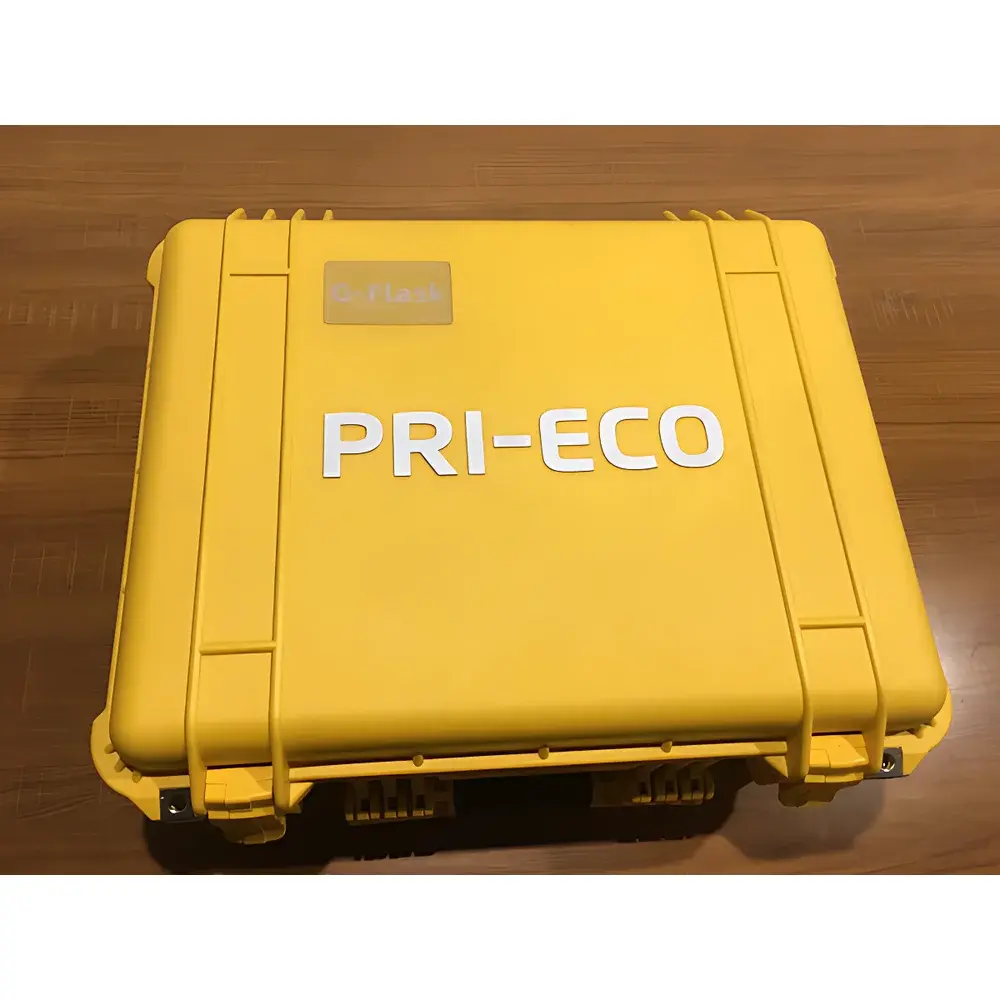
G-Flask Automated Greenhouse Gas Sampling System by PRI-ECO
| Brand | PRI-ECO |
|---|---|
| Origin | Beijing, China |
| Manufacturer Type | Original Equipment Manufacturer (OEM) |
| Country of Origin | China |
| Model | G-Flask |
| Pricing | Available Upon Request |
Overview
The G-Flask Automated Greenhouse Gas Sampling System is a field-deployable, laboratory-grade atmospheric sampling instrument engineered for high-fidelity collection of ambient air samples intended for subsequent ultra-trace analysis of long-lived greenhouse gases (LLGHGs). It operates on a controlled-pressure, dry-compression principle: an oil-free, chemically inert diaphragm pump draws ambient air through a desiccant-based drying module (optional), then compresses the conditioned gas into pre-evacuated, electropolished Pyrex® glass flasks under precisely regulated pressure (0–60 psi, factory-set at 30 psi). This methodology eliminates hydrocarbon contamination, minimizes adsorption losses, and preserves sample integrity during transport and storage—critical for isotopic and concentration measurements of CO₂, CH₄, N₂O, SF₆, HFCs, PFCs, CFCs, and halons at sub-part-per-trillion (ppt) sensitivity levels. Designed for unattended operation in remote meteorological stations, flux towers, and boundary-layer monitoring networks, the G-Flask meets the foundational requirements of WMO-GAW (World Meteorological Organization Global Atmosphere Watch) compatibility protocols for flask-based sampling.
Key Features
- Pyrex® borosilicate glass sampling flasks (2.1 L volume, 110 mm diameter × 410 mm height, 780 g mass) with ultra-low outgassing characteristics and certified inertness for reactive trace gases
- Integrated yellow anti-explosion polymer film encapsulation providing mechanical containment up to 35 psi working pressure and mitigating risk from accidental over-pressurization or thermal shock
- Dual-flask configuration (standard) with modular expansion capability for sequential or parallel sampling campaigns
- Intuitive tri-color LED status indicator: red = power-on / system initialization; amber = active compression cycle; green = sampling complete and pressure stabilized
- Adjustable pressure relief valve (10–300 psi range) ensuring compliance with ISO 8573-1 Class 0 compressed air purity standards for analytical use
- Configurable sampling modes: dry-mode (post-desiccant) and ambient-mode (unconditioned), selectable via front-panel toggle switch
- Real-time digital pressure display (0.1 psi resolution), battery level indicator, and tactile power/operation controls housed in an IP54-rated enclosure
Sample Compatibility & Compliance
The G-Flask is compatible with standard 2.1 L EPA/NOAA-compliant glass flasks fitted with PTFE-sealed glass stopcocks and ground-glass or quick-connect interfaces. All wetted materials—including pump diaphragms, tubing, valves, and seals—are fluoropolymer- or stainless-steel-based to prevent catalytic degradation or adsorption of target analytes. The system adheres to ASTM D6159-22 (Standard Practice for Collection of Ambient Air Samples for Subsequent Analysis of Gaseous Pollutants) and supports GLP-compliant data traceability when paired with PRI-ECO’s optional audit-log-enabled firmware. Flasks are evacuated to <10⁻³ mbar prior to deployment using certified vacuum manifolds, satisfying WMO-GAW flask preparation guidelines for inter-laboratory comparability.
Software & Data Management
While the G-Flask operates as a standalone hardware platform, it integrates seamlessly with PRI-ECO’s proprietary FlaskLog™ data acquisition suite (v3.2+), which records timestamped pressure profiles, pump runtime, ambient temperature/humidity (via optional external sensor input), and operator-defined metadata (site ID, flask ID, sampling protocol). All logs comply with FDA 21 CFR Part 11 requirements for electronic records and signatures, including user authentication, audit trails, and immutable data archiving. Export formats include CSV, NetCDF, and XML for ingestion into ICOS (Integrated Carbon Observation System) or NOAA’s HATS (Halocarbons and Other Atmospheric Trace Species) databases.
Applications
- Long-term atmospheric monitoring networks requiring stable, reproducible flask archives for trend analysis of LLGHGs
- Source attribution studies using dual-isotope (e.g., δ¹³C–CH₄, δ¹⁵N–N₂O) and compound-specific isotopic analysis
- Validation of satellite-based remote sensing products (e.g., OCO-2, GOSAT, Sentinel-5P)
- Urban emission inventory verification and regional inverse modeling
- Calibration cylinder preparation for primary and secondary reference gas standards
- Field intercomparison exercises under ACTRIS (Aerosols, Clouds, and Trace gases Research Infrastructure) and IGAC (International Global Atmospheric Chemistry) frameworks
FAQ
What is the maximum allowable fill pressure for the G-Flask sampling bottles?
The Pyrex® flasks are rated for continuous service up to 35 psi; the system’s default compression setpoint is 30 psi to ensure margin for thermal expansion during transport.
Can the G-Flask be used for isotopic analysis without introducing fractionation bias?
Yes—the inert gas path, absence of lubricants, and rapid, low-shear compression minimize kinetic fractionation; validation data per IUPAC Technical Report TR-2021-01 confirms δ¹³C-CO₂ reproducibility within ±0.02‰ (1σ) across repeated fills.
Is remote monitoring or control supported?
Optional RS-485 or LoRaWAN telemetry modules enable real-time status reporting and scheduled start/stop commands; no cloud dependency required for core sampling functionality.
How is moisture managed during dry-mode sampling?
A replaceable, regenerable silica gel or molecular sieve cartridge (not included) is installed upstream of the pump; dew point suppression to –40°C is achievable with proper maintenance.
Does the system meet regulatory requirements for emissions monitoring under EPA Method TO-15 or ISO 16017-1?
The G-Flask is designed for ambient background sampling—not stack or fugitive emission testing; however, its performance specifications align with the quality assurance criteria outlined in EPA 40 CFR Part 58 Appendix A for network-level precision and stability.







