
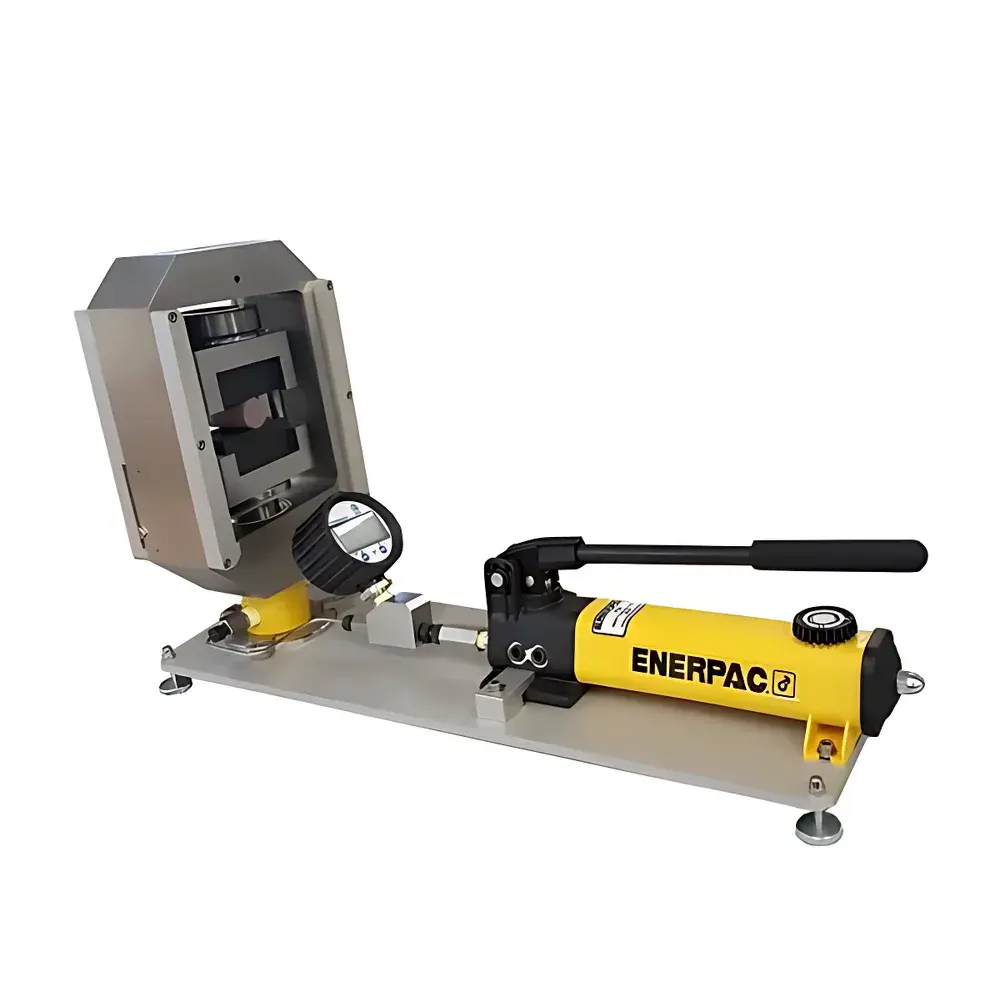
FLOXLAB ITB100 Brazilian Tensile Strength Tester
| Brand | FLOXLAB |
|---|---|
| Origin | France |
| Model | ITB 100 |
| Test Principle | Indirect Tensile (Brazilian) Method via Radial Compression |
| Compliance | ASTM D3967, ISRM Suggested Method |
| Max Sample Diameter | 54.7 mm (NX core), 42.0 mm (BX), 38.1 mm (1.5″) |
| Sample Thickness Range | 0.2–0.75 × Diameter |
| Load Capacity | 100 kN |
| Construction Material | High-Grade Stainless Steel |
Overview
The FLOXLAB ITB100 Brazilian Tensile Strength Tester is a precision-engineered mechanical testing system designed specifically for the determination of indirect tensile strength (ITS) of brittle and quasi-brittle materials—including rock, concrete, ceramics, and geological specimens—using the standardized Brazilian disc test method. Unlike direct tension tests—which are impractical for most rigid solids due to gripping difficulties and stress concentration—the ITB100 applies diametral compressive loading across a circular disc specimen, inducing uniform tensile stress along the vertical diameter. This principle, governed by elastic theory for a thin circular plate under opposing line loads, enables reliable quantification of tensile strength without specimen failure at the grips. The instrument operates in accordance with ASTM D3967 (“Standard Test Method for Splitting Tensile Strength of Cylindrical Concrete Specimens”) and the International Society for Rock Mechanics (ISRM) Suggested Method for the Brazilian test, ensuring data compatibility with international geomechanical and materials characterization protocols.
Key Features
- Robust 100 kN load frame constructed entirely from high-grade stainless steel, engineered for long-term dimensional stability and corrosion resistance in laboratory and field-prep environments.
- Modular platen configuration supporting three standard core diameters: 38.1 mm (1.5″), 42.0 mm (BX), and 54.7 mm (NX), enabling seamless transition between rock core sizes commonly used in mining, civil engineering, and petroleum geomechanics.
- Precisely aligned, hardened steel loading platens with cylindrical contact surfaces (radius-matched to specimen curvature) to ensure uniform line-load distribution and minimize edge effects per ASTM D3967 requirements.
- Integrated load cell with traceable calibration certificate (NIST-traceable or equivalent national metrology institute), providing high-resolution force measurement across the full 100 kN range with typical linearity ≤ ±0.5% of full scale.
- Manual or motorized crosshead actuation options available; base configuration includes calibrated handwheel-driven displacement control with fine-pitch leadscrew for repeatable, low-velocity compression rates suitable for quasi-static ITS evaluation.
Sample Compatibility & Compliance
The ITB100 accommodates cylindrical disc specimens with thickness-to-diameter ratios ranging from 0.2 to 0.75—within the validated range specified by both ASTM D3967 and ISRM guidelines to maintain acceptable stress field uniformity. Specimen preparation follows strict dimensional tolerances: parallelism ≤ 0.02 mm, surface roughness Ra ≤ 3.2 µm, and absence of visible cracks or heterogeneities within the loaded zone. The system is routinely deployed in accredited geotechnical laboratories performing ASTM-compliant rock property assessments, and supports audit-ready documentation for ISO/IEC 17025:2017 compliance. While not an automated GMP system, its mechanical architecture and calibration traceability align with GLP principles for non-regulated research and QA/QC applications in construction materials testing.
Software & Data Management
The ITB100 operates as a stand-alone mechanical tester and does not include embedded digital control or data acquisition hardware. Force readings are obtained via external digital load indicators or third-party universal testing machine (UTM) controllers compatible with analog (±10 V) or digital (RS-232/USB) output interfaces. When integrated into a broader test ecosystem—such as MTS, Instron, or Tinius Olsen systems—the ITB100 functions as a dedicated fixture for Brazilian tensile testing. Users may export raw load vs. time or load vs. displacement data for post-processing in MATLAB, Excel, or specialized geomechanics software (e.g., RocScience Phase2, MATLAB-based ITS calculators). Calibration records, specimen geometry logs, and test reports can be maintained in accordance with internal QA procedures or client-specific data retention policies.
Applications
- Determination of tensile strength of intact rock cores (granite, basalt, sandstone, limestone) for slope stability analysis and tunnel support design.
- Quality assessment of pre-cast concrete segments and high-performance cementitious composites during production validation.
- Comparative evaluation of fracture toughness proxies in ceramic tile, refractory bricks, and sintered metal components.
- Teaching and research applications in undergraduate and graduate geomechanics, materials science, and civil engineering laboratories.
- Supplementary testing in ASTM C39/C39M (compressive strength) workflows to derive tensile-to-compressive strength ratios for empirical strength criteria (e.g., Hoek-Brown).
FAQ
What standards does the ITB100 comply with?
ASTM D3967 and ISRM Suggested Method for the Brazilian tensile test.
Can the ITB100 test non-rock materials such as concrete or asphalt?
Yes—it is widely used for concrete cylinders and molded asphalt briquettes, provided specimens meet dimensional and homogeneity requirements outlined in ASTM D3967.
Is the 100 kN capacity sufficient for NX-size rock cores?
Yes—typical Brazilian failure loads for NX cores (54.7 mm dia.) of medium-strength rock (e.g., 80 MPa UCS) fall well below 80 kN, leaving adequate safety margin and resolution headroom.
Does the ITB100 include automatic data logging?
No—data acquisition requires integration with an external load indicator or UTM controller; no proprietary software or onboard memory is included.
What maintenance is required for long-term accuracy?
Annual recalibration of the load cell and periodic inspection of platen alignment and surface finish are recommended; stainless steel construction minimizes environmental degradation.



