
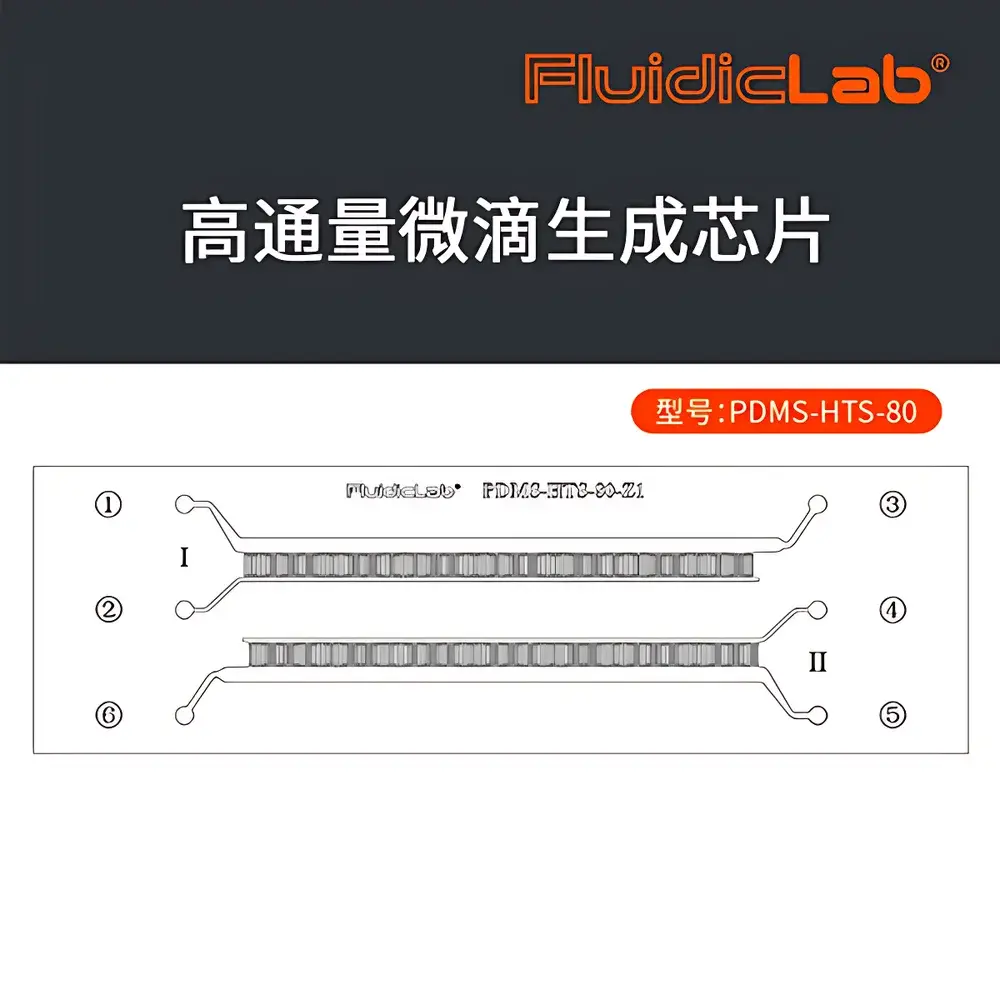
FluidicLab PDMS-HTS-80 High-Throughput Droplet Generation Chip
| Brand | FluidicLab |
|---|---|
| Origin | Shanghai, China |
| Manufacturer Type | OEM Producer |
| Product Category | Domestic |
| Model | PDMS-HTS-80 |
| Price | USD 185 (excl. VAT & shipping) |
| Chip Material | Covalently bonded PDMS microchannels on borosilicate glass substrate |
| Chip Type | Step-emulsion droplet generation chip |
| Channel Width | 160 µm |
| Nozzle Geometry | Parallel stepped orifice array (188 independent units) |
| Droplet Diameter Range | 80–100 µm |
| Aqueous Phase Flow Rate Range | 10–1000 µL/min (CV < 5% under stable pressure control) |
| Substrate Dimensions | 75 × 25 × 2 mm (glass), Chip Active Area: 62 × 19 × 2 mm |
| Surface Treatment | Hydrophobic silanization of PDMS channels |
| Operational Configuration | Dual-inlet/dual-output symmetric layout (Chip I: Inlets ①/② → Outlet ③ |
| Chip II | Inlets ④/⑤ → Outlet ⑥) |
Overview
The FluidicLab PDMS-HTS-80 High-Throughput Droplet Generation Chip is an engineered microfluidic device designed for robust, parallelized emulsion formation via step-emulsion (Laplace-force-driven) droplet generation. Unlike conventional flow-focusing geometries, this chip leverages 188 identical, spatially isolated stepped orifices—each consisting of a sudden expansion from a narrow channel (160 µm wide) into a wider chamber—to induce rapid interfacial instability at the aqueous/oil phase boundary. This mechanism relies on localized Laplace pressure reduction upon passage over the step, enabling deterministic droplet pinch-off with high temporal reproducibility and reduced sensitivity to upstream flow fluctuations. The chip integrates covalently bonded polydimethylsiloxane (PDMS) microstructures onto a precision-ground borosilicate glass slide (75 × 25 × 2 mm), ensuring dimensional stability, optical clarity for real-time microscopy, and compatibility with standard inverted microscope stages. Its dual-channel symmetry supports simultaneous operation of two independent droplet streams or sequential validation runs without chip replacement.
Key Features
- Parallel architecture with 188 identical step-orifice units, delivering >20× higher throughput than single-channel flow-focusing chips under matched flow conditions.
- Covalent PDMS-to-glass bonding eliminates delamination risk during prolonged operation or elevated backpressure (tested up to 3.5 bar).
- Hydrophobically functionalized PDMS channels (via vapor-phase silanization) ensure consistent oil-wetting behavior and suppress aqueous-phase adhesion or clogging.
- Dual-input/dual-output configuration enables flexible experimental design: Chip I (Inlets ①/② → Outlet ③) and Chip II (Inlets ④/⑤ → Outlet ⑥) operate independently or in tandem.
- Optimized nozzle geometry (160 µm channel width, 80–100 µm droplet diameter output) balances resolution, throughput, and compatibility with standard syringe pump systems and fluorinated oils (e.g., Drop-Surf series).
- Manufactured under cleanroom-grade protocols; each chip undergoes post-fabrication inspection for channel integrity, bond quality, and surface uniformity.
Sample Compatibility & Compliance
The PDMS-HTS-80 is compatible with common biocompatible continuous phases (e.g., HFE-7500, FC-40, or mineral oil with 2% Span 80) and dispersed aqueous media including PBS, cell suspensions (≤10⁶ cells/mL), PCR master mixes, and hydrogel precursors (e.g., GelMA, PEGDA). Its glass substrate meets ISO 8549-1:2017 specifications for microscope slide dimensional tolerances, while PDMS processing adheres to ASTM F2998-15 standards for microfluidic device fabrication. The chip supports GLP-aligned workflows when paired with traceable pressure controllers and calibrated syringe pumps; full audit trails for droplet generation parameters (flow rates, pressure logs, timestamped imaging) can be maintained using third-party acquisition software compliant with FDA 21 CFR Part 11 requirements.
Software & Data Management
While the PDMS-HTS-80 operates as a passive hardware component, it is fully interoperable with industry-standard fluid control platforms—including Elveflow OB1 Mk III pressure controllers, Fluigent Flow-EZ modules, and Harvard Apparatus PHD Ultra syringe pumps—via analog voltage or digital TTL triggering. Real-time droplet characterization is enabled using open-source tools such as MicroManager + Python-based analysis pipelines (e.g., TrackPy, scikit-image), supporting automated diameter distribution histograms, coefficient-of-variation (CV) reporting, and frame-by-frame stability metrics. Raw image sequences acquired on Nikon Ti2-E or Zeiss Axio Observer systems may be archived in OME-TIFF format for long-term FAIR (Findable, Accessible, Interoperable, Reusable) data management.
Applications
- Single-cell encapsulation for scRNA-seq library preparation, where uniform 80–100 µm droplets enable >95% capture efficiency and minimal doublet formation.
- High-throughput screening of enzyme kinetics or antibody affinity using compartmentalized aqueous droplets as picoliter-scale reactors.
- Microgel synthesis (e.g., alginate, chitosan) with controlled crosslinking kinetics and monodisperse particle size distributions.
- Diagnostic assay development, including digital ELISA and CRISPR-based nucleic acid detection in water-in-oil emulsions.
- Materials science applications such as templated nanoparticle synthesis and Janus microparticle fabrication.
FAQ
What pressure range is recommended for stable operation?
Stable droplet generation is achieved between 50–350 kPa for the aqueous phase and 100–500 kPa for the oil phase, depending on viscosity and surfactant concentration.
Can the chip be reused after cleaning?
Yes—provided it is flushed sequentially with isopropanol, DI water, and nitrogen drying; reuse beyond 5 cycles requires revalidation of CV and droplet monodispersity.
Is plasma treatment required before use?
No—hydrophobic surface treatment is factory-applied and stable for ≥72 h post-packaging; optional oxygen plasma activation may be used to temporarily render channels hydrophilic for specific assays.
Which mounting fixtures are compatible?
The chip is dimensionally optimized for FluidicLab’s standard PDMS chip clamp (part #CLAMP-PDMS-STD) and third-party holders conforming to ANSI/SCTE 12-2021 microfluidic interface standards.
Does the chip support UV-curable resins?
Not recommended—PDMS exhibits UV-induced swelling and degradation; for photopolymer workflows, consider glass-PDMS hybrid variants with quartz windows (available upon request).




