
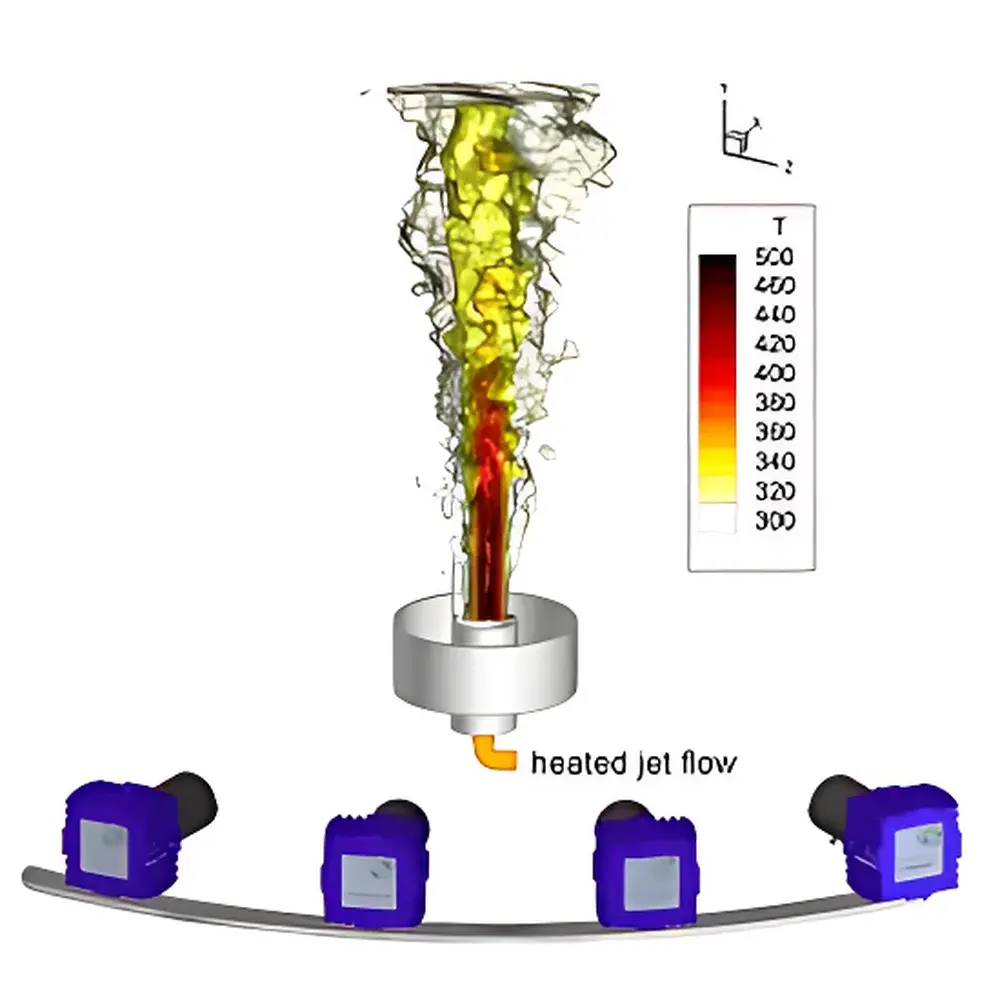
FluidMaster-BOS Background Oriented Schlieren (BOS) Temperature Imaging System
| Brand | LaVision GmbH |
|---|---|
| Origin | Germany |
| Model | FluidMaster-BOS |
| Type | Imported Optical Measurement Instrument |
| Application | Quantitative 2D/3D density and temperature field imaging in transparent media |
| Compliance | Designed for GLP/GMP-aligned research environments |
Overview
The FluidMaster-BOS Background Oriented Schlieren (BOS) Temperature Imaging System is a non-intrusive, laser-free optical diagnostic platform engineered for quantitative visualization of refractive index gradients in transparent gaseous and liquid media. Unlike classical schlieren or shadowgraph techniques requiring collimated light sources or knife-edge alignment, BOS operates on the principle of background pattern displacement correlation—leveraging natural or synthetic random dot targets imaged before and during thermal or compositional transients. As refractive index variations arise from local density changes governed by the Gladstone–Dale relation, the system enables indirect but spatially resolved reconstruction of temperature fields (e.g., in convective air flows, combustion boundary layers, or thermal plumes above heated surfaces) without flow seeding or coherent illumination. The FluidMaster-BOS integrates high-resolution CMOS imaging, sub-pixel digital image correlation (DIC), and physics-based inversion algorithms to deliver path-integrated gradient data, which—when combined with appropriate boundary conditions and calibration—yields 2D quantitative temperature maps. For axisymmetric or volumetric analysis, it serves as the foundational module for LaVision’s Tomo-BOS extension.
Key Features
- True laser-free operation: Eliminates requirements for laser safety infrastructure, optical alignment, or particle seeding—reducing setup complexity and operational overhead.
- High-sensitivity background pattern correlation: Achieves sub-pixel displacement resolution (<0.1 pixel) using optimized cross-correlation kernels within the DaVis software environment.
- Modular architecture: Supports single-camera 2D BOS for planar thermal mapping and scalable multi-camera configurations (up to 8 synchronized cameras) for tomographic reconstruction.
- Real-time acquisition readiness: Compatible with high-speed cameras (≥1 kHz frame rates) for time-resolved monitoring of transient thermal events such as rapid heating, quenching, or buoyancy-driven instabilities.
- Physics-integrated post-processing: Includes built-in refractive index-to-temperature conversion modules calibrated against standard gas/liquid thermo-optic coefficients (e.g., dn/dT for air, water, or CO₂).
- Rigorous geometric calibration support: Implements target-based multi-view calibration routines compliant with Zhang’s method, ensuring reproducible projection geometry across camera arrays.
Sample Compatibility & Compliance
The FluidMaster-BOS is validated for use with optically transparent media including ambient air, nitrogen, argon, water, ethanol, and silicone oils—provided sufficient background contrast and minimal surface reflection interference. It is not suitable for opaque, highly scattering, or turbid media. The system adheres to fundamental metrological principles outlined in ISO 5725 (accuracy of measurement methods) and supports documentation workflows aligned with ISO/IEC 17025 for laboratory accreditation. When deployed in regulated R&D settings (e.g., thermal management validation for aerospace components or HVAC prototyping), the DaVis software environment provides audit-trail logging, user-access controls, and electronic signature capability compliant with FDA 21 CFR Part 11 requirements. All hardware components meet CE marking directives for electromagnetic compatibility (EMC) and low-voltage safety (LVD).
Software & Data Management
BOS data acquisition and processing are fully integrated into LaVision’s DaVis 10.x platform—a modular, scriptable scientific imaging software suite. The dedicated BOS module performs real-time image registration, adaptive background subtraction, robust pattern correlation, and gradient field integration via Poisson solvers. For quantitative temperature reconstruction, users define reference conditions (e.g., ambient T₀, P₀), select medium-specific thermo-optic models, and apply regularization constraints to stabilize inverse solutions. Tomo-BOS workflows incorporate iterative algebraic reconstruction techniques (ART/SART) with GPU-accelerated computation. Raw image sequences, intermediate correlation matrices, and final 2D/3D scalar fields are stored in HDF5 format with embedded metadata (camera parameters, timestamp, calibration IDs), enabling traceable long-term archiving and FAIR (Findable, Accessible, Interoperable, Reusable) data practices.
Applications
- Convective heat transfer analysis in electronics cooling, solar thermal receivers, and building envelope studies.
- Validation of CFD simulations—particularly LES and RANS models predicting buoyancy-driven flows and thermal boundary layer development.
- Non-contact thermography of microscale devices where conventional sensors perturb thermal fields (e.g., MEMS actuators, thin-film heaters).
- Combustion diagnostics: Flame front tracking, exhaust plume dispersion, and afterburner thermal stratification without intrusive probes.
- Material science: Monitoring thermal stress evolution during laser annealing or rapid thermal processing (RTP) of semiconductors.
- Geophysical fluid dynamics: Laboratory-scale simulation of atmospheric convection cells and oceanic thermohaline structures.
FAQ
Does the FluidMaster-BOS require laser illumination or flow seeding?
No. BOS relies solely on passive imaging of a static background pattern; no laser source, optical components beyond lenses/cameras, or tracer particles are needed.
Can it measure absolute temperature values, or only relative gradients?
With proper calibration against known thermal references (e.g., thermocouple-validated isotherms), the system reconstructs absolute 2D temperature fields; 3D reconstructions require additional constraints or complementary modalities.
What camera specifications are recommended for optimal BOS performance?
Cameras should offer ≥4 MP resolution, global shutter, ≤2.5 e⁻ read noise, and precise trigger synchronization. LaVision recommends PCO.edge or Phantom v-series models for high-speed applications.
Is tomographic BOS compatible with existing FluidMaster-BOS hardware?
Yes—Tomo-BOS is a software-enabled extension requiring only additional calibrated cameras and updated DaVis licensing; no hardware retrofitting is necessary.
How is system accuracy verified prior to experimental deployment?
LaVision provides NIST-traceable calibration kits including precision-machined thermal wedges and certified refractive index standards, alongside validation protocols per ASTM E2847 for optical measurement uncertainty quantification.




