
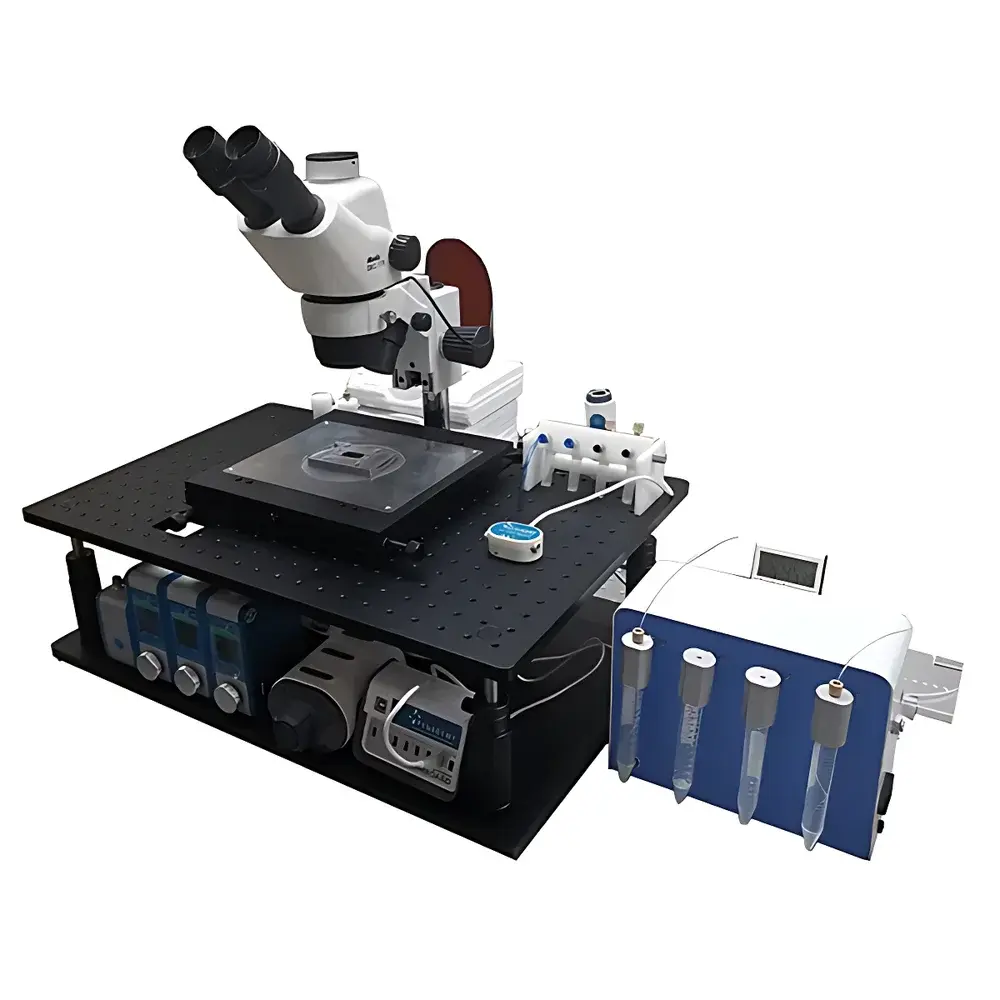
Fluigent-CETONI EOR Microfluidic Visualized Enhanced Oil Recovery System
| Brand | CETONI (Germany) |
|---|---|
| Origin | Germany |
| Manufacturer Type | Authorized Distributor |
| Import Status | Imported |
| Model | Fluigent-CETONI-EOR |
| Instrument Type | Precision Syringe Pump System |
| Pressure Range | Up to 890 bar |
| Flow Control Modes | Constant Pressure & Constant Flow |
| Temperature Range | Ambient to 200 °C (with heated syringes & jacketed tubing) |
| Compliance | Designed for ASTM D6377, ISO 10438, and petroleum core analysis workflows |
| Software Interface | FluentControl™ with real-time pressure/flow logging, audit trail, and GLP-compliant data export |
Overview
The Fluigent-CETONI EOR Microfluidic Visualized Enhanced Oil Recovery System is an engineered platform for quantitative, optically accessible investigation of multiphase fluid displacement in porous media under reservoir-relevant conditions. Built around CETONI’s modular high-precision syringe pump architecture—certified for operation across four pressure classes (low, medium, high, and ultra-high, up to 890 bar)—the system integrates pressure-stable fluid delivery, real-time sensor feedback, thermal management, and microfabricated flow cells to replicate subsurface pore-scale dynamics. Its core measurement principle relies on controlled volumetric displacement combined with high-resolution optical imaging (e.g., brightfield, fluorescence, or confocal microscopy), enabling direct observation of saturation fronts, capillary trapping, wettability effects, and interfacial instabilities during chemical, thermal, or gas-based EOR processes.
Key Features
- Modular CETONI QmixES syringe pump modules, each independently programmable for synchronized multi-channel injection of oil, water, surfactant, CO₂, or polymer solutions
- Ultra-high-pressure capability (up to 890 bar) with integrated pressure transducers (±0.1% FS accuracy) and active pressure regulation
- Thermal control subsystem: Peltier-heated syringes (max. 200 °C), insulated jacketed tubing, and PID-regulated chip-stage heating for isothermal or gradient-driven experiments
- Optical-grade microfluidic chips fabricated in fused silica or silicon with etched pore networks (e.g., Berea sandstone analogs, fractured media, or stochastic pore geometries)
- Real-time synchronization of flow rate, pressure, temperature, and image acquisition via FluentControl™ software with hardware-triggered TTL outputs
- Rugged stainless-steel manifold architecture with Swagelok®-compatible ultra-high-pressure fittings (rated to 1000 bar), leak-tested per ISO 15848-1
Sample Compatibility & Compliance
The system accommodates a broad range of reservoir fluids—including crude oils (API 10–40), brines (up to 30 wt% NaCl), low-surface-tension surfactants, supercritical CO₂, and thermally stable polymers—without degradation of sealing integrity or flow stability. All wetted materials comply with NACE MR0175/ISO 15156 for sour service compatibility. The platform supports experimental protocols aligned with ASTM D6377 (crude oil vapor pressure), ISO 10438 (petroleum industry instrumentation standards), and API RP 44 (core flooding test methodology). Data acquisition meets GLP and GMP requirements through time-stamped audit trails, user access controls, and 21 CFR Part 11–compliant electronic signatures when configured with validated FluentControl™ modules.
Software & Data Management
FluentControl™ serves as the central orchestration interface, providing deterministic sequencing of multi-step EOR protocols (e.g., waterflooding → surfactant slug → polymer chase). It logs pressure, flow rate, temperature, and valve states at ≥100 Hz with lossless binary storage. Export formats include CSV, HDF5, and MATLAB-compatible .mat files. Integrated metadata tagging enables traceability from raw sensor output to processed saturation maps. Optional Python SDK allows custom algorithm integration for real-time image segmentation (e.g., phase identification via thresholding or U-Net inference) and adaptive control loop implementation.
Applications
- Core-scale visualization of CO₂ huff-and-puff recovery mechanisms in tight carbonate formations
- Quantitative assessment of nanoparticle-stabilized emulsions for mobility control in heterogeneous sandpacks
- Wettability alteration kinetics under thermal stimulation (e.g., steam-assisted gravity drainage analogs)
- Interfacial tension reduction efficacy screening of novel biosurfactants under reservoir salinity and temperature
- Validation of pore-network modeling assumptions using experimentally derived saturation–pressure–time curves
- Multi-phase relative permeability determination with dynamic saturation tracking via image analysis
FAQ
What pressure classes are supported by the Fluigent-CETONI-EOR system?
The system is configurable across four pressure tiers: low (≤10 bar), medium (≤100 bar), high (≤400 bar), and ultra-high (≤890 bar), selected based on target reservoir depth and fluid compressibility.
Can the system operate under true reservoir temperatures?
Yes—integrated heated syringes and chip-stage thermal control enable sustained operation from ambient to 200 °C, matching typical deep-reservoir thermal profiles.
Is the microfluidic chip design standardized or customizable?
Both options are available: off-the-shelf chips (e.g., 2D/3D etched sandstone mimics, fracture networks) and fully custom designs (via mask-based photolithography or DRIE) with turnaround times of ≤6 weeks.
How is data integrity ensured for regulatory submissions?
FluentControl™ supports ALCOA+ principles: attributable, legible, contemporaneous, original, accurate, complete, consistent, enduring, and available—with full electronic audit trail, role-based permissions, and optional IQ/OQ documentation packages.
Does the system support automated long-duration flooding tests?
Yes—scheduled protocols can run unattended for >168 hours with automatic fail-safe shutdown upon pressure deviation, temperature drift, or flow interruption detection.



