
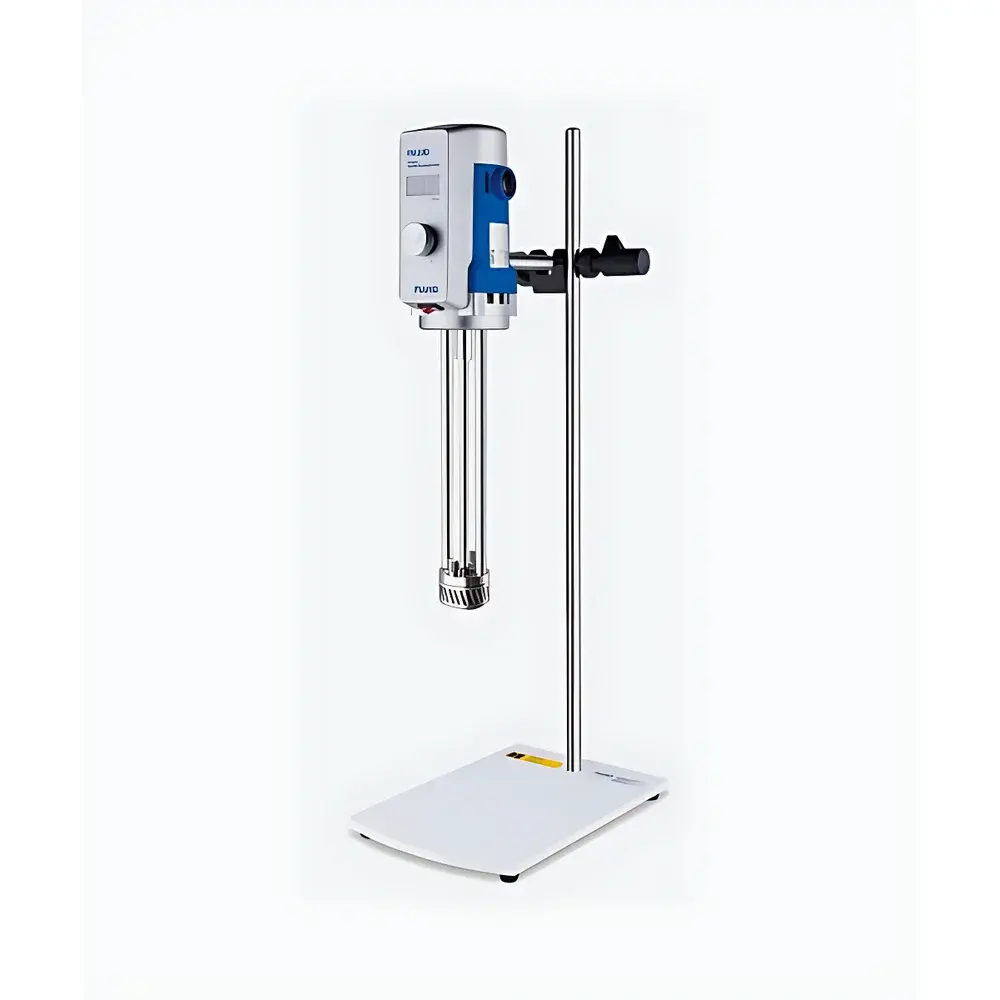
FLUKO FM20D High-Shear Dispersing and Emulsifying Homogenizer
| Brand | FLUKO |
|---|---|
| Origin | Germany |
| Model | FM20D |
| Power | 500 W |
| Voltage/Frequency | 220 V, 50 Hz |
| Processing Volume (H₂O) | 150–3000 mL |
| Max. Viscosity | 5000 cP |
| Speed Range | 2000–14,000 rpm |
| Speed Display | Digital |
| Speed Control | Continuously Variable |
| Standard Stator Type | Slotted |
| Wetted Parts Material | SS316L |
| Shaft Sleeve Material | Copper Alloy |
| Ambient Temperature Range | 5–40 °C |
| Relative Humidity Limit | ≤80% |
| Operation Mode | Batch |
| Base & Stand | Included |
| Dimensions (W×D×H) | 210 × 290 × 675 mm |
| Weight | ~10 kg |
Overview
The FLUKO FM20D is a precision-engineered high-shear dispersing and emulsifying homogenizer designed for rigorous laboratory-scale processing of complex liquid and suspension systems. Operating on the principle of rotor-stator mechanical shear, the FM20D generates intense hydrodynamic forces—via controlled fluid acceleration through narrow stator slots—to achieve efficient particle size reduction, droplet breakup, and homogeneous phase dispersion. Its robust 500 W motor delivers high torque across a wide speed range (2000–14,000 rpm), enabling reproducible processing of medium-viscosity fluids (up to 5000 cP) and solid-containing suspensions. Unlike low-shear mixers, the FM20D is specifically configured for applications demanding true colloidal stability, interfacial area maximization, and kinetic control over dispersion kinetics—making it suitable for formulation development in pharmaceuticals, cosmetics, coatings, and advanced materials research.
Key Features
- Continuously variable speed control with digital RPM readout ensures precise process parameter replication and method transfer between R&D and pilot scale.
- High-torque 500 W motor maintains stable rotational performance under load, minimizing speed drift during high-viscosity or particle-laden operation.
- Interchangeable slotted stators (standard configuration) allow optimization of shear intensity and flow pattern—supporting coarse dispersion, fine emulsification, or ultra-fine homogenization depending on geometry and clearance.
- All wetted surfaces constructed from electropolished SS316L stainless steel meet stringent corrosion resistance and cleanability requirements for GMP-aligned environments.
- Copper alloy shaft sleeves provide thermal stability and wear resistance during prolonged operation, extending service life and maintaining concentricity.
- Integrated universal base and adjustable support column enable secure mounting of vessels ranging from 150 mL beakers to 3 L jacketed reactors—ensuring mechanical stability during high-speed operation.
- Compact footprint (210 × 290 × 675 mm) and lightweight design (~10 kg) facilitate flexible benchtop deployment in shared lab spaces or fume hood installations.
Sample Compatibility & Compliance
The FM20D accommodates a broad spectrum of sample types, including aqueous and non-aqueous emulsions, polymer dispersions, pigment pastes, nanosuspensions, and biopolymer gels. It is validated for batch processing of samples containing up to 40% w/w solids, provided adequate cooling is maintained within the 5–40 °C ambient operating envelope. The device complies with IEC 61000-6-2 (immunity) and IEC 61000-6-4 (emission) standards for laboratory electrical equipment. While not intrinsically rated for explosion-proof use, its copper-alloy components and grounded chassis support safe operation with flammable solvents when used in ventilated enclosures. For regulated environments, the absence of embedded data logging or electronic audit trails means external documentation (e.g., handwritten logs or third-party DAQ integration) is required to satisfy GLP or FDA 21 CFR Part 11 record-keeping expectations.
Software & Data Management
The FM20D operates as a standalone analog-controlled instrument with no onboard firmware, cloud connectivity, or proprietary software suite. Speed setting and real-time RPM feedback are managed exclusively via front-panel controls and LED display—eliminating cybersecurity risks and ensuring long-term operational continuity without software updates or license dependencies. Users requiring traceable process records may integrate the unit with external data acquisition systems using optional analog voltage output (0–10 V) or pulse signal interfaces (upon request from FLUKO technical support). This architecture aligns with ISO/IEC 17025 Clause 6.4.10 on equipment verification and supports calibration traceability through accredited third-party service providers.
Applications
- Pharmaceutical: Preparation of nanoemulsions for oral delivery, dispersion of poorly soluble APIs in lipid matrices, and stabilization of protein-based colloids.
- Coatings & Inks: Deagglomeration of pigment concentrates, rheology modification of acrylic dispersions, and viscosity-controlled mixing of UV-curable formulations.
- Food Science: Development of plant-based dairy alternatives, homogenization of starch-protein blends, and controlled fat globule size distribution in functional beverages.
- Materials Research: Exfoliation of 2D nanomaterials (e.g., graphene oxide, MXenes) in aqueous surfactant systems and dispersion of ceramic nanoparticles for inkjet-printed electronics.
- Adhesives & Sealants: Incorporation of fillers into silicone or polyurethane bases while preserving thixotropic profile and avoiding air entrapment.
FAQ
What is the maximum recommended processing volume for viscous samples?
For samples exceeding 2000 cP, optimal performance is achieved at volumes between 500–1500 mL to ensure adequate vortex formation and heat dissipation.
Can the FM20D be used with glass or PTFE-coated vessels?
Yes—provided the vessel has sufficient wall thickness and thermal stability; however, borosilicate glass containers must be secured with non-slip clamps to prevent resonance-induced cracking at speeds above 10,000 rpm.
Is sterilization of the rotor-stator assembly possible?
SS316L components are autoclavable at 121 °C for 20 minutes; repeated steam exposure may affect copper alloy sleeve integrity, so dry-heat sterilization (160 °C, 2 h) is preferred for full assembly.
Does FLUKO offer validation documentation for IQ/OQ protocols?
Factory test reports—including speed accuracy verification, torque curve validation, and material certification—are available upon order; site-specific OQ execution requires user-defined acceptance criteria and calibrated metrology equipment.
How often should maintenance be performed?
Visual inspection and lubrication of drive coupling should occur every 200 operational hours; stator wear assessment is recommended after 500 hours of continuous high-shear operation.



