
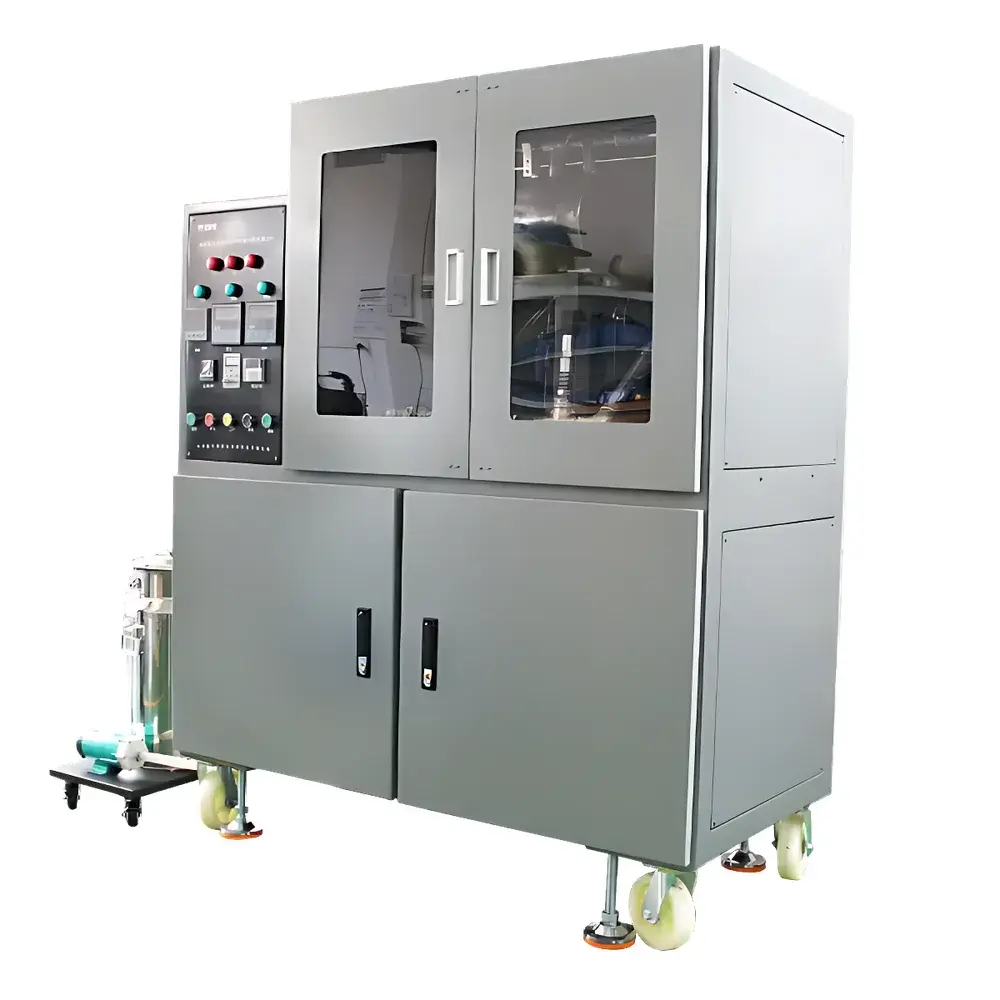
Fluorand FDY-0701 Engine Coolant Aluminum Pump Cavitation Corrosion Tester
| Brand | Fluorand (csfriend) |
|---|---|
| Origin | Hunan, China |
| Manufacturer Type | Authorized Distributor |
| Country of Manufacture | China |
| Model | FDY-0701 |
| Price Range | USD 1,400 – 14,000 |
| Pump Speeds | 2675 rpm and 4600 ± 100 rpm |
| System Pressure | 103 ± 3 kPa |
| Temperature Control Ranges | 63–68 °C and 113 ± 3 °C |
| Heating Power | 2 kW |
| Total Power Consumption | 4.2 kW |
| Supply Voltage | AC 380 V ± 10%, 50 Hz |
| Dimensions (L×W×H) | 1100 × 660 × 1400 mm |
| Net Weight | 180 kg |
Overview
The Fluorand FDY-0701 Engine Coolant Aluminum Pump Cavitation Corrosion Tester is a purpose-built laboratory instrument engineered to evaluate the cavitation-induced corrosion resistance of aluminum coolant pumps under simulated engine operating conditions. It replicates the hydrodynamic stress, thermal cycling, and chemical exposure experienced by OEM-grade aluminum impeller pumps—specifically using a production-representative Buick-sourced aluminum pump assembly mounted with original engine front cover geometry. The system operates on the principle of controlled cavitation generation within a closed-loop glycol-water coolant circuit, where localized pressure collapse at the impeller inlet induces micro-jet formation and subsequent surface pitting. This accelerated test methodology enables quantitative assessment of coolant formulation efficacy in mitigating erosion-corrosion damage—a critical performance metric defined in ASTM D2570, SAE J1085, and GMW14292 specifications.
Key Features
- Original-equipment aluminum pump assembly (Buick-sourced) with interchangeable mounting interface for rapid pump replacement and comparative testing across multiple coolant formulations.
- Dual-speed operation via industrial-grade frequency converter driving an explosion-proof motor; real-time rotational speed displayed on high-resolution digital tachometer with ±5 rpm repeatability.
- Full stainless-steel fluid path—including 316L tubing, electropolished reservoir, and SS304 structural frame—with corrosion-resistant fasteners ensuring long-term integrity in aggressive ethylene glycol/water environments.
- Intelligent digital timer with memory retention: automatically resumes elapsed test duration after unscheduled power interruption or manual pause, supporting multi-shift validation protocols.
- Precision PID temperature control using imported solid-state digital controller (±0.3 °C stability over 12-hr continuous operation), integrated with over-temperature cut-off circuitry compliant with IEC 61000-4-5 surge immunity standards.
- Electric immersion heating system (2 kW, Incoloy-sheathed elements) coupled with ASME-certified safety relief valve (set at 120 kPa) on the pressurized reservoir to prevent thermal runaway and ensure Class II hazardous location compliance.
Sample Compatibility & Compliance
The FDY-0701 accommodates standard ASTM D1121-compliant coolant samples (50/50 ethylene glycol/water, organic acid technology [OAT], hybrid OAT, and silicate-based formulations) in volumes of 8–12 L per test cycle. Test specimens include OEM aluminum pump housings, impellers, and front covers—mounted without modification to preserve native flow geometry. The system meets mechanical and electrical safety requirements per GB/T 3797–2016 (equivalent to IEC 60204-1) and supports traceable calibration per ISO/IEC 17025 when used with certified reference thermocouples and pressure transducers. Data outputs are structured to satisfy GLP audit trails and FDA 21 CFR Part 11 electronic record requirements when paired with validated third-party data acquisition software.
Software & Data Management
While the FDY-0701 operates as a stand-alone hardware platform, its analog sensor outputs (temperature, pressure, RPM, time) are compatible with industry-standard DAQ systems including National Instruments CompactDAQ and Keysight 34972A. Optional RS-485 Modbus RTU interface enables integration into centralized lab monitoring networks. All digital displays feature non-volatile memory and timestamped event logging (start/stop/pause/resume). When deployed with compliant LIMS or ELN platforms, the instrument supports automated report generation aligned with ASTM D2570 Annex A3—detailing cumulative cavitation exposure hours, mass loss measurements (via pre/post-test gravimetric analysis), and surface morphology scoring per ISO 4287 roughness parameters.
Applications
- Formulation development and benchmarking of extended-life coolants (ELC) for aluminum-intensive powertrains.
- Validation of corrosion inhibitor package stability under sustained thermal-mechanical stress.
- Root-cause analysis of field-reported pump failures linked to coolant degradation or improper mixing.
- Supplier qualification testing per OEM technical specifications (e.g., Ford WSS-M97B57-A2, Chrysler MS-12106).
- Academic research on cavitation erosion mechanisms in Al-Si cast alloys exposed to low-pH glycolic environments.
FAQ
What aluminum pump configurations are supported?
The FDY-0701 is configured with a production-intent Buick aluminum water pump assembly, including original front cover gasket interface and impeller geometry. Custom mounting plates can be fabricated for alternate OEM pumps upon request.
Is the system compatible with fully formulated ready-to-use coolants?
Yes—tested with ASTM D1121 Type A, B, and C coolants, including nitrite-free OAT and phosphate-free HOAT formulations. Pre-conditioning per ASTM D3306 Section 7.2 is recommended prior to test initiation.
How is cavitation severity quantified?
Cavitation intensity is inferred from standardized exposure duration at prescribed pressure (103 ± 3 kPa) and temperature (113 ± 3 °C) setpoints. Quantitative assessment requires post-test metrology: weight loss (mg), SEM imaging of pit density (>1 µm depth), and profilometry-derived Ra/Rz values.
Does the instrument support automated data export?
Native analog outputs (4–20 mA or 0–10 V) are provided for temperature, pressure, and RPM. Digital export requires external DAQ hardware; CSV or Excel-compatible logs are generated via connected PC-based acquisition software.
What maintenance intervals are recommended?
Bi-weekly inspection of gasket integrity and electrical grounding; quarterly calibration of temperature controller and pressure transducer using NIST-traceable references; annual full-system leak test per ISO 5208 Class A criteria.
Related Products






