
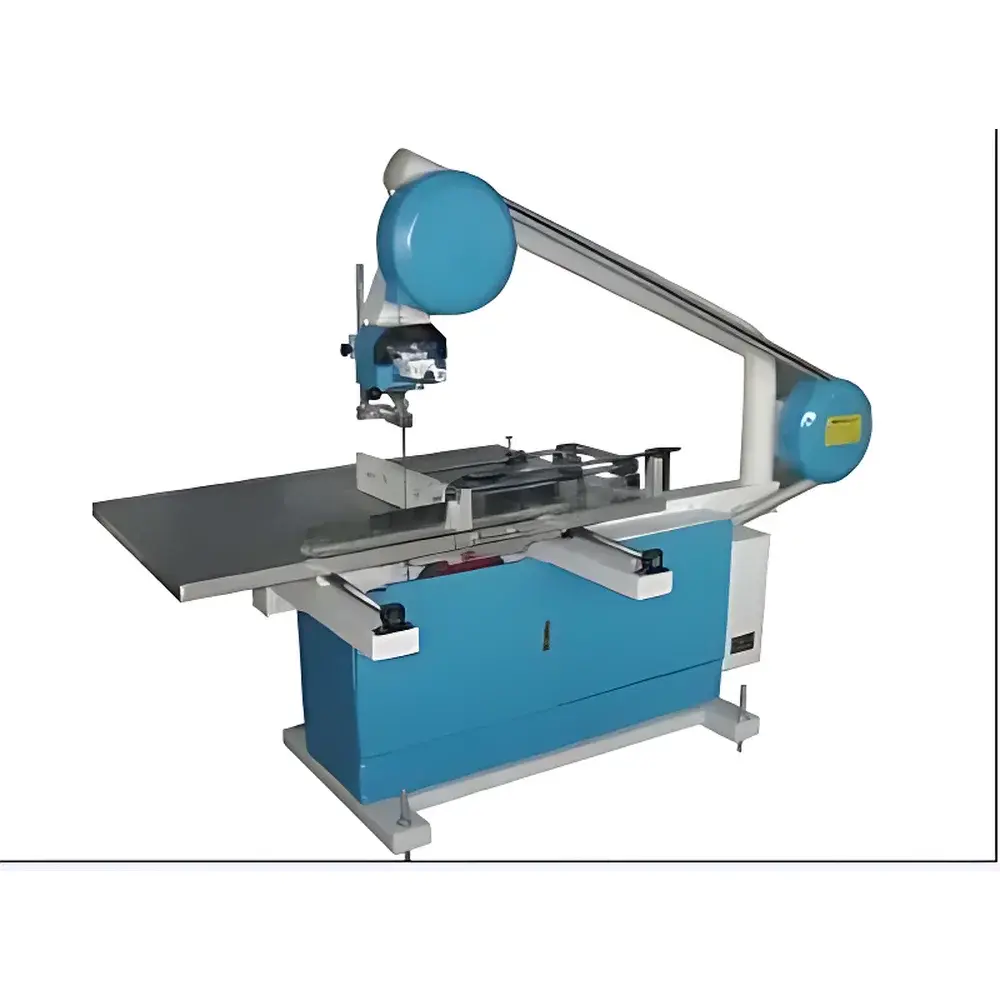
Foam Cutting Machine PZY-200 by Changchun Intelligent
| Brand | Changchun Intelligent |
|---|---|
| Origin | Jilin, China |
| Model | PZY-200 |
| Cutting Display Resolution | 0.01 mm |
| Dimensional Accuracy | ±1 mm |
| Worktable Dimensions | 1000 × 700 mm |
| Effective Travel of Movable Worktable | 500 mm |
| Power Supply | 380 V AC |
| Rated Power | 2.2 kW |
| Specimen Size | 25 × 25 × 10 mm |
Overview
The PZY-200 Foam Cutting Machine is an industrial-grade precision cutting system engineered for consistent, repeatable sectioning of rigid and flexible polymeric foam materials. Designed in accordance with standard mechanical testing preparation protocols—particularly those referenced in ASTM D3574 (Standard Test Methods for Flexible Cellular Materials – Slab, Bonded, and Molded Urethane Foams) and ISO 1923 (Flexible Cellular Polymeric Materials – Determination of Dimensions)—the PZY-200 employs a guided linear-motion blade mechanism driven by a high-torque AC motor. Its core function is to produce geometrically defined specimens—squares, rectangles, and strips—with dimensional fidelity required for downstream physical testing (e.g., compression, tensile, or thermal conductivity analysis). The machine operates under open-loop motion control with digital position feedback via integrated linear scale sensors, enabling traceable cut positioning without reliance on closed-loop servo tuning.
Key Features
- Precision-adjustable movable worktable with 500 mm effective travel range, mechanically constrained by hardened linear rails and anti-backlash lead screws for long-term repeatability.
- Digital display caliper scale (0.01 mm resolution) mounted directly on the carriage assembly, providing real-time positional feedback independent of operator interpretation.
- Dual-blade configuration with standardized mounting interface; blades are replaceable and compatible with optional tungsten-carbide edge variants for extended service life on abrasive closed-cell foams.
- Integrated electromagnetic braking system: brake engagement is disengaged automatically upon start command, ensuring synchronized motor activation and blade motion initiation.
- Dedicated emergency stop circuit featuring red mushroom-head pushbutton with NC (normally closed) contact logic, compliant with IEC 60204-1 safety standards for industrial machinery.
- Onboard dust extraction port (Ø50 mm) compatible with standard industrial vacuum systems, minimizing airborne particulate generation during cutting—a critical requirement for laboratory environments adhering to OSHA 1910.95 and ISO 8502-3 surface cleanliness guidelines.
Sample Compatibility & Compliance
The PZY-200 accommodates a broad spectrum of cellular polymer substrates including polyurethane (PU), polystyrene (EPS/XPS), polyethylene (PE), polypropylene (PP), and melamine-formaldehyde foams. It supports specimen geometries ranging from 25 × 25 × 10 mm minimum up to full worktable capacity (1000 × 700 mm planar area). All structural components—including frame, guide rails, and clamping fixtures—are fabricated from stress-relieved carbon steel with electrostatically applied epoxy coating to resist chemical degradation from common foam processing agents (e.g., isocyanates, blowing agents, flame retardants). The system meets CE marking requirements for machinery (2006/42/EC) and conforms to EMC Directive 2014/30/EU. Electrical insulation and grounding pathways comply with GB/T 5226.1–2019 (equivalent to IEC 60204-1).
Software & Data Management
The PZY-200 operates as a standalone electromechanical instrument with no embedded firmware or network connectivity. Positional data from the digital scale is analog-to-digital converted onboard and displayed locally via a 4-digit LED readout; no data logging, export, or remote interface capability is provided. For laboratories requiring audit-trail compliance (e.g., GLP or ISO/IEC 17025 accredited facilities), manual recording of cut coordinates and specimen IDs into controlled lab notebooks—or integration with external metrology software via RS-232 (optional add-on module)—is recommended. No FDA 21 CFR Part 11 functionality is implemented, as the device performs no regulated analytical measurement; it serves solely as a sample preparation tool.
Applications
- Preparation of standardized test coupons for ASTM D1621 (Compressive Properties of Rigid Cellular Plastics), ASTM C177 (Steady-State Thermal Transmission Properties), and ISO 844 (Rigid Cellular Plastics – Determination of Compression Properties).
- Cutting of acoustic foam panels to exact dimensions for impedance tube or reverberation chamber testing (ISO 10534-2, ASTM E1050).
- Sectioning of thermal insulation boards for building material certification per EN 13165 and ASTM C578.
- Manufacturing support for prototyping gasketing, packaging inserts, and cushioning components where dimensional consistency across batch production is critical.
- Academic research in polymer physics, where reproducible specimen geometry is essential for correlating microstructure (e.g., cell size distribution via SEM) with bulk mechanical response.
FAQ
What types of foam materials can the PZY-200 cut?
It is validated for rigid and semi-rigid polyurethane, expanded and extruded polystyrene, polyethylene, polypropylene, and melamine foams. Soft, highly compressible open-cell foams may require custom clamping fixtures.
Is the cutting accuracy traceable to national standards?
The digital scale provides 0.01 mm resolution and ±1 mm overall dimensional accuracy. Calibration certificates for the linear scale can be supplied upon request, traceable to CNAS-accredited metrology labs.
Does the machine support automated batch cutting sequences?
No—it is manually operated with single-cycle actuation. Repeat cuts require manual repositioning and initiation.
Can the PZY-200 be integrated into a cleanroom environment?
Yes, provided dust extraction is externally managed and electrical supply complies with Class I, Division 2 hazardous location requirements if used near flammable solvent vapors.
What maintenance is required for long-term dimensional stability?
Biannual inspection of rail lubrication, belt tension verification, and verification of scale zero-point drift using certified gauge blocks (recommended every 6 months).



