
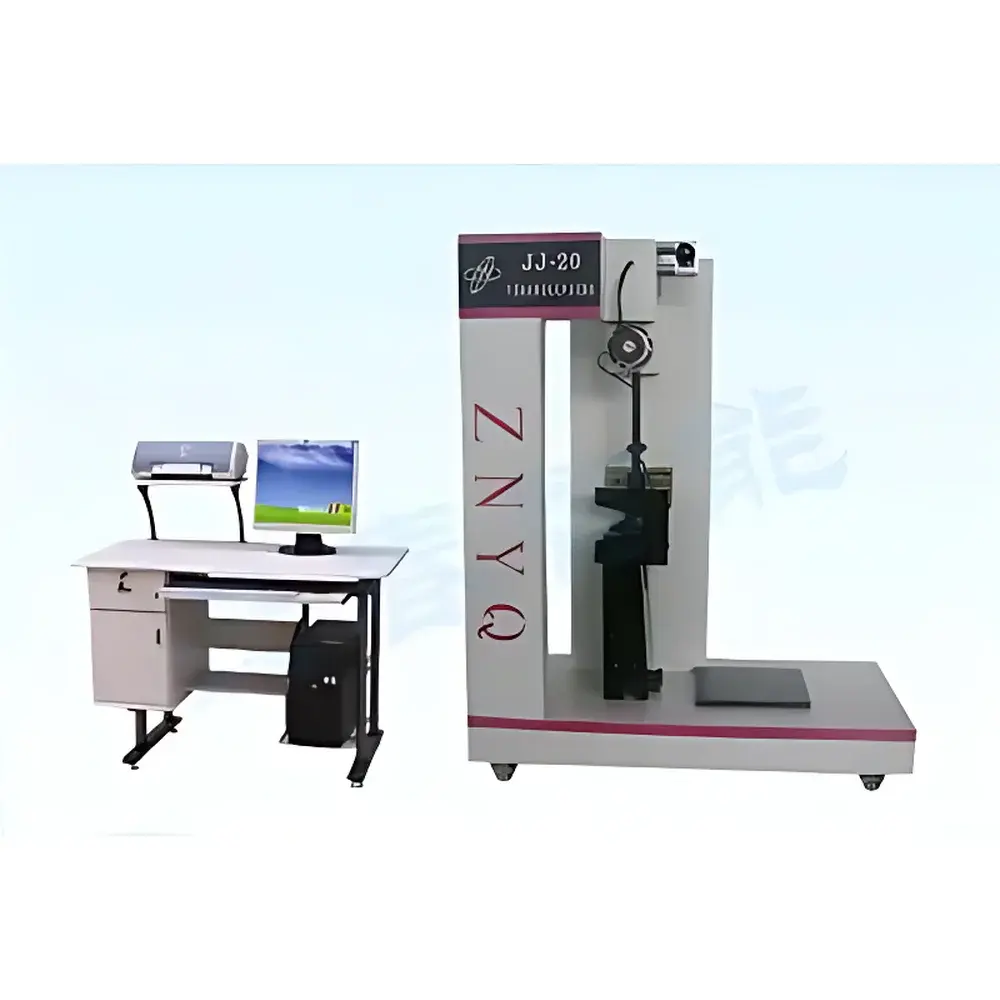
Computer-Controlled Pendulum Impact Tester JJ-20
| Origin | Jilin, China |
|---|---|
| Manufacturer Type | Authorized Distributor |
| Origin Category | Domestic (PRC) |
| Model | JJ-20 |
| Pricing | Available Upon Request |
| Max Impact Energy | 4 J (Simply Supported Beam), 5.5 J (Cantilever Beam) |
| Sampling Rate | 1.2 µs |
| A/D Resolution | 1/65536 |
| Load Range Selection | ×1, ×2, ×4, ×8 |
| Load Measurement Accuracy | ≤1% FS |
| Simply Supported Beam Span Options | 40, 60, 62, 70, 95 mm |
| Standard Specimen Dimensions (Simply Supported) | 4×6×50 mm, 4×10×80 mm, 10×15×120 mm, 13×13×120 mm |
| Cantilever Beam Specimen Dimensions | 4×10×80 mm, (3.2–12.7)×12.7×63.5 mm |
| Pendulum Impact Velocity | 2.9 m/s (0.5–4 J range), 3.50 m/s (Cantilever mode) |
| Compliance | GB/T 1043–1993, GB/T 1843–1996 |
Overview
The JJ-20 Computer-Controlled Pendulum Impact Tester is a high-fidelity dynamic mechanical testing system engineered for precise quantification of impact resistance in polymeric, composite, and metallic materials under standardized beam configurations. It operates on the fundamental principle of conservation of mechanical energy in a calibrated pendulum system, where potential energy is converted into kinetic energy prior to specimen fracture. Unlike conventional analog impact testers, the JJ-20 integrates dual-sensor acquisition—simultaneous high-speed force measurement via piezoelectric load cell and angular displacement tracking via optical encoder—to capture full-time-domain response during the <10 ms impact event. This enables reconstruction of both force–time (F–t) and energy–time (J–t) curves with sub-microsecond temporal resolution (1.2 µs sampling interval) and 16-bit digital fidelity (1/65536 resolution), supporting rigorous analysis of initiation toughness, propagation behavior, and post-yield energy dissipation mechanisms.
Key Features
- Modular beam configuration: Interchangeable anvil assemblies enable rapid reconfiguration between simply supported beam (SSB) and cantilever beam (CB) test modes per ISO 179-1 and ISO 180 standards.
- Dual-channel synchronized data acquisition: Simultaneous recording of dynamic load (≤1% full-scale accuracy) and angular displacement ensures traceable energy balance validation and eliminates reliance on theoretical velocity assumptions.
- Multi-range load amplification: Four selectable gain settings (×1, ×2, ×4, ×8) optimize signal-to-noise ratio across low-energy polymer tests (e.g., 0.5 J) and higher-energy metallic validations (up to 5.5 J).
- Calibration-traceable architecture: Factory-certified alignment, pendulum moment-of-inertia verification, and NIM (National Institute of Metrology, PRC)-issued calibration certificate ensure compliance with JJG 145–2019 (Verification Regulation for Pendulum Impact Testing Machines).
- Real-time curve visualization: On-screen display of F–t, J–t, and derived parameters (e.g., maximum force, absorbed energy, ductile/brittle transition indicators) during test execution.
Sample Compatibility & Compliance
The JJ-20 accommodates standardized specimen geometries defined in major national and international specifications. For simply supported beam testing, it supports spans of 40 mm, 60 mm, 62 mm, 70 mm, and 95 mm, compatible with specimens up to 13×13×120 mm. Cantilever mode accepts standard 4×10×80 mm bars and ASTM D256-compliant widths (3.2–12.7 mm × 12.7 mm × 63.5 mm). The system fully satisfies GB/T 1043–1993 (equivalent to ISO 179-1:2010) for rigid plastics and GB/T 1843–1996 (equivalent to ISO 180:2019) for notched/unnotched cantilever impact testing. All mechanical components—including pendulum shaft, knife edge radius, and anvil radius—conform to dimensional tolerances specified in ISO 13802:2015 (Reference materials for impact machines).
Software & Data Management
The embedded Windows-based control software provides full GLP-compliant operation: user-level access control, electronic signature support, audit trail logging (per FDA 21 CFR Part 11 requirements), and automatic metadata tagging (operator ID, timestamp, calibration status, environmental conditions). Raw binary data (.bin) and processed ASCII exports (.csv) retain full 16-bit resolution. Report generation includes customizable templates aligned with internal QA documentation, ISO/IEC 17025 test records, and submission-ready formats for regulatory filings. Data archives are encrypted and time-stamped; version-controlled firmware updates ensure long-term interoperability and cybersecurity baseline adherence.
Applications
The JJ-20 is routinely deployed in automotive R&D laboratories for qualification of impact-modified thermoplastics used in bumper systems, interior trim, and structural housings—particularly where correlation between lab-scale Charpy-like response and real-world crash performance is required. It serves as a primary tool for formulation screening of polypropylene/EPDM blends, PC/ABS alloys, and glass-fiber-reinforced nylons. In academic and national research institutes—including the Changchun Institute of Applied Chemistry and Institute of Metal Research, CAS—the system supports fundamental studies on temperature-dependent brittle–ductile transitions, notch sensitivity in biodegradable polymers, and aging-induced embrittlement in engineering resins. Its metrological traceability also supports supplier qualification audits under IATF 16949 clause 8.4.2.2.
FAQ
Does the JJ-20 comply with ASTM D256 or ISO 180 for cantilever impact testing?
Yes—its anvil geometry, specimen clamping mechanism, and pendulum kinematics meet all dimensional and operational requirements of ISO 180:2019 and ASTM D256–22, including notch depth tolerance (±0.025 mm) and support span verification.
Can raw sensor data be exported for third-party analysis?
Yes—full-resolution .bin files (16-bit, time-synchronized dual-channel) and ASCII-formatted .csv exports are available without proprietary codec restrictions.
Is calibration verification performed before shipment?
Each unit ships with a NIM-issued calibration certificate covering pendulum energy, load cell linearity, and encoder angular accuracy, valid for 12 months under normal operating conditions.
What environmental conditions are recommended for optimal accuracy?
Operation within 23 ± 2 °C and 50 ± 10 % RH is recommended; temperature-controlled labs should maintain thermal stability <0.5 °C/hour to minimize pendulum material expansion effects.
How is traceability maintained across software updates and operator changes?
All actions—including test execution, parameter modification, and report generation—are logged with immutable timestamps, user IDs, and cryptographic hash signatures in accordance with ISO/IEC 17025:2017 clause 7.11.2.



