
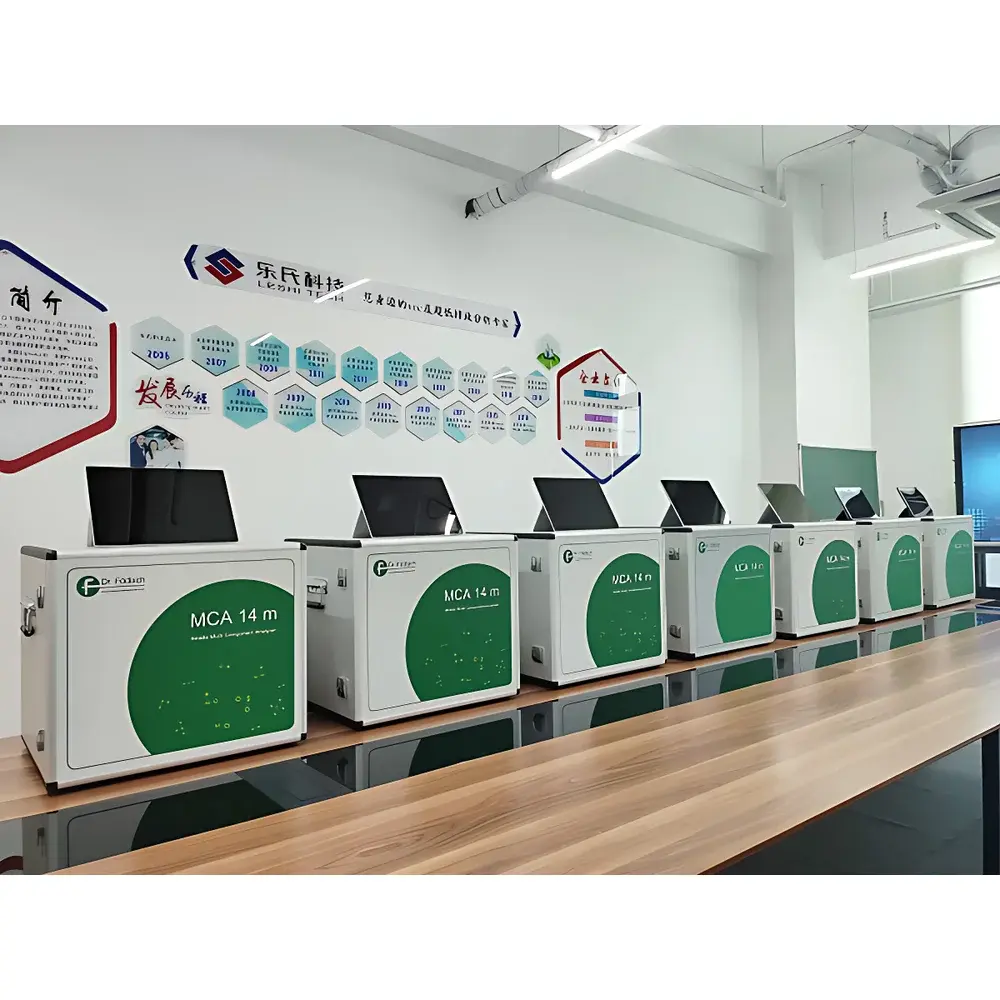
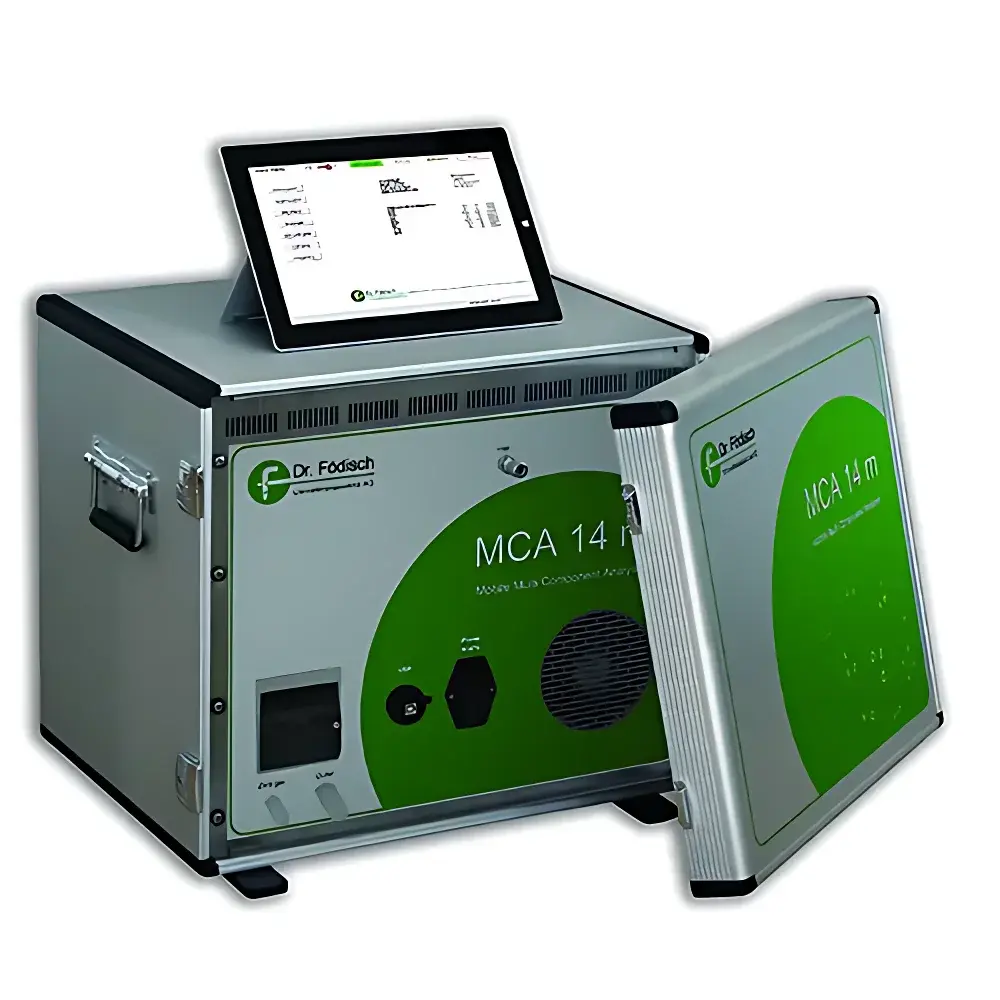
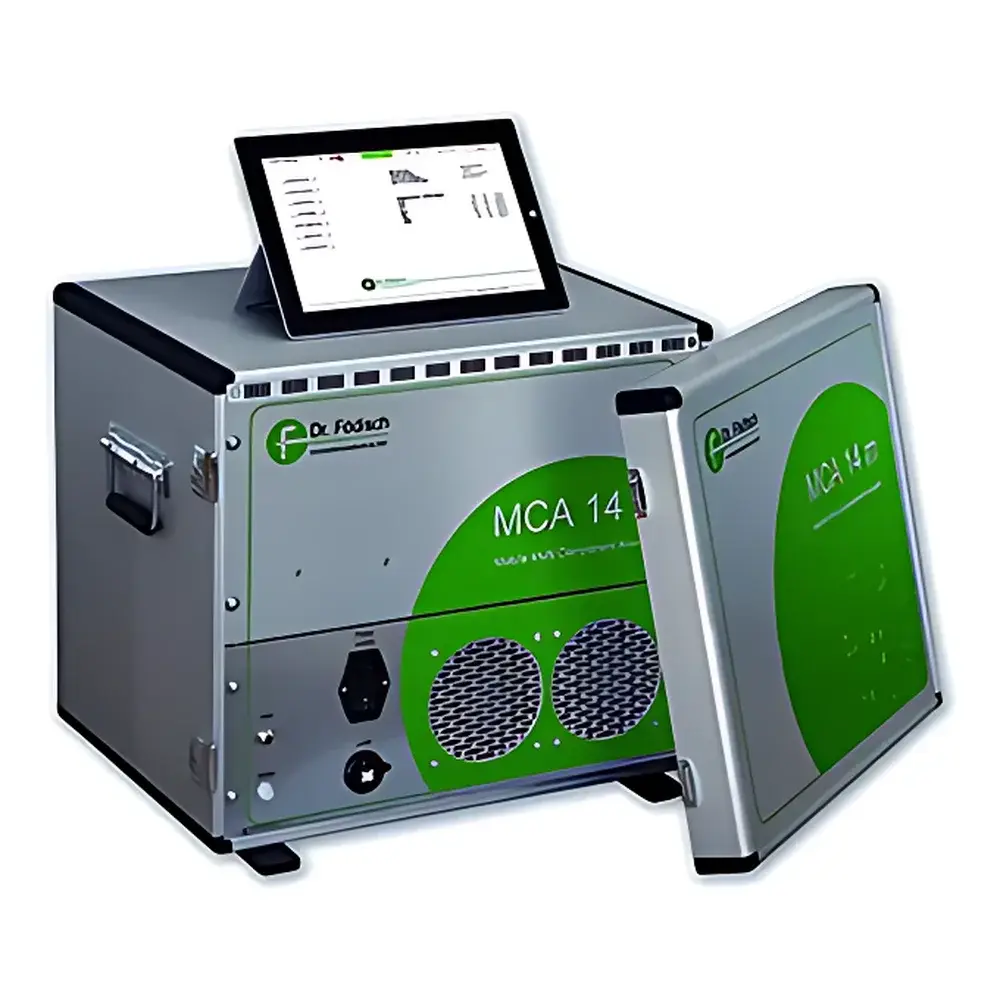
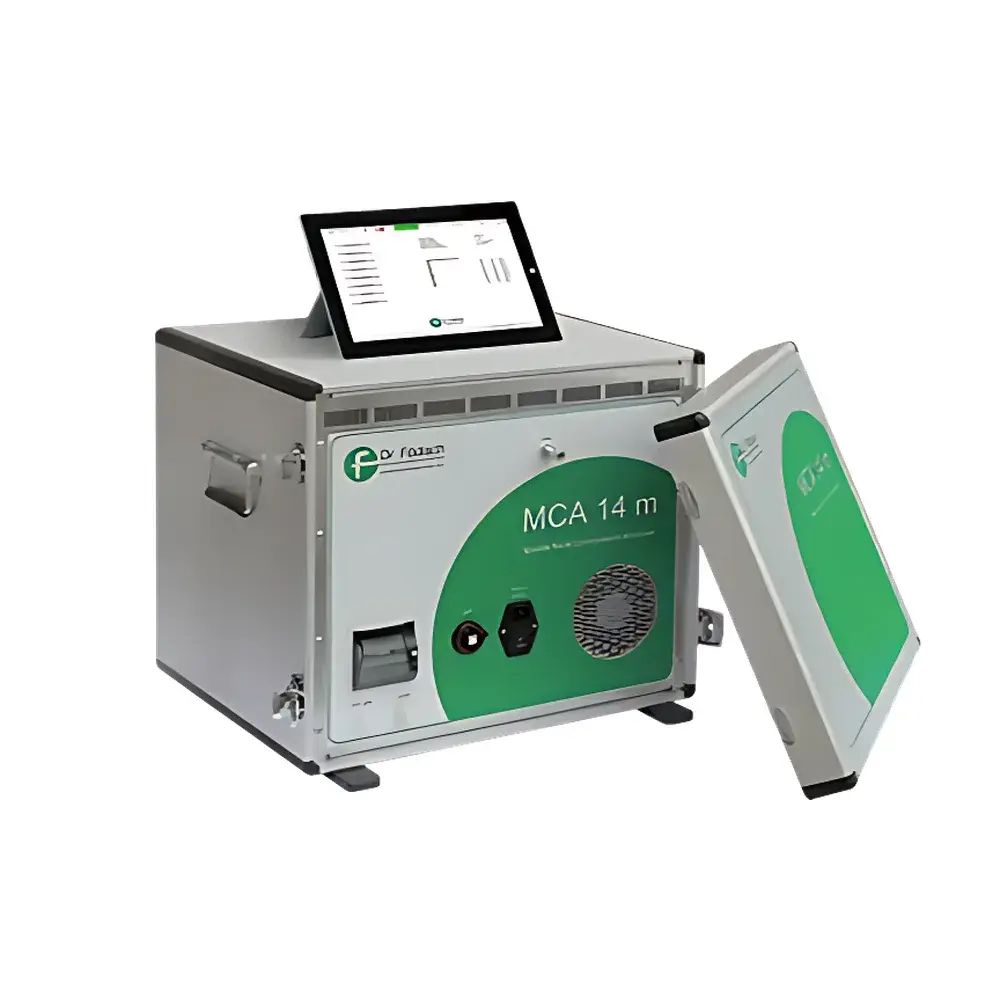
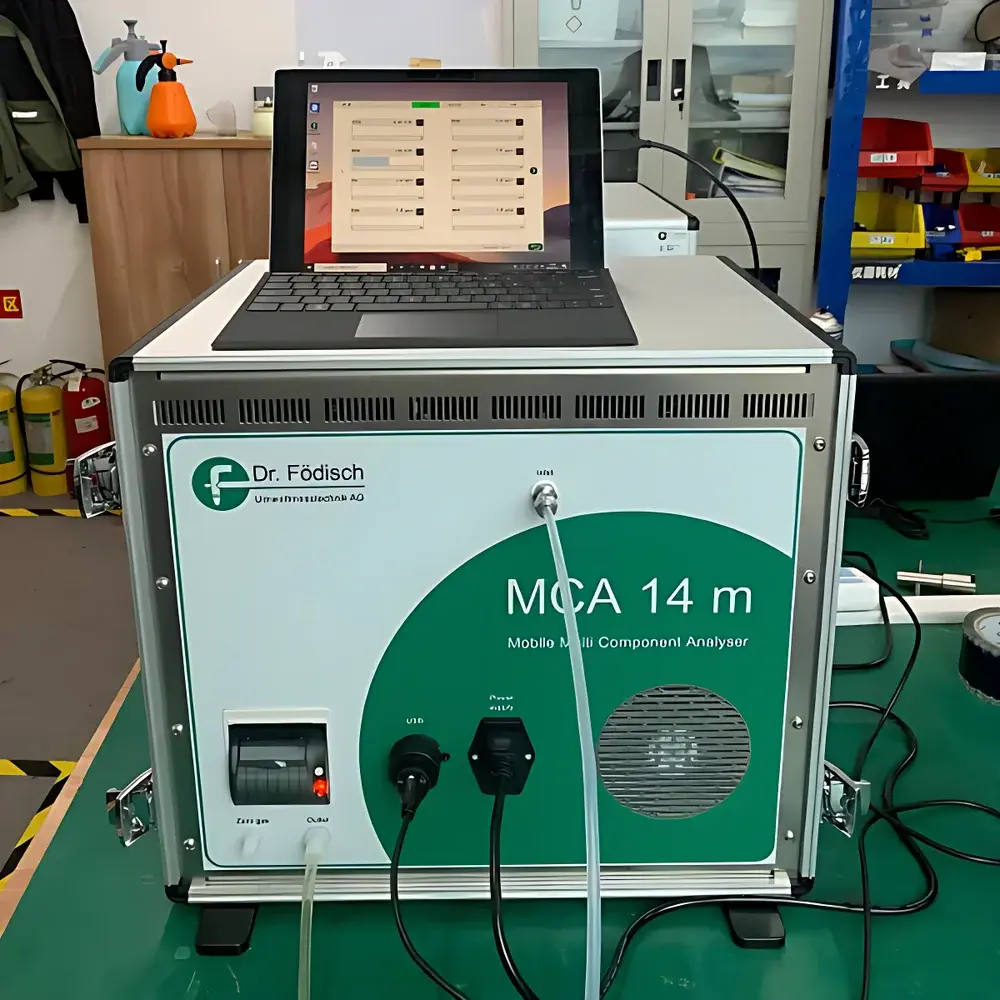
Foedisch MCA14m High-Temperature Infrared Multi-Component Flue Gas Analyzer
| Brand | Foedisch |
|---|---|
| Origin | Germany |
| Model | MCA14m |
| Measurement Principle | Non-Dispersive Infrared (NDIR) with High-Temperature Optical Path |
| Operating Temperature | 185 °C (entire gas path heated) |
| Accuracy | ≤1% FS |
| Repeatability | ±2% FS |
| Response Time (T90) | <10 s |
| Zero Calibration | Automatic, using ambient air |
| Gas Components | O₂, CO₂, H₂O, SO₂, NO, NO₂, N₂O, NH₃, HCl, CO, CH₄ |
| Sampling Method | Extractive, hot-wet |
| Power Supply | 230 V AC, 50/60 Hz |
| Enclosure Rating | IP65 |
| Compliance | EN 15267-3, EN 14181, MCERTS, ISO 14001-compatible operation |
| Data Output | RS485, Ethernet, 4–20 mA analog outputs |
| Software | PC-based configuration & data logging (free OEM software with audit trail) |
Overview
The Foedisch MCA14m is a high-temperature, extractive, multi-component flue gas analyzer engineered for continuous emission monitoring (CEM) and process control in demanding industrial environments. Unlike conventional cooled or dilution-based systems, the MCA14m maintains its entire optical measurement path—including sample cell, detector, and reference chamber—at a constant 185 °C. This eliminates condensation, prevents acid gas adsorption on surfaces, and ensures stable, interference-free quantification of corrosive and condensable species such as SO₂, HCl, NH₃, and H₂O vapor—without requiring chilled mirrors, permeation dryers, or zero-air generators. The instrument employs dual-beam non-dispersive infrared (NDIR) spectroscopy with thermoelectrically cooled detectors and narrow-band optical filters, enabling simultaneous, real-time quantification of up to 11 gas components—including O₂ (via paramagnetic sensor)—within a single compact chassis. Its design complies with EU Directive 2010/75/EU (IED), EN 15267-3 (QAL1 certification framework), and supports compliance with EPA Method 320 and ISO 12039 for stationary source emissions.
Key Features
- Full-path high-temperature operation at 185 °C—no gas conditioning required beyond particulate filtration
- Simultaneous measurement of 11 gas species: O₂, CO₂, H₂O, SO₂, NO, NO₂, N₂O, NH₃, HCl, CO, CH₄
- Automatic zero calibration using ambient air—no external zero-gas supply or compressor needed
- Integrated hot sampling pump with ceramic diaphragm, rated for >10,000 hours MTBF
- Dual-range auto-switching for each IR channel (e.g., 0–100 ppm / 0–1000 ppm for NO), ensuring optimal signal-to-noise across dynamic concentration profiles
- IP65-rated enclosure with integrated display and tactile interface for local operation and diagnostics
- Real-time internal stoichiometric compensation for cross-interference (e.g., NO₂ correction in NO channel, H₂O spectral subtraction)
- Onboard data logger (≥32 GB) with time-stamped, CRC-protected records compliant with EN 14181 Level 2 requirements
Sample Compatibility & Compliance
The MCA14m is validated for hot-wet analysis of flue gases from coal-, oil-, biomass-, and waste-fired boilers; cement kilns; petrochemical crackers; and municipal solid waste incinerators. It meets MCERTS Performance Standards for SO₂, NOₓ, CO, and NH₃ under high-humidity (>30% v/v), low-sulfur (<10 mg/m³), and ultra-low-emission (ULE) conditions. All gas-specific calibrations are traceable to NIST-certified standard mixtures and verified per ISO 6145-7 (dynamic blending) and ISO 17025-accredited procedures. The system supports full GLP/GMP audit trails—including user login history, calibration logs, alarm events, and firmware version stamps—and satisfies FDA 21 CFR Part 11 requirements when operated with optional electronic signature modules.
Software & Data Management
The included Foedisch AnalyzeSuite™ software provides commissioning, remote configuration, trend visualization, and report generation (PDF/CSV). It implements secure role-based access control (operator, engineer, administrator), configurable alarm thresholds with email/SMS notification via SMTP, and automated daily zero/span verification scheduling. Data export conforms to PI System, OPC UA (IEC 62541), and Modbus TCP protocols for integration into DCS/SCADA platforms. Raw spectral data (interferograms) and processed concentration time-series are stored with embedded metadata (temperature, pressure, flow rate, filter status), enabling retrospective reprocessing and uncertainty budgeting per GUM (JCGM 100:2008).
Applications
- Continuous Emission Monitoring Systems (CEMS) for power plants complying with IED Annex V and national BAT conclusions
- Ammonia slip monitoring in SCR/SNCR de-NOₓ systems—critical for catalyst efficiency and downstream corrosion mitigation
- In-process optimization of lime injection, activated carbon dosing, and wet FGD scrubber pH control
- Research-grade quantification of N₂O and CH₄ in waste-to-energy combustion studies per IPCC Tier 3 methodology
- Commissioning and performance validation of regenerative thermal oxidizers (RTOs) and catalytic oxidizers in chemical manufacturing
- Long-term stability assessment of low-NOₓ burners and oxy-fuel combustion trials
FAQ
Does the MCA14m require external zero or span gas cylinders?
No. Zero calibration uses ambient air drawn through an integrated particulate filter; span calibration is performed using certified multi-gas standards via the built-in calibration port.
Can the instrument operate continuously in high-dust environments?
Yes—when paired with Foedisch’s high-temperature ceramic probe (model HT-PROBE-MCA) and cyclonic pre-filter, it achieves >99.5% particulate removal without clogging, validated per EN 13284-1.
Is H₂O measurement reported as wet-basis or dry-basis concentration?
Both. The analyzer computes and logs wet-basis concentrations by default; dry-basis values are derived in real time using measured H₂O partial pressure and total stack pressure input.
How is O₂ measured, and does it interfere with IR channels?
O₂ is measured independently via a sealed paramagnetic sensor (not IR), eliminating optical cross-talk and enabling accurate excess-air calculation without spectral compensation.
What maintenance intervals are recommended for field operation?
Optical alignment verification every 12 months; ceramic filter replacement every 6 months (or per differential pressure alarm); full QAL2 validation every 3 months per EN 14181.
Related Products







