
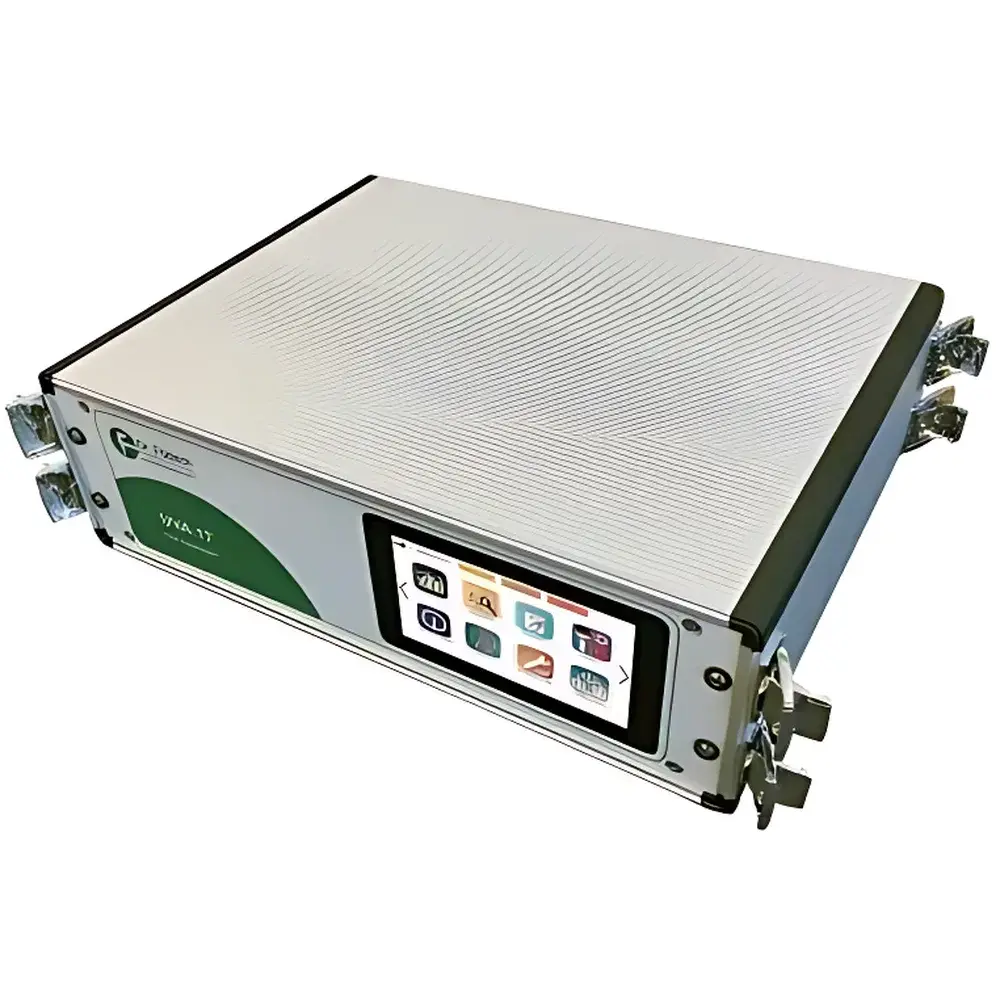
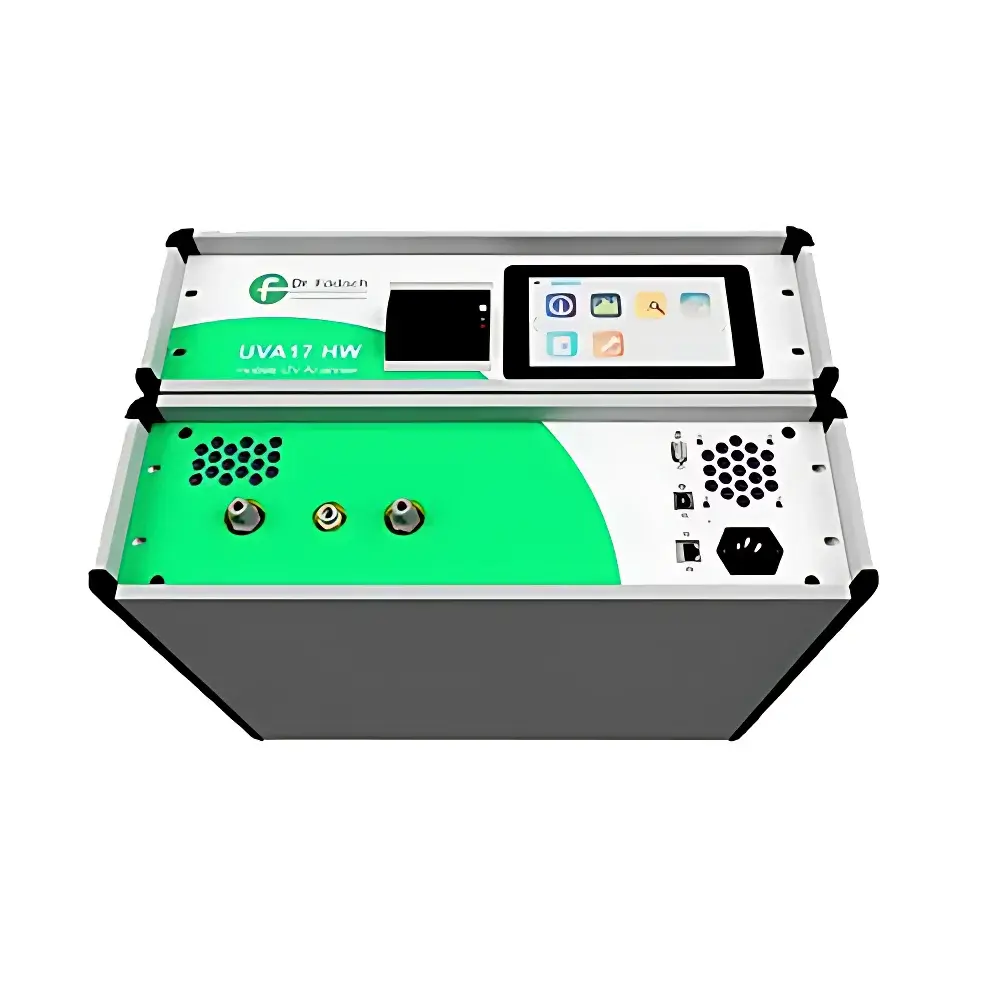
Foedisch UVA17m Portable High-Temperature UV Gas Analyzer
| Brand | Foedisch |
|---|---|
| Origin | Germany |
| Model | UVA17m |
| Type | Portable Multicomponent Gas Analyzer |
| Measurement Principle | High-Temperature Ultraviolet Absorption Spectroscopy |
| Response Time | ≤2 s |
| Measurable Gases | O₂, NOₓ (NO/NO₂), SO₂, NH₃, H₂S |
| Operating Temperature Range | 185–200 °C (full-path heated) |
| Detection Limits | SO₂ down to 0–50 mg/m³ |
| Sample Handling | Hot-wet, in-situ sampling without drying, dilution or cooling |
| Compliance | Designed for EN 15267-3, EN 14181, ISO 12039, and EPA Method 201A-compliant monitoring |
Overview
The Foedisch UVA17m Portable High-Temperature UV Gas Analyzer is an engineered solution for real-time, multi-component flue gas analysis at elevated temperatures. It employs high-temperature ultraviolet absorption spectroscopy (UV-DOAS) as its core measurement principle—operating with the entire gas path maintained at 185–200 °C. This hot-wet configuration eliminates condensation, avoids aqueous-phase dissolution of reactive species (e.g., NO₂, SO₂, NH₃, H₂S), and preserves sample integrity from probe tip to detector. Unlike cooled or diluted sampling systems, the UVA17m enables direct, undiluted analysis of raw stack emissions—making it especially suited for post-SCR, post-FGD, and low-emission combustion applications where sub-ppm NH₃ slip, trace NO₂, or low-concentration SO₂ quantification is critical. Its compact, field-deployable architecture meets stringent requirements for regulatory compliance, process optimization, and continuous emission monitoring system (CEMS) validation.
Key Features
- Full-path high-temperature operation: Sample line, filter, cell, and optical components are actively heated to 185–200 °C, ensuring water remains gaseous and reactive gases remain chemically stable.
- Dual-range auto-switching optics: Independent optical paths and detectors support simultaneous high- and low-range measurements (e.g., SO₂: 0–50 mg/m³ and 0–500 mg/m³; NH₃: 0–10 mg/m³ and 0–100 mg/m³), enabling high resolution across wide dynamic concentration spans.
- Industrial-grade embedded platform: Powered by a ruggedized ARM-based processor with real-time OS, the analyzer delivers deterministic response (<2 s T₉₀) and stable baseline performance under thermal and mechanical stress.
- Hot-gas particulate filtration: Integrated ceramic sintered filter (≤2 µm pore size) operates continuously at >190 °C, rejecting ash and fly ash without clogging or thermal degradation.
- Advanced spectral deconvolution algorithm: Proprietary mathematical correction model compensates for spectral overlap (e.g., NO₂–SO₂–NH₃ cross-absorption), water vapor continuum, and lamp drift—enhancing linearity (R² > 0.9999) and long-term reproducibility.
- Dual-mode human interface: 7-inch sunlight-readable capacitive touchscreen with tactile industrial keypad ensures reliable operation in gloves, noise, or vibration-prone environments.
Sample Compatibility & Compliance
The UVA17m is validated for use with hot, humid, dusty, and corrosive flue gases typical of coal-fired boilers, waste incinerators, cement kilns, and catalytic cracking units. It complies with key international standards governing CEMS performance: EN 15267-3 (QAL1 certification readiness), EN 14181 (ASTM D6522 equivalent for QA/QC), ISO 12039 (for SO₂/NOₓ determination), and EPA Method 201A (for filterable particulate-free UV absorption). Its hot-wet methodology satisfies GLP-aligned data integrity requirements—no sample conditioning artifacts, no calibration drift induced by condensate formation, and full traceability of raw absorbance spectra. The instrument supports audit-ready data logging compliant with 21 CFR Part 11 when paired with optional secure firmware modules.
Software & Data Management
Embedded firmware provides local data acquisition, real-time trend visualization, alarm management (threshold-based and rate-of-change), and automatic zero/span verification scheduling. All raw spectra, processed concentrations, diagnostic flags (e.g., lamp intensity, cell temperature deviation, flow stability), and user actions are timestamped and stored on internal eMMC (≥16 GB) with configurable retention policies. Export formats include CSV, XML, and MODBUS TCP for integration into SCADA, DCS, or cloud-based environmental data management platforms. Optional IoT module enables TLS-encrypted MQTT/HTTPS transmission to central servers, supporting remote diagnostics, over-the-air firmware updates, and synchronized calibration log synchronization across fleet deployments.
Applications
- Ammonia slip monitoring downstream of selective catalytic reduction (SCR) and selective non-catalytic reduction (SNCR) systems
- Low-concentration SO₂ and NO₂ quantification in desulfurized/denitrified flue gas streams
- Real-time combustion efficiency assessment via O₂ + CO + NOₓ co-monitoring
- Regulatory CEMS backup and reference method validation (per EN 14181 QAL2)
- Mobile source emission testing (e.g., marine engine exhaust, locomotive stacks)
- R&D applications requiring speciated nitrogen oxide partitioning (NO vs. NO₂) under thermal equilibrium conditions
FAQ
Does the UVA17m require gas drying or chemical scrubbing prior to analysis?
No. The analyzer operates exclusively in hot-wet mode; all sample handling occurs above dew point, eliminating the need for permeation dryers, Nafion membranes, or chemical scrubbers that may adsorb or react with target analytes.
How does the instrument handle spectral interference between NH₃ and NO₂ in the UV range?
It applies a multi-wavelength, constrained least-squares fitting algorithm trained on high-fidelity reference spectra acquired under representative flue gas matrices—including variable H₂O, CO₂, and particulate loadings—to resolve overlapping absorption features with <±2% cross-sensitivity.
Is the UVA17m certified for legal metrology or regulatory reporting?
While not pre-certified as a standalone QAL1 device, its design conforms to EN 15267-3 structural and functional requirements, and it is routinely deployed as part of QAL1-validated CEMS configurations by authorized system integrators.
What maintenance intervals are recommended for field operation?
Optical window cleaning every 30 days (depending on dust loading); lamp replacement every 12 months; full QAL2 verification annually or after major component service.
Can the UVA17m be integrated into existing plant DCS networks?
Yes—via native MODBUS RTU/TCP, Profibus DP (with optional gateway), or analog 4–20 mA outputs (configurable per channel), with configurable engineering units and alarm relay contacts.







