
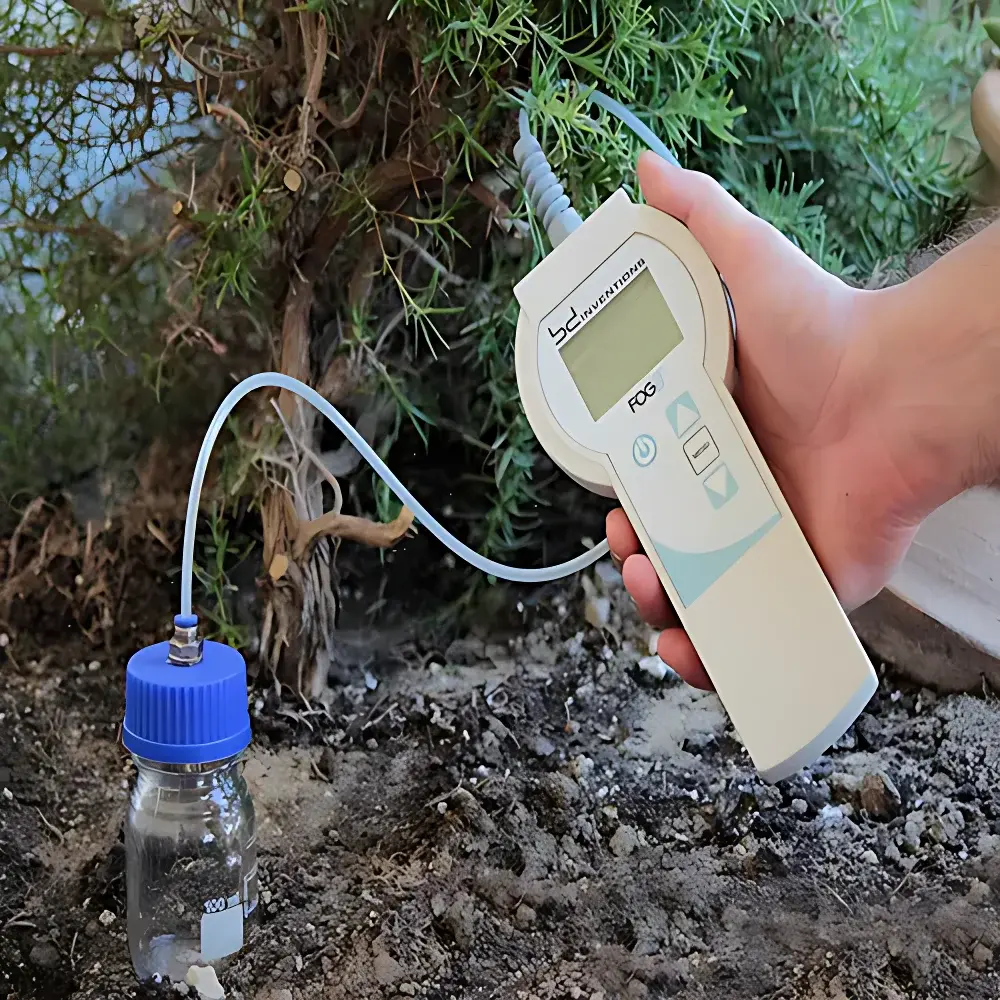
FOGII Portable Soil Calcium Carbonate Analyzer
| Origin | Greece |
|---|---|
| Manufacturer Type | Distributor |
| Origin Category | Imported |
| Model | FOGII |
| Price Range | USD 2,700–6,800 (est.) |
| Instrument Type | Fertilizer/Nutrient Analyzer |
| User Interface | Membrane keypad & backlit LCD |
| Power Supply | 3 × AA alkaline batteries |
| Measurement Unit | % CaCO₃ |
| Accuracy | ±0.5% CaCO₃ |
| Resolution | 0.1% CaCO₃ |
| Linearity (R²) | 0.999 |
| Temperature Compensation | Integrated sensor (5–50 °C) |
| Moisture Compensation | Built-in soil moisture sensor |
Overview
The FOGII Portable Soil Calcium Carbonate Analyzer is a field-deployable, reaction-based analytical instrument engineered for rapid, in-situ quantification of total carbonate content—expressed as calcium carbonate equivalent (% CaCO₃)—in soil matrices. It operates on the principle of acid-carbonate reaction kinetics: a precisely metered volume of hydrochloric acid (HCl) is introduced into a sealed reaction chamber containing a representative soil sample; the stoichiometric release of carbon dioxide (CO₂) gas is measured via high-stability pressure transduction. The resulting pressure differential is linearly correlated to the molar quantity of carbonate species (primarily CaCO₃ and MgCO₃), enabling direct calculation of % CaCO₃ with traceable calibration against NIST-traceable carbonate standards. Unlike titrimetric or gravimetric lab methods, the FOGII eliminates solvent handling, extended digestion times, and laboratory infrastructure dependency—making it suitable for real-time decision support in precision agriculture, land reclamation projects, and pedological field surveys.
Key Features
- True in-situ measurement capability: No sample drying, sieving, or transport required—enables immediate assessment at multiple field locations within a single workday.
- Integrated dual-parameter compensation: Simultaneous real-time correction for both soil moisture content (via capacitive moisture sensor) and ambient temperature (via embedded thermistor), minimizing matrix-induced bias across variable field conditions.
- Robust electro-mechanical architecture: Sealed reaction chamber with corrosion-resistant PTFE-coated components; optimized gas-tight sealing mechanism ensures reproducible CO₂ capture and pressure response.
- Field-optimized human interface: Backlit LCD display with intuitive membrane keypad navigation; menu-driven calibration, zeroing, and data logging functions accessible without external software.
- Low-power operational design: Powered by three standard AA alkaline batteries, supporting ≥200 consecutive measurements per set under typical field use (25 °C, 15% moisture).
- Traceable metrology: Factory-calibrated using certified reference materials (CRM) with documented uncertainty budgets compliant with ISO/IEC 17025 requirements for field instruments.
Sample Compatibility & Compliance
The FOGII accommodates air-dry or field-moist soil samples with particle sizes ≤2 mm (no grinding required). It demonstrates consistent performance across textural classes—from sandy loams to heavy clays—and is validated for soils with pH 4.5–8.5 and organic matter content up to 15% (w/w). Methodologically, the instrument aligns with ASTM D4373–22 “Standard Test Method for Carbonate Content of Soils” and supports compliance with ISO 10390:2021 (soil pH and carbonate determination) and EU Soil Thematic Strategy reporting frameworks. While not a GLP-certified lab instrument, its audit-ready calibration logs, timestamped measurement records, and user-accessible firmware versioning enable alignment with FAO-recommended soil health monitoring protocols and national soil survey QA/QC workflows.
Software & Data Management
Data output is stored internally in non-volatile memory (up to 500 measurement records), each tagged with date/time stamp, temperature, moisture reading, and calculated % CaCO₃. Export is supported via optional USB-C adapter (sold separately), enabling CSV-formatted transfer to desktop applications for geospatial mapping (e.g., QGIS, ArcGIS) or statistical analysis (R, Python pandas). Firmware updates are distributed via secure HTTPS portal; all measurement sessions retain immutable metadata—including operator ID, calibration status, and environmental parameters—to satisfy basic 21 CFR Part 11 electronic record integrity expectations for field-collected environmental data.
Applications
- Liming requirement assessment: Quantifying residual carbonate prior to lime application in acidic soils (pH < 5.5), supporting cost-effective amendment dosing and avoiding over-liming.
- Carbon stock estimation: Supporting Tier 1–2 soil inorganic carbon (SIC) inventories for IPCC AR6 land-use change reporting and blue carbon project baselines.
- Soil genesis studies: Mapping calcic horizon development, dust deposition history, and paleoclimatic indicators in arid and semi-arid regions.
- Land degradation monitoring: Tracking carbonate leaching in irrigated systems or carbonate accumulation in saline-sodic soils under long-term management.
- Educational field pedology: Enabling undergraduate and graduate students to conduct hands-on carbonate profiling across landscape gradients with immediate feedback.
FAQ
Does the FOGII measure only calcium carbonate, or does it report total carbonates?
The FOGII reports total acid-reactive carbonate content expressed as % CaCO₃ equivalent—accounting for contributions from CaCO₃, MgCO₃, and other soluble carbonates present in the sample.
Is sample homogenization required before measurement?
Yes—field-moist or air-dry subsamples should be gently broken apart to ensure uniform particle distribution; no milling or sieving is necessary unless coarse gravel (>2 mm) is present.
How often must the instrument be recalibrated?
Factory calibration remains stable for ≥12 months under normal use; annual verification using CRM S-101 (certified 12.7% CaCO₃) is recommended per ISO/IEC 17025 Clause 7.7.2.
Can the FOGII be used in flooded or waterlogged soils?
No—excess free water interferes with acid dispersion and CO₂ capture; samples must be drained to field capacity (typically 1–3 days post-rainfall) prior to analysis.
What maintenance is required between measurements?
Chamber cleaning with distilled water and lint-free wipe after every 10–15 measurements; periodic inspection of O-ring integrity and acid reservoir level (replace HCl solution every 6 months if unused).







