
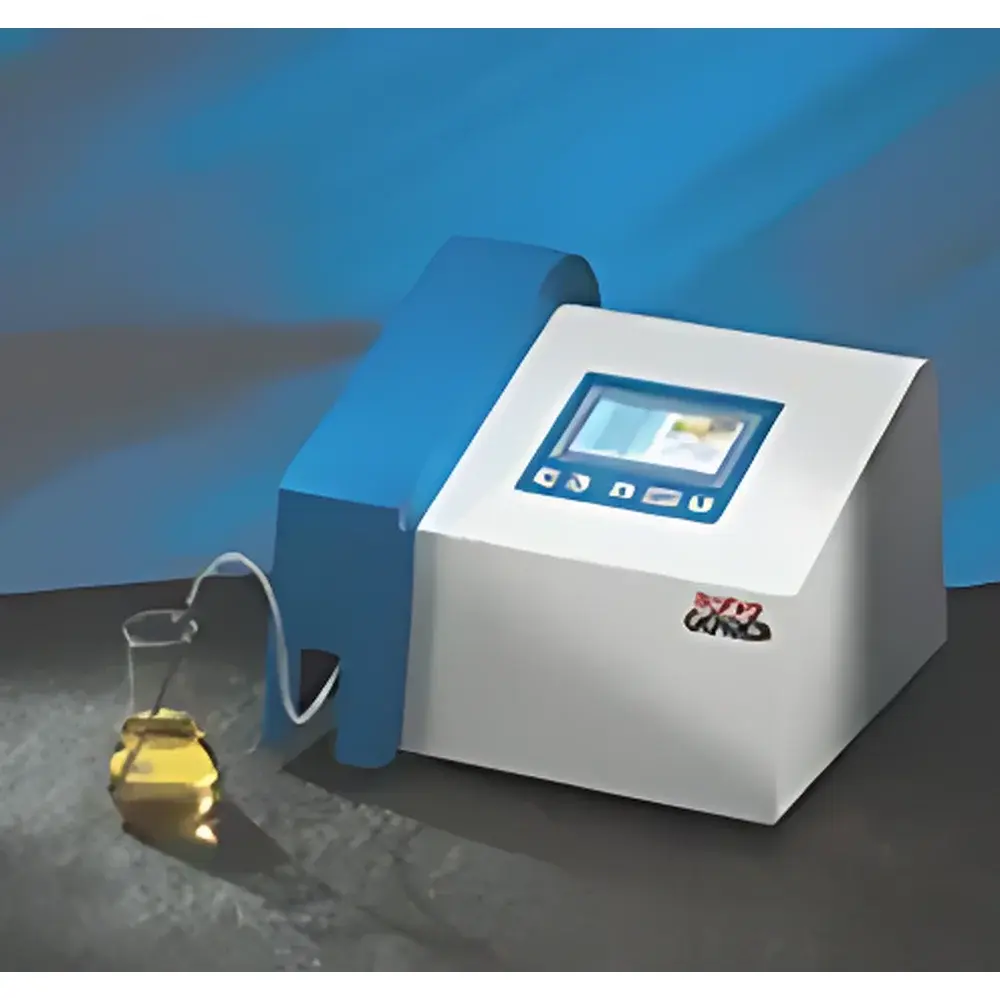
Gerber FermentoFlash BEER ANALYZER
| Brand | Funke Gerber |
|---|---|
| Origin | Germany |
| Model | FermentoFlash BEER ANALYZER |
| Instrument Type | Dedicated Beer Analyzer |
| Alcohol Range | 0–15 % v/v |
| Original Wort Extract (OE) | 0–20 % w/w |
| Real Extract (RE) | 0–10 % w/w |
| Apparent Extract (AE) | 0–10 % w/w |
| Density | 0.95–1.05 g/cm³ |
| Measurement Time | ~120 s (including sample introduction) |
| Sample Volume | 12–20 mL (degassed beer) |
| Calibration | Reference beer-based, supports up to 20 stored reference profiles |
| Interface | RS232 serial port, integrated display, optional printer output |
Overview
The Gerber FermentoFlash BEER ANALYZER is a fully automated, benchtop analytical system engineered for rapid, standardized quantification of key physicochemical parameters in finished beer and wort samples. Based on the principle of oscillating U-tube densimetry coupled with temperature-controlled refractometric correlation, the instrument simultaneously determines alcohol by volume (ABV), original wort extract (OE), real extract (RE), apparent extract (AE), and density — all within approximately two minutes per analysis. This methodology complies with internationally recognized brewing standards including ASBC Methods of Analysis (Beer-1, Beer-2), EBC Analytica (Chapter 9), and ISO 15528:2018 (Cereals and cereal products — Sampling). The system is designed for routine use in brewery quality control laboratories, contract testing facilities, and R&D departments where high throughput, method reproducibility, and regulatory traceability are critical.
Key Features
- Integrated dual-sensor architecture: High-precision oscillating U-tube densimeter (certified to ASTM D4052 accuracy class) combined with a Peltier-stabilized inline refractometer for robust multi-parameter derivation.
- Automated sample handling: Single-step injection of degassed beer (12–20 mL); no manual dilution or reagent addition required.
- Reference-based calibration workflow: Supports storage and recall of up to 20 unique reference beer profiles (e.g., Pilsner, Weizen, Stout, Bock), enabling matrix-matched calibration without external standard solutions.
- Real-time thermal equilibration: Built-in temperature control maintains measurement cell at 20.0 ± 0.1 °C, eliminating manual water-bath dependency and ensuring compliance with EBC/ASBC reference conditions.
- Comprehensive data integrity: All measurements include timestamp, operator ID (optional login), ambient temperature/humidity logging, and raw sensor output — fully auditable for GLP/GMP environments.
- Modular connectivity: RS232 interface enables direct integration with LIMS, ERP, or brewery process control systems; optional Ethernet upgrade available for TCP/IP communication.
Sample Compatibility & Compliance
The FermentoFlash BEER ANALYZER is validated for use with filtered, centrifuged, or membrane-degassed beer samples across the full spectrum of modern brewing styles — including lagers, ales, sour beers, non-alcoholic variants, and hopped worts. It accommodates carbonation levels ≤ 0.5 vol CO₂ post-degassing. The instrument meets mechanical and electrical safety requirements per IEC 61010-1:2010 and carries CE marking under the EU Machinery Directive 2006/42/EC. Its measurement algorithms are aligned with the statistical validation criteria defined in ISO/IEC 17025:2017 (clause 7.2.2) for calibrated instruments used in accredited testing laboratories.
Software & Data Management
The embedded firmware provides intuitive touchscreen navigation with multilingual UI (English, German, Spanish, French). All results are stored locally with automatic backup to USB drive. Audit trail functionality records every calibration event, parameter change, and user action — satisfying FDA 21 CFR Part 11 requirements when paired with optional electronic signature module. Export formats include CSV, PDF report templates (customizable per brewery SOP), and XML for structured data exchange. Remote diagnostics and firmware updates are supported via secure HTTPS connection to Gerber’s authorized service portal.
Applications
- Final product release testing: Verification of ABV and OE against label claims and national alcohol taxation thresholds.
- Fermentation monitoring: Tracking real extract decline and alcohol accumulation during active fermentation (using representative wort/beer blends).
- Quality consistency control: Batch-to-batch comparison of density-derived attenuation indices (e.g., apparent attenuation %, real attenuation %).
- Raw material screening: Rapid assessment of adjunct substitution impact on original extract yield.
- Contract laboratory reporting: Generation of compliant certificates of analysis (CoA) meeting ISO/IEC 17025 documentation requirements.
- Regulatory submission support: Data packages formatted for submissions to TTB (USA), HMRC (UK), or Zollamt (Germany) for excise duty classification.
FAQ
What sample preparation is required prior to analysis?
Beer must be degassed using vacuum filtration, centrifugation, or gentle agitation followed by standing — residual CO₂ must be < 0.5 vol to prevent bubble interference in the oscillating tube sensor.
Can the instrument analyze non-alcoholic beer or low-ABV products?
Yes; the system maintains full accuracy down to 0.05 % ABV and is routinely used for verifying <0.5 % ABV claims in dealcoholized products.
Is third-party certification available for metrological traceability?
Each unit ships with a factory calibration certificate traceable to PTB (Physikalisch-Technische Bundesanstalt) reference standards; UKAS-accredited calibration services are available through authorized Gerber service partners.
How frequently must the instrument be recalibrated?
Calibration verification using a certified reference beer is recommended before each analytical session; full recalibration is required after maintenance, sensor replacement, or if drift exceeds ±0.02 % ABV over 24 hours.
Does the system support integration with brewery SCADA or MES platforms?
Yes; the RS232 interface supports Modbus RTU protocol, and optional OPC UA gateway modules enable seamless integration with Siemens Desigo, Rockwell FactoryTalk, or SAP ME systems.




