
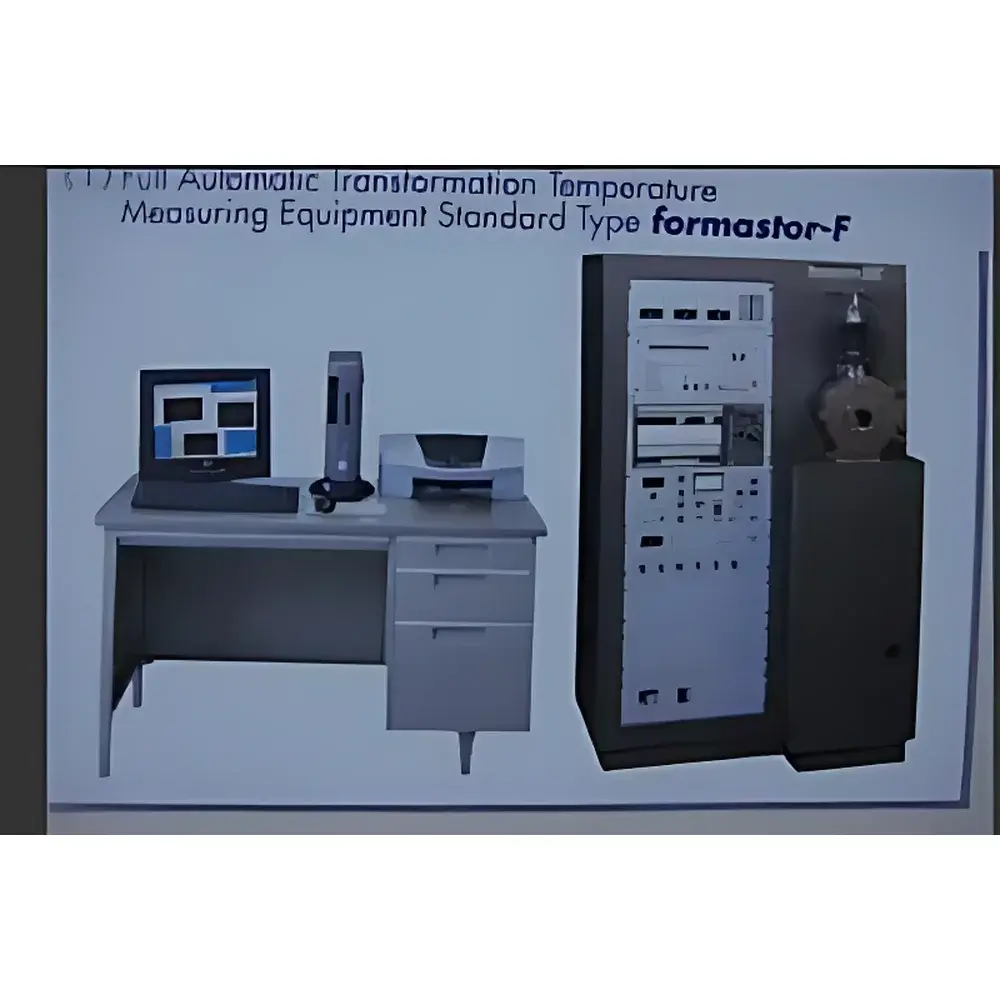
Formastor-F Automatic Phase Transformation Dilatometer
| Origin | Japan |
|---|---|
| Manufacturer Type | Authorized Distributor |
| Origin Category | Imported Instrument |
| Model | Formastor-F |
| Price | USD 280,000 (FOB Japan) |
Overview
The Formastor-F Automatic Phase Transformation Dilatometer is a high-precision, vacuum-compatible thermal expansion analyzer engineered for quantitative characterization of solid-state phase transformations in metallic alloys, steels, and advanced functional materials. First introduced in 1963 and recognized as one of Japan’s Ten Outstanding Inventions of the Year, this instrument employs differential dilatometry—measuring dimensional changes (ΔL/L₀) with sub-micrometer resolution—as a direct probe of lattice reorganization during heating, continuous cooling, or isothermal holding. Its core measurement principle relies on a dual-sensor differential displacement transducer system that eliminates thermal drift artifacts by referencing against a thermally stable inert rod. Designed for metallurgical R&D laboratories, heat treatment process development, and materials qualification under ISO/ASTM standards, the Formastor-F delivers traceable, reproducible data essential for constructing time–temperature–transformation (TTT) and continuous-cooling-transformation (CCT) diagrams—critical inputs for predictive modeling of microstructure evolution and mechanical property optimization.
Key Features
- Vacuum-compatible chamber with ultimate pressure <1×10⁻³ Pa, achieved via integrated two-stage pumping: rotary vane mechanical pump (162 L/min @ 50 Hz) and oil diffusion pump (360 L/s, 3-inch diameter)
- High-frequency induction heating system enabling rapid, uniform heating up to 1400 °C with programmable ramp rates: up to 140 °C/s (non-linear), 100 °C/s (linear control)
- Multi-gas quenching capability (N₂, Ar, He) with digitally regulated mass flow controllers; maximum linear cooling rate of 50 °C/s (He, 900–300 °C); peak transient cooling >250 °C/s
- Differential phase transformation detection system with four selectable full-scale ranges: ±0.5, ±0.2, ±0.1, ±0.05 mm, each calibrated to ±1.0% FS accuracy
- Thermocouple-based temperature control using Type R (Pt–13%Rh / Pt) sensors; static temperature stability ±1 °C over RT–1350 °C range
- Robust mechanical design optimized for long-term operational reliability—field-proven in industrial and academic labs worldwide for over five decades
Sample Compatibility & Compliance
The Formastor-F accepts standard cylindrical specimens (φ3 × 10 mm), compatible with ASTM E228, ISO 11359-1, and JIS Z 2247 dilatometric test protocols. Its vacuum and inert-gas environments ensure oxidation-free testing critical for reactive alloys (e.g., Ti-, Al-, and Ni-based systems). All thermal cycles—including interrupted quenches, step-cooling, and isothermal holds—are fully programmable and repeatable per GLP/GMP-aligned workflows. The system supports audit-ready data capture compliant with FDA 21 CFR Part 11 requirements when paired with validated software modules (electronic signatures, change logs, user access controls).
Software & Data Management
The native control and analysis suite enables full automation: users define custom thermal profiles (heating/cooling rates, hold times, gas switching points) via intuitive parameter entry or script-based sequencing. Real-time acquisition delivers synchronized displacement vs. temperature/time datasets. Post-test processing automatically generates standardized TTT and CCT diagrams with user-definable transformation onset/offset criteria (e.g., 1%, 5%, or inflection-point detection). Raw data exports natively to CSV and Excel-compatible formats; metadata (instrument ID, operator, calibration date, environmental conditions) is embedded in every file header. Optional integration with MATLAB® and Python APIs allows advanced statistical modeling and machine learning–driven phase prediction.
Applications
- Determination of critical transformation temperatures (e.g., Ac1, Ac3, Ar1, Ar3) in ferrous alloys during continuous heating and cooling
- Construction of CCT diagrams for hardenability assessment and quench severity optimization
- Generation of TTT diagrams to evaluate bainite/pearlite/martensite kinetics under isothermal conditions
- Thermal expansion coefficient (CTE) measurement across phase fields—supporting thermo-mechanical modeling in FEA simulations
- Validation of CALPHAD-predicted phase boundaries and kinetic models
- Qualification of new alloy compositions for aerospace, power generation, and tool steel applications
FAQ
What sample geometry is required for optimal performance?
Standard specimens are φ3 mm × 10 mm cylindrical rods; custom geometries (e.g., rectangular cross-sections) may be accommodated with recalibration.
Can the system operate under controlled partial pressures of reactive gases (e.g., H₂, CO)?
Yes—the vacuum manifold and gas delivery architecture support partial-pressure operation up to 1 bar absolute, provided appropriate gas-handling safety interlocks are installed.
Is temperature calibration traceable to national standards?
Yes—factory calibration includes NIST-traceable Type R thermocouples; on-site verification kits and third-party calibration services are available.
How is thermal drift compensated during long-duration isothermal holds?
The differential sensor architecture inherently rejects common-mode thermal expansion of the furnace assembly; additional stabilization is achieved via active ambient temperature regulation (±1 °C) and 2 µm/hour baseline stability at room temperature.
Does the software support automated reporting per ISO 11359-2 Annex A?
Yes—report templates include all mandatory fields: specimen identification, thermal history summary, transformation onset/peak/end temperatures, CTE values, and uncertainty estimates per GUM guidelines.



