
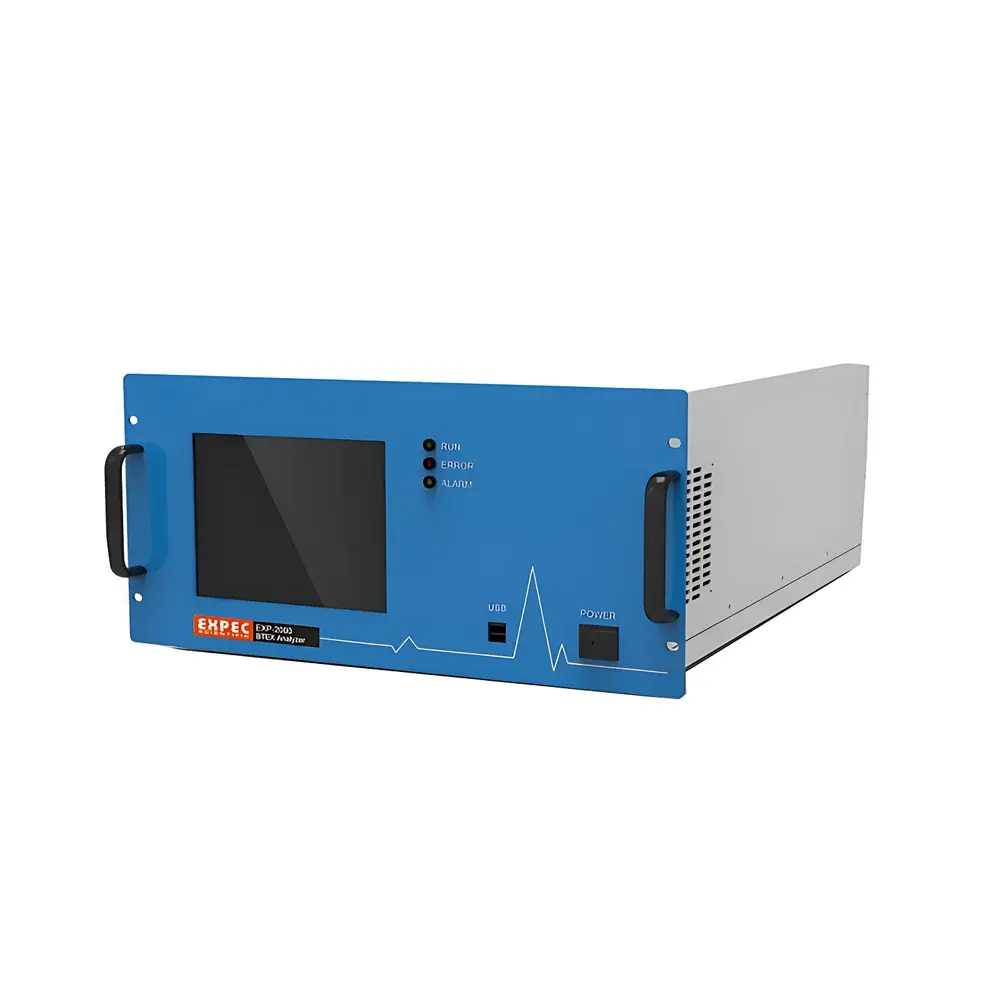
FPI Atmospheric BTEX Online Analyzer
| Brand | FPI |
|---|---|
| Origin | Zhejiang, China |
| Manufacturer Type | Original Equipment Manufacturer (OEM) |
| Product Category | Atmospheric Heavy Metal & VOCs Online Analyzer |
| Model | Atmospheric BTEX Online Analyzer |
| Measurement Principle | Ambient-Temperature Preconcentration + High-Temperature Thermal Desorption + Capillary Gas Chromatography + Photoionization Detection (GC-PID) |
| Sample Introduction | Mass Flow Controlled (MFC) Quantitative Sampling |
| Thermal Desorption | Direct-Heating Rapid Desorption (>40°C/s) |
| Chromatographic Separation | Capillary Column with Valve-Switched Backflush |
| Detector | High-Sensitivity PID (10.6 eV Lamp) |
| Carrier Gas Control | Electronic Pressure & Flow Control (EPC/EFC) for Carrier, Make-up, and Auxiliary Gases |
| Compliance Framework | Designed for ISO 16000-6, ASTM D5197, US EPA Method TO-15 & IP-12, and GLP/GMP-aligned data integrity requirements |
Overview
The FPI Atmospheric BTEX Online Analyzer is an engineered solution for continuous, unattended monitoring of benzene, toluene, ethylbenzene, and xylenes (collectively BTEX) in ambient air and industrial boundary environments. It operates on a validated multi-stage analytical architecture: quantitative sampling via precision mass flow control (MFC), ambient-temperature adsorption preconcentration on sorbent traps, rapid thermal desorption using direct-heating elements (>40 °C/s ramp rate), high-resolution separation on fused-silica capillary GC columns, and selective detection via 10.6 eV photoionization detection (PID). This integrated GC-PID workflow ensures trace-level sensitivity, compound-specific identification, and robust quantification under variable environmental conditions—without reliance on cryogenic cooling or radioactive sources. The system is purpose-built for regulatory-grade compliance in long-term atmospheric monitoring networks and industrial fence-line surveillance.
Key Features
- Mass Flow Controlled (MFC) Sampling: Eliminates dependence on ambient temperature, pressure, and humidity fluctuations—ensuring stoichiometric sample introduction and metrological traceability.
- Rapid Direct-Heating Thermal Desorption: Achieves full trap desorption in <90 seconds with minimal peak broadening, preserving chromatographic resolution and retention time stability across extended operation cycles.
- Valve-Switched Backflush Architecture: Diverts heavy-end hydrocarbons and semi-volatile organic compounds (SVOCs) away from the analytical column, extending column lifetime beyond 18 months under typical urban/industrial air matrix conditions.
- Electronic Pressure & Flow Control (EPC/EFC): Independently regulates carrier gas (N₂ or He), make-up gas, and auxiliary gases with ≤0.5% full-scale repeatability—critical for retention time locking and method transferability.
- 10.6 eV PID Detector: Delivers sub-part-per-trillion (pptv) detection limits for aromatic VOCs while maintaining negligible response to saturated aliphatics, enabling selective BTEX quantification in complex matrices.
- Integrated System Diagnostics: Real-time monitoring of trap temperature, column oven profile, detector gain, and flow calibration status—loggable with timestamped event flags for audit-ready maintenance records.
Sample Compatibility & Compliance
The analyzer accepts undiluted ambient air, stack effluent (with optional dilution module), and workplace breathing-zone samples across a standard operating range of −10 °C to 45 °C and 10–90% RH (non-condensing). It meets design intent alignment with ISO 16000-6 (indoor air VOC measurement), ASTM D5197 (ambient air benzene by GC-PID), and US EPA Compendium Method TO-15 (determination of VOCs in air by GC/PID). Data acquisition firmware supports 21 CFR Part 11-compliant user authentication, electronic signatures, and immutable audit trails—enabling deployment in GLP and GMP-regulated environmental laboratories and third-party monitoring stations.
Software & Data Management
FPI’s proprietary Analytical Control Suite (ACS v3.2) provides browser-based instrument control, method scheduling, real-time chromatogram visualization, automated peak integration (with configurable baseline algorithms), and calibrated concentration reporting in µg/m³ or ppbv. Raw chromatographic data are stored in vendor-neutral .cdf format (NetCDF-compatible), supporting post-acquisition reprocessing and third-party spectral library matching (NIST MS Search). All configuration changes, calibration events, and maintenance logs are time-stamped and digitally signed—fully auditable for regulatory submissions and QA/QC reviews.
Applications
- Continuous ambient air quality monitoring networks (AQN) for urban, suburban, and background sites per national air quality standards (e.g., China’s HJ 1010-2018, EU Directive 2008/50/EC).
- Fence-line monitoring at petrochemical refineries, bulk terminal facilities, and organic chemical manufacturing plants to verify emission control performance and support risk-based exposure assessment.
- Occupational hygiene surveys in paint booths, printing facilities, and adhesive application zones where short-term exposure limit (STEL) compliance must be verified against OSHA PEL or ACGIH TLV thresholds.
- Source apportionment studies integrating with meteorological data and receptor modeling tools (e.g., PMF, CMB) to attribute BTEX contributions to traffic, solvent use, or industrial point sources.
FAQ
What is the typical detection limit for benzene under standard operating conditions?
Benzene detection limits are method-dependent but typically achieve 10–50 pptv (v/v) for 1-hour integrated sampling, based on trap capacity, desorption efficiency, and PID signal-to-noise optimization.
Can the system be configured for simultaneous BTEX and C2–C4 alkane monitoring?
Yes—via column selection (e.g., DB-VRX or similar broad-range phase) and optional dual-detector configuration (PID + FID), though BTEX specificity requires dedicated method validation per compound group.
Is remote diagnostics and firmware update supported?
Yes—through secure TLS 1.2-enabled web interface with role-based access; updates require digital signature verification and automatic rollback on checksum failure.
How often does the sorbent trap require replacement?
Under typical urban ambient air (≤5 µg/m³ total BTEX), traps maintain performance for ≥3,000 sampling cycles (approx. 6–12 months), verified by daily blank checks and breakthrough testing per ISO 16017-1.
Does the system comply with data integrity requirements for regulatory reporting?
Yes—ACS software implements ALCOA+ principles (Attributable, Legible, Contemporaneous, Original, Accurate, Complete, Consistent, Enduring, Available) with full 21 CFR Part 11 functionality, including electronic signatures and audit trail export in CSV/PDF.







