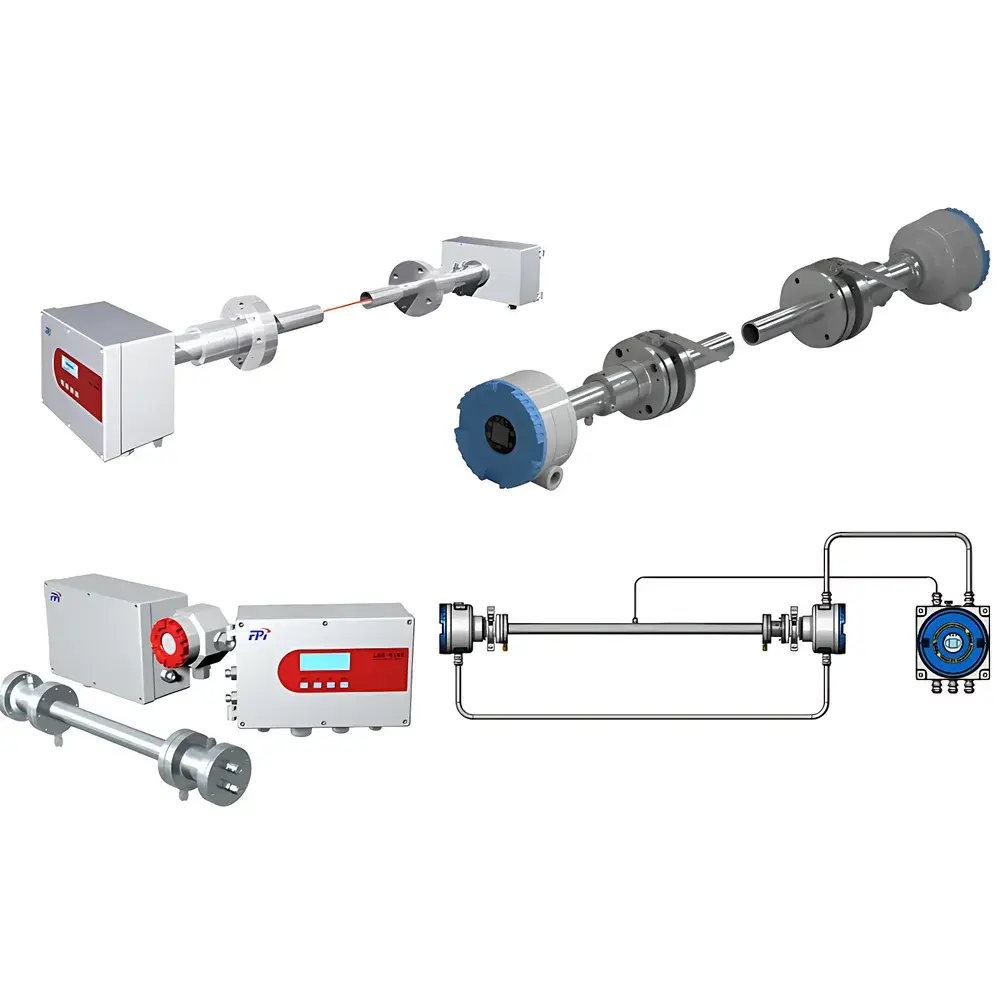
FPI LGA Series Tunable Diode Laser Absorption Spectroscopy (TDLAS) Gas Analyzer
| Brand | FPI |
|---|---|
| Origin | Zhejiang, China |
| Manufacturer Type | Original Equipment Manufacturer (OEM) |
| Country of Origin | China |
| Model | LGA Series |
| Pricing | Available upon Request |
Overview
The FPI LGA Series Tunable Diode Laser Absorption Spectroscopy (TDLAS) Gas Analyzer is an in-situ and extractive industrial gas measurement system engineered for high-precision, real-time concentration analysis of multiple trace and major gas species under demanding process conditions. Leveraging the physical principle of semiconductor laser absorption—where a narrow-linewidth tunable diode laser emits light at a wavelength precisely matched to a rovibrational absorption line of the target gas—the analyzer quantifies gas concentration via Beer-Lambert law-based attenuation measurement. Unlike conventional extractive systems requiring extensive sample conditioning, the LGA Series implements direct optical path measurement across the process stream, eliminating sampling delays, condensation artifacts, and calibration drift associated with filters, pumps, dryers, and heated lines. Its robust optical architecture supports continuous operation in environments characterized by extreme temperatures (up to 1800 °C in furnace applications), high pressure (up to 10 MPa), heavy particulate loading, and aggressive chemical exposure (e.g., HCl, HF, NH₃, SO₂). Designed for integration into distributed control systems (DCS) and safety instrumented systems (SIS), it delivers millisecond-level response times and long-term stability compliant with industrial process automation requirements.
Key Features
- In-situ and Extractive Configurations: Available in four certified explosion-proof variants—In-situ Positive Pressure Enclosure, In-situ Flameproof (Ex d), Extractive Positive Pressure Enclosure, and Extractive Flameproof—to meet ATEX, IECEx, and CNEx zone classification requirements (Zone 1/21, Class I Div 1).
- Single-Line Spectral Selectivity: Utilizes quantum cascade or distributed feedback (DFB) lasers operating in the near- to mid-infrared range (1.3–12 µm), enabling measurement specificity without spectral interference from background gases such as CO₂, H₂O, or N₂.
- Dynamic Compensation Algorithms: Integrates real-time temperature and pressure sensors co-located with the optical path; proprietary software applies thermodynamic correction models (based on HITRAN database parameters) to maintain accuracy across ±50 °C and ±200 kPa operational ranges.
- Dust & Window Contamination Mitigation: Employs wavelength modulation spectroscopy (WMS) with second-harmonic detection and adaptive baseline tracking to suppress signal degradation caused by optical obscuration or scattering.
- Zero-Maintenance Optical Path: No moving parts, no consumables, and no sample conditioning hardware—reducing mean time between failures (MTBF) to >8760 hours and total cost of ownership (TCO) by up to 65% versus NDIR or electrochemical alternatives.
Sample Compatibility & Compliance
The LGA Series is validated for continuous monitoring of over 15 industrial gases—including O₂, CO, CO₂, H₂O, H₂S, HF, HCl, HCN, NH₃, CH₄, C₂H₂, C₂H₄, and CH₃I—in gaseous matrices typical of steelmaking (sintering, blast furnace, coke oven), petrochemical cracking units, FCC regenerator flue gas, syngas purification trains, and waste incineration stacks. All configurations comply with IEC 61508 (SIL2 capable), IEC 61000-6-2/4 (EMC immunity/emission), and ISO 9001:2015 quality management systems. The analyzer conforms to the international standard IEC 61207-7 (Expression of Performance of Gas Analyzers – Part 7: Tunable Semiconductor Laser Gas Analyzers), as well as national standards GB/T 25476–2010 and HG/T 4376–2013. Optional hazardous area certifications include ATEX II 2G Ex px IICT4 Gb / II 2D Ex ptb IIIB T135°C Db and IECEx Ex px IIC T4 Gb / Ex ptb IIIB T135°C Db.
Software & Data Management
FPI’s proprietary LGA Control Suite provides embedded web-based HMI accessible via Ethernet (Modbus TCP, OPC UA, and Profibus DP optional), supporting remote configuration, diagnostics, and firmware updates. The system logs raw absorbance spectra, processed concentration values, environmental compensation parameters, and event-triggered alarms with full audit trail functionality aligned with FDA 21 CFR Part 11 requirements (electronic signatures, data integrity, and change control). Data export formats include CSV, XML, and JSON; historical trends are stored locally for ≥30 days and synchronized to cloud-based SCADA platforms using MQTT or HTTPS REST APIs. Calibration verification routines support automated zero/span checks using integrated reference cells or external gas standards traceable to NIST or NMi.
Applications
- Real-time O₂ and CO monitoring in blast furnace stoves for combustion efficiency optimization and refractory life extension.
- HCl and HF detection in waste-to-energy flue gas streams for compliance with EU Directive 2010/75/EU (IED) and US EPA Method 26A.
- NH₃ slip measurement downstream of SCR reactors in coal-fired power plants to ensure NOₓ reduction targets while minimizing ammonium bisulfate fouling.
- C₂H₂ and CH₄ quantification in ethylene cracker off-gas for feedstock recovery and safety interlock triggering (LEL monitoring).
- H₂O vapor analysis in natural gas transmission pipelines per ISO 8503-1 for hydrate formation risk assessment.
- HF and HCN monitoring in fluorination and acrylonitrile production units under OSHA PEL and ACGIH TLV regulatory limits.
FAQ
What is the minimum detectable concentration for HCl?
The LGA Series achieves a limit of detection (LOD) of 0.1 ppm for HCl in 100% N₂ matrix, verified per ISO 10723:2012 Annex B protocols.
Can the analyzer operate without external cooling water or purge air?
Yes—standard in-situ models feature air-cooled optics and sealed detector housings rated for ambient temperatures up to 60 °C; optional thermoelectric coolers are available for extended low-noise operation.
Is third-party validation data available for EPA Method 30B compliance?
FPI has completed third-party field validation per EPA PS-18 at three independent cement kiln sites; summary reports and QA/QC documentation are available under NDA.
How is traceability maintained for factory calibrations?
All factory calibrations use NIST-traceable gas standards certified by China National Institute of Metrology (NIM); calibration certificates include uncertainty budgets calculated per GUM (JCGM 100:2008).
Does the system support redundant communication interfaces for SIL2-rated safety loops?
Yes—dual-channel 4–20 mA outputs with HART 7.5 protocol and configurable fail-safe modes (e.g., 3.6 mA, 22 mA) are certified for use in safety-related applications per IEC 61511.
Related Products