
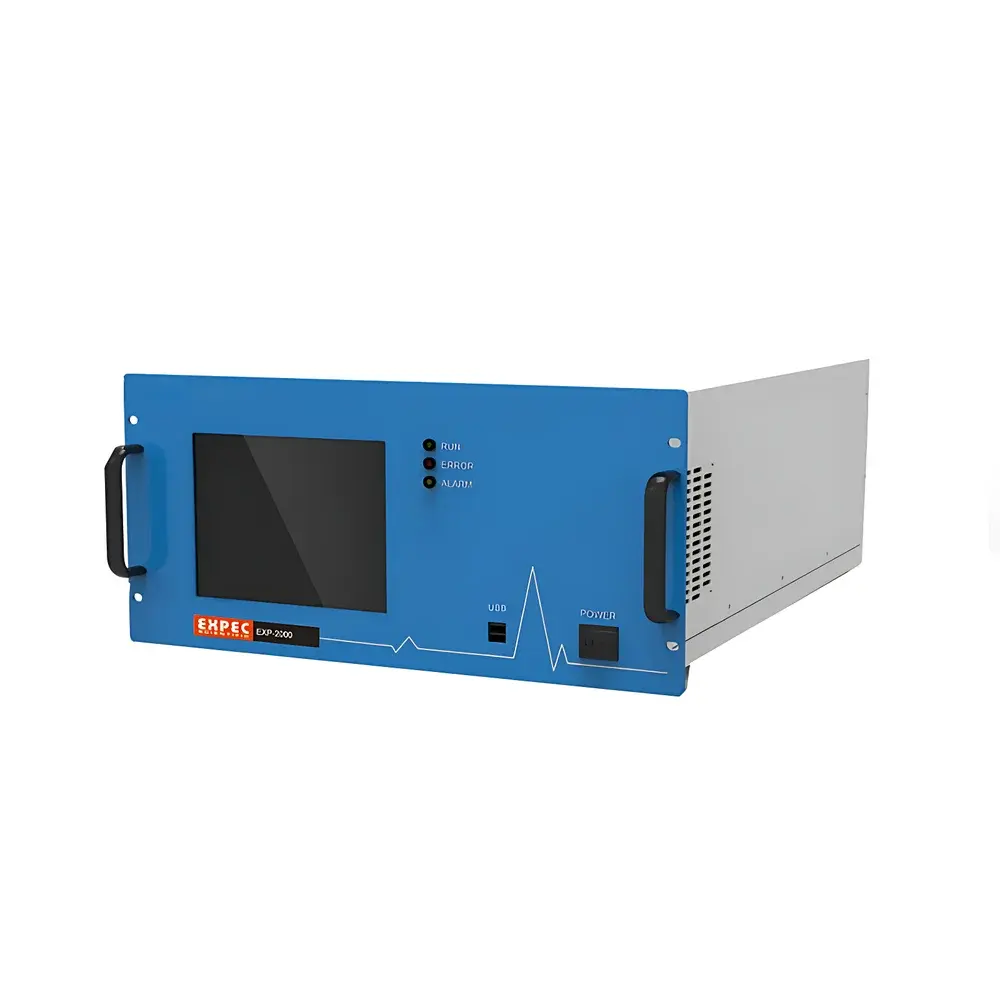
FPI Pre-3000 Deep-Cryogenic Preconcentration Module with FPI 315 VOC Online Analyzer
| Brand | FPI |
|---|---|
| Origin | Zhejiang, China |
| Manufacturer Type | OEM Manufacturer |
| Country of Origin | China |
| Model | Pre-3000 + 315 VOC Online Analyzer |
| Product Category | Atmospheric VOC Online Monitoring System |
| Measurement Principle | Cryogenic Preconcentration Coupled with Capillary Gas Chromatography–Flame Ionization Detection (GC-FID) |
| Detection Target | C2–C12 Volatile Organic Compounds (VOCs), including alcohols, ketones, esters, halogenated hydrocarbons, and aromatic compounds |
| Typical Detection Limit | Sub-ppbv (dependent on compound, integration time, and system configuration) |
| Water Removal Efficiency | >99% at −100 °C |
| Cryogenic Temperature Range | −100 °C to ambient |
| Thermal Desorption Rate | >40 °C/s (direct-resistive heating) |
| Carrier Gas Control | Electronic Pressure Control (EPC) and Electronic Flow Control (EFC) for H₂, air, and carrier gas (N₂ or He) |
| Enclosure | 19-inch rack-mount industrial chassis (standard 4U height) |
Overview
The FPI Pre-3000 Deep-Cryogenic Preconcentration Module, integrated with the FPI 315 VOC Online Analyzer, constitutes a fully automated, continuous-monitoring platform for trace-level volatile organic compounds (VOCs) in ambient air and other gaseous matrices. The system operates on the principle of cryogenic adsorption–thermal desorption–capillary gas chromatography–flame ionization detection (GC-FID). Ambient air is drawn through the Pre-3000 module, where it undergoes active cooling to −100 °C via solid-state thermoelectric refrigeration. At this temperature, water vapor condenses and is physically removed with >99% efficiency—eliminating humidity-induced baseline drift, column degradation, and retention time variability in downstream GC analysis. Simultaneously, VOCs are selectively trapped on a multi-bed sorbent cartridge engineered for broad chemical compatibility (e.g., Tenax TA, Carbopack B, and graphitized carbon black). Following preconcentration, rapid thermal desorption (>40 °C/s) delivers a narrow, solvent-free analyte plug into the GC column. Separation is achieved using programmable temperature ramping across a fused-silica capillary column, and quantification is performed via hydrogen flame ionization detection—offering linear dynamic range over six orders of magnitude and compound-specific sensitivity in the low parts-per-quadrillion (ppqv) to sub-parts-per-trillion (pptv) range under optimized conditions.
Key Features
- Deep-cryogenic preconcentration at −100 °C using maintenance-free thermoelectric cooling—no liquid nitrogen or mechanical compressors required
- Multi-layer sorbent trap with composite packing for simultaneous capture of polar (e.g., methanol, acetone) and non-polar (e.g., benzene, toluene, chloroform) VOCs
- Direct-resistive thermal desorption ensuring rapid, reproducible release kinetics and minimal peak broadening
- Split injection capability to manage high-concentration samples without column overload or detector saturation
- Electronic pressure and flow control (EPC/EFC) for carrier gas (N₂ or He), hydrogen, and synthetic air—guaranteeing <±0.5% flow stability and <±0.01 psi pressure resolution
- Rack-mounted 19-inch industrial enclosure (4U height) designed for unattended operation in field shelters, mobile labs, or central monitoring stations
- Automated calibration sequence support via external standard gas manifold (optional)
Sample Compatibility & Compliance
The system is validated for continuous sampling of ambient air, stack emissions, indoor air, and headspace from aqueous samples (when coupled with purge-and-trap interface). It meets performance criteria outlined in EPA Method TO-17 (for sorbent tube-based VOC analysis) and aligns with ISO 16017-1 for indoor air VOC measurement. Data acquisition and instrument control comply with 21 CFR Part 11 requirements when deployed with audit-trail-enabled software (e.g., FPI VOC Manager v3.2+), supporting electronic signatures, user role management, and immutable raw data archiving. All hardware components conform to IEC 61000-6-2 (EMC immunity) and IEC 61010-1 (safety for laboratory equipment).
Software & Data Management
FPI VOC Manager software provides real-time chromatogram visualization, automated peak integration using retention time locking (RTL), and customizable reporting templates aligned with national environmental monitoring protocols (e.g., China’s HJ 644–2013, US EPA 40 CFR Part 58). Raw chromatographic data are stored in vendor-neutral .cdf format (NetCDF-compliant), enabling third-party reprocessing in OpenLAB CDS, Chromeleon, or R-based chemometric tools. Audit trails record all method changes, calibration events, and user actions with timestamps and operator IDs. Remote diagnostics and firmware updates are supported via secure TLS 1.2 encrypted HTTP(S) communication.
Applications
- Continuous ambient air quality monitoring of aromatic hydrocarbons (BTEX), oxygenated VOCs (e.g., formaldehyde precursors), and halogenated solvents in urban and industrial zones
- Fenceline monitoring at petrochemical refineries, pharmaceutical manufacturing sites, and paint/coating facilities per EPA OTM-33 and EU Industrial Emissions Directive (IED) Annex VII
- Research-grade VOC speciation for atmospheric chemistry modeling, including OH-radical reactivity estimation and ozone formation potential (OFP) calculation
- Mobile monitoring on vehicle-mounted platforms for spatially resolved plume mapping and source attribution
- Integration with online water purge-and-trap systems for dissolved VOC quantification in surface water and groundwater effluents
FAQ
What VOC compound classes does this system reliably detect?
Aliphatic and aromatic hydrocarbons, alcohols, aldehydes, ketones, esters, ethers, chlorinated solvents (e.g., PCE, TCE), and selected sulfur-containing compounds—provided they exhibit sufficient volatility (boiling point <220 °C) and thermal stability below 350 °C.
Is the system suitable for high-humidity environments such as coastal or monsoon-affected regions?
Yes—the Pre-3000 module’s >99% water removal efficiency at −100 °C ensures stable chromatographic performance even at 95% RH; no additional Nafion dryers or permeation membranes are required.
Can the system be configured for unattended operation over extended periods?
Yes—fully automated cycle times (typically 30–120 min per analysis), onboard memory for >30 days of raw data, and optional 4G/LTE telemetry enable remote supervision with minimal site visits.
Does the analyzer support regulatory reporting formats?
Yes—export modules generate EPA-compliant CSV/Excel reports, ISO 14001-aligned summary logs, and China’s MEP-formatted air quality bulletins (AQI-VOC subset) directly from the embedded database.
What maintenance intervals are recommended for routine operation?
Sorbent traps: replace every 3–6 months depending on particulate loading; GC columns: 12–18 months; FID jet cleaning: quarterly; EPC sensor calibration: semiannually; full system performance verification: annually per ISO/IEC 17025 internal protocol.







