
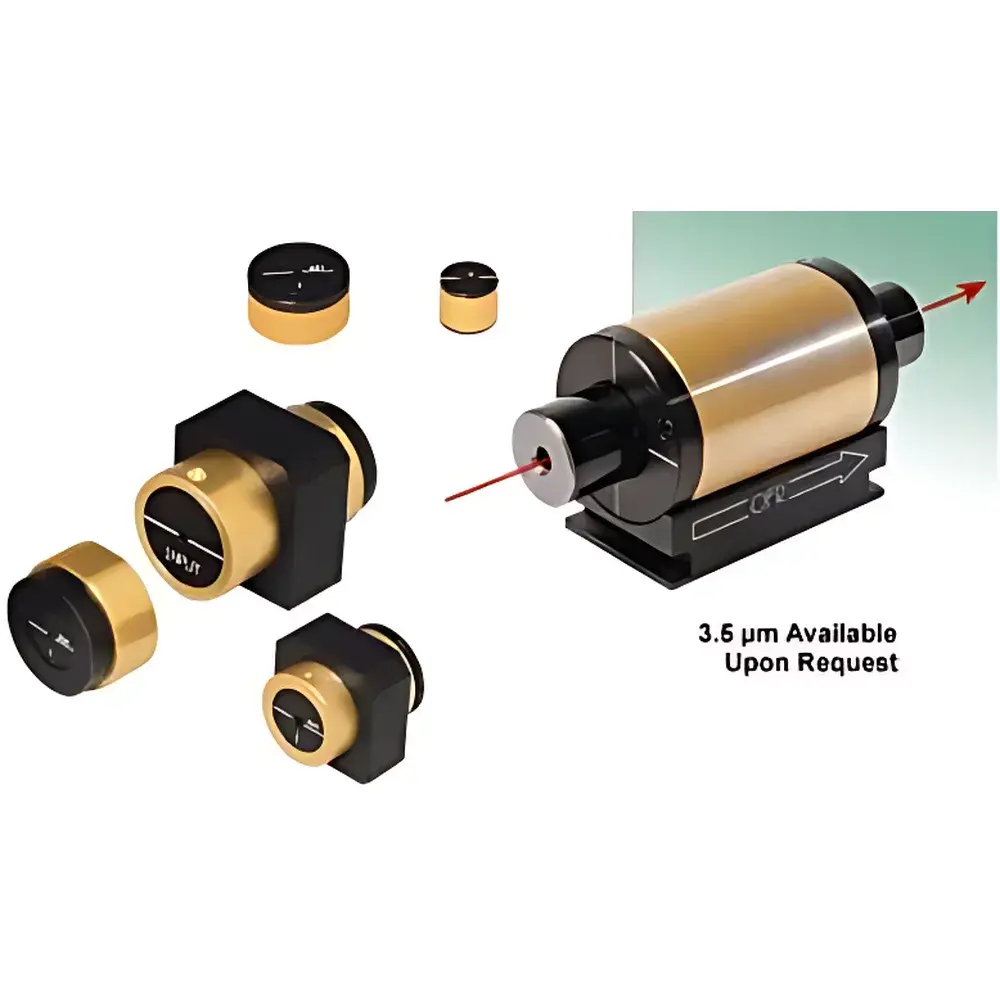
Free-Space Optical Isolator IO-5-1064-VHP
| Key | Wavelength: 1064 nm |
|---|---|
| Power Handling | 100 W CW / 10 W Pulsed |
| Aperture | 4.8 mm |
| Max Beam Diameter | 3.1 mm |
| Transmission | ≥91% |
| Isolation | 35–44 dB |
| Spectral Bandwidth | 1064 ± 6 nm |
| Beam Diameter Definition | 1/e² for high-power models |
| Compliance | ISO 10110-7, RoHS, CE |
Overview
The Free-Space Optical Isolator IO-5-1064-VHP is a high-performance, non-reciprocal optical component engineered for unidirectional transmission in demanding laser systems operating at 1064 nm. Based on the Faraday magneto-optic effect, it utilizes a terbium gallium garnet (TGG) crystal biased by a permanent magnet and integrated with precision broadband antireflection-coated polarizers to achieve robust isolation between forward and backward propagating light. Unlike fiber-pigtailed isolators, this free-space design eliminates coupling losses and mode-field mismatch, enabling optimal beam quality preservation in high-finesse cavities, ultrafast amplifier chains, MOPA architectures, and industrial laser processing setups where spatial mode control and power scalability are critical. Its compact monolithic housing ensures mechanical stability under thermal cycling and vibration, while its alignment-free configuration minimizes setup complexity in OEM integration.
Key Features
- Isolation performance of 35–44 dB across the 1064 ± 6 nm bandwidth—optimized for Nd:YAG, Nd:YVO₄, and fiber laser sources with narrow linewidth or moderate chirp
- High-power handling capability: rated for 100 W continuous-wave (CW) operation and 10 W pulsed (with <10 ns pulse width), supported by low-absorption TGG crystal and water-cooled or conduction-cooled mounting options (configurable)
- Transmission ≥91% at 1064 nm, measured at 1/e² beam diameter (3.1 mm), with residual reflection <0.25% per surface per AR coating specification (per ISO 13697)
- Beam aperture of 4.8 mm accommodates Gaussian beams up to 3.1 mm (1/e²), ensuring minimal clipping and diffraction-induced wavefront distortion
- Thermally stable design with coefficient of thermal expansion (CTE)-matched mounts; operational temperature range: −10 °C to +50 °C, storage: −20 °C to +70 °C
- Compliant with ISO 10110-7 for surface quality (scratch-dig 10–5), MIL-PRF-13830B for cleanliness, and IEC 60825-1:2014 for laser safety classification support
Sample Compatibility & Compliance
This isolator is compatible with collimated free-space beams from solid-state lasers, diode-pumped lasers, and amplified spontaneous emission (ASE) sources operating within the specified spectral window. It supports TEM₀₀ and low-order multimode beams with M² ≤ 1.3. No polarization conditioning is required for use with linearly polarized input; for unpolarized or elliptically polarized sources, an external half-wave plate or polarizing beam splitter may be integrated upstream. The device meets RoHS Directive 2011/65/EU and carries CE marking for conformity with EU electromagnetic compatibility (EMC) and low-voltage directives. While not intrinsically FDA 21 CFR Part 11 compliant (as it is a passive optical component), full traceability documentation—including calibration certificates, spectral transmittance/reflectance reports, and isolation vs. wavelength characterization—is supplied with each unit to support GLP/GMP audit readiness in regulated photonics R&D and medical laser manufacturing environments.
Software & Data Management
As a passive, analog optical component, the IO-5-1064-VHP does not incorporate embedded firmware or digital interfaces. However, comprehensive metrology data is delivered with every shipment: spectral transmission and isolation curves (measured via calibrated photodiode-based spectroradiometer, NIST-traceable), wavefront error maps (via Zygo Verifire Interferometer), and environmental stress test logs (thermal shock, humidity cycling, and mechanical vibration per MIL-STD-810H). These datasets are provided in ASCII-compatible CSV and PDF formats, fully compatible with LIMS (Laboratory Information Management Systems) import protocols and enterprise document control workflows. Optional custom reporting—including ISO/IEC 17025-compliant uncertainty budgets—can be requested at order entry.
Applications
- Protection of master oscillators and seed lasers from back-reflected light in multi-stage amplifiers (e.g., regenerative, multipass, or cryogenic Yb:YAG systems)
- Stabilization of external cavity diode lasers (ECDLs) and tapered amplifier systems by suppressing feedback-induced frequency jitter and mode hopping
- Isolation in quantum optics experiments involving high-fidelity single-photon sources and cavity-enhanced detection schemes
- Industrial laser material processing lines where back-reflection from workpiece plasma or ablation plumes threatens pump diode integrity
- Ultrafast Ti:sapphire and Yb-fiber amplifier front-ends requiring dispersion-insensitive, broadband-capable isolation without GDD accumulation
- Space-qualified laser communication terminals (subject to additional screening per ECSS-Q-ST-70-08C)
FAQ
What defines the “VHP” designation in the model number?
The “VHP” suffix denotes Very High Power rating—specifically, optimized thermal management architecture including low-thermal-resistance bonding, enhanced heat-sinking interface geometry, and extended damage-threshold coatings validated per ISO 21254-2 at 1064 nm.
Can this isolator be used with femtosecond pulses?
Yes, provided pulse energy remains below the fluence limit (typically 0.5 J/cm² for 100 fs pulses at 1064 nm); group delay dispersion (GDD) is negligible (<5 fs²) over the central 10 nm bandwidth due to thin-film AR design and bulk TGG path length.
Is angular alignment sensitivity specified?
Maximum allowable incidence angle deviation is ±1.5° for maintained isolation >35 dB; angular tuning capability is available via optional kinematic mount (Part No. KM-IO-5-VHP).
Does the isolator require magnetic shielding in sensitive environments?
The internal permanent magnet generates a stray field <0.5 mT at 50 mm distance; magnetic shielding (Mu-metal canister) is available as an accessory for applications near electron microscopes or atomic clocks.
How is long-term reliability validated?
Accelerated life testing includes 1,000 hours of continuous 100 W CW operation at 45 °C ambient, followed by post-test verification of isolation, transmission, and wavefront fidelity per ISO 10110-5.




