
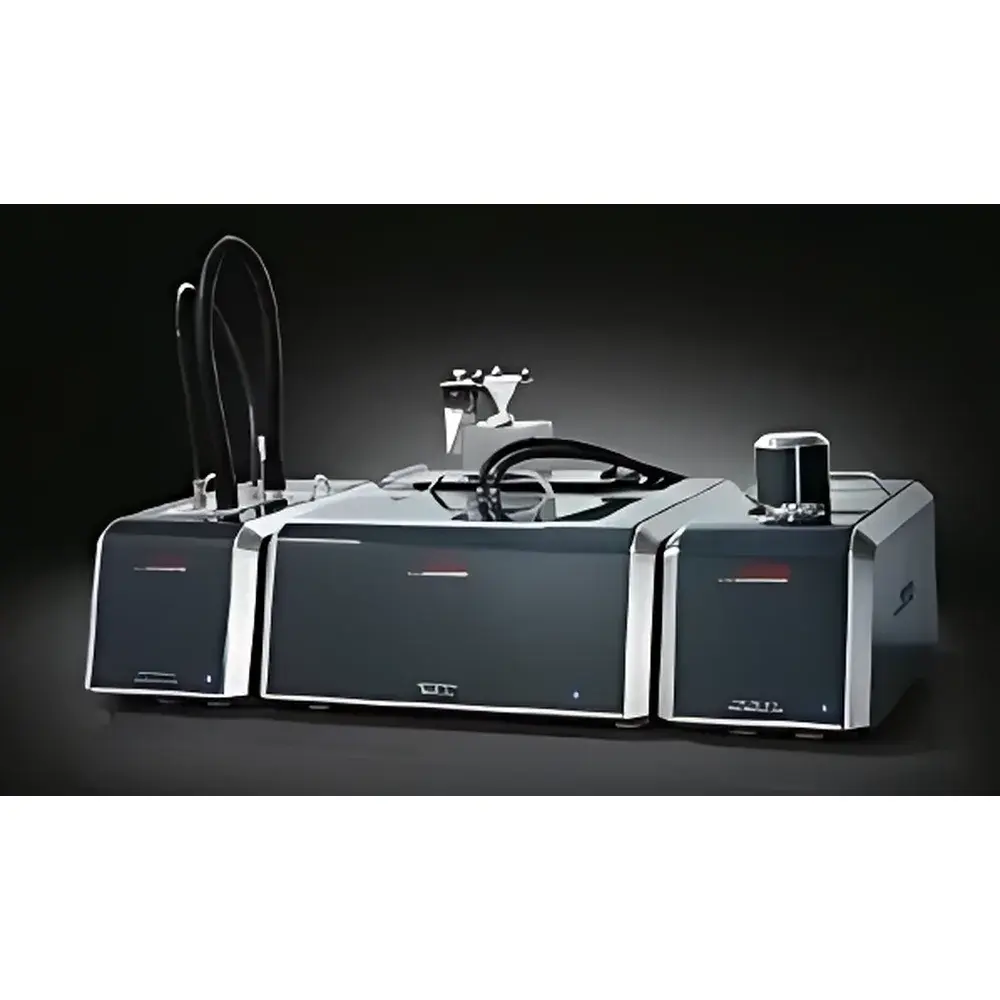
Fritsch ANALYSETTE 22 NanoTec Dry/Wet Laser Particle Size Analyzer
| Origin | Germany |
|---|---|
| Manufacturer Type | Authorized Distributor |
| Origin Category | Imported |
| Model | Fritsch ANALYSETTE 22 NanoTec |
| Pricing | Upon Request |
Overview
The Fritsch ANALYSETTE 22 NanoTec is a high-precision, dual-mode laser diffraction particle size analyzer engineered for rigorous R&D and QC/QA applications across pharmaceuticals, advanced materials, ceramics, catalysts, and nanomaterials. Based on ISO 13320-compliant laser diffraction principles, it quantifies particle size distribution (PSD) in both dry powder and liquid suspension/colloidal states—without requiring hardware reconfiguration. Its optical architecture employs a patented inverse Fourier design with three integrated lasers (two green, λ = 532 nm, 7 mW each; one infrared, λ = 940 nm, 9 mW), all Class 1 laser safety certified per EN 60825-1. The system achieves a validated dynamic measurement range of 0.01–2000 µm—extending significantly beyond the 0.08–2000 µm capability of the MicroTec variant—enabled by enhanced backscatter detection, extended sample cell translation, and a 520-channel photodetector array optimized for sub-100 nm resolution.
Key Features
- Triple-laser optical system: Dual 532 nm green lasers for forward and side scattering + dedicated 940 nm infrared laser for high-sensitivity backscatter detection—critical for resolving nanoparticles and fine agglomerates.
- Automated, motorized sample cell with extended axial travel range—ensuring full laser beam coverage across the entire measurement volume and maximizing signal-to-noise ratio.
- Inverse Fourier optical layout with compact refractive optics: Reduces instrument footprint while maintaining optical path integrity and minimizing alignment drift.
- Modular dry- and wet-dispersion units: Independently configurable and interchangeable—each designed to meet ISO 13320 dispersion energy requirements and material-specific handling protocols (e.g., jet dispersion for cohesive powders; ultrasonic-assisted wet dispersion for stable suspensions).
- Self-aligning laser beam technology: Eliminates manual optical recalibration during routine operation or module swaps.
- Integrated background acquisition and automatic cleaning cycles: Enables rapid transition between samples with minimal carryover risk; compatible with deionized water or tap water due to robust baseline correction algorithms.
Sample Compatibility & Compliance
The ANALYSETTE 22 NanoTec accommodates a broad spectrum of particulate systems—including fragile nanoemulsions, electrostatically charged metal powders, heat-sensitive polymers, and highly refractive ceramic oxides—without compromising measurement fidelity. Dry dispersion meets ISO 13320 Annex C specifications for pneumatic dispersion energy control and complies with ISO 14644-1 Class H cleanroom operational standards. Wet dispersion modules support ASTM D4291 and USP for subvisible particle testing in injectables. All optical and mechanical components are manufactured in Germany under DIN EN ISO 9001-certified production, and firmware supports audit trails compliant with FDA 21 CFR Part 11 and GLP/GMP documentation requirements.
Software & Data Management
The proprietary MaS Control software provides full SOP-driven workflow management, with modular parameter assignment—allowing independent configuration of dispersion time, sonication power, pump speed, or measurement duration per sample type. Reporting templates are fully customizable (PDF, CSV, XML export); statistical analysis includes D10/D50/D90, span, relative width, and cumulative frequency plots. Built-in database supports multi-user access control, versioned method storage, and raw scattering pattern archiving for retrospective reprocessing. All calibration records, maintenance logs, and measurement histories are timestamped and digitally signed to satisfy regulatory traceability mandates.
Applications
- Pharmaceutical development: PSD characterization of micronized APIs, nanoparticle drug carriers, and inhalation powder formulations per ICH Q5A and Q5C guidelines.
- Advanced battery materials: Anode/cathode active material sizing (e.g., graphite, NMC, LFP), slurry homogeneity assessment, and post-milling quality control.
- Catalyst R&D: Quantification of supported metal nanoparticle distributions and sintering behavior under thermal aging conditions.
- Food & cosmetics: Emulsion droplet stability monitoring, pigment dispersion uniformity, and starch granule size profiling.
- Environmental science: Aerosol generation studies, soil sediment fractionation, and microplastic particle identification workflows.
FAQ
What is the minimum detectable particle size for the NanoTec configuration?
The system achieves reliable detection down to 0.01 µm (10 nm) under optimal dispersion and refractive index matching conditions—validated using NIST-traceable polystyrene latex standards.
Can the same instrument be used for both GMP-regulated QC and exploratory research?
Yes—software-enforced SOPs, electronic signatures, and 21 CFR Part 11-compliant audit trails support regulated environments, while open parameter editing and raw data access enable method development and fundamental research.
Is external ultrasonication required for wet measurements?
No—the integrated ultrasonic disperser (up to 100 W adjustable power) is sufficient for most colloidal systems; optional external probe sonicators may be coupled via auxiliary ports for extreme deagglomeration needs.
How does the system handle high-refractive-index particles like TiO₂ or SiC?
The triple-laser configuration, particularly the 940 nm infrared channel, improves scattering signal differentiation for high-n materials; Mie theory-based inversion algorithms include refractive index input fields with built-in dispersion models for common industrial materials.
What maintenance intervals are recommended for long-term operational reliability?
Laser alignment verification every 6 months; detector window cleaning after every 200 dry measurements or 500 wet cycles; annual calibration using certified reference materials (CRM) traceable to PTB or NIST.



