
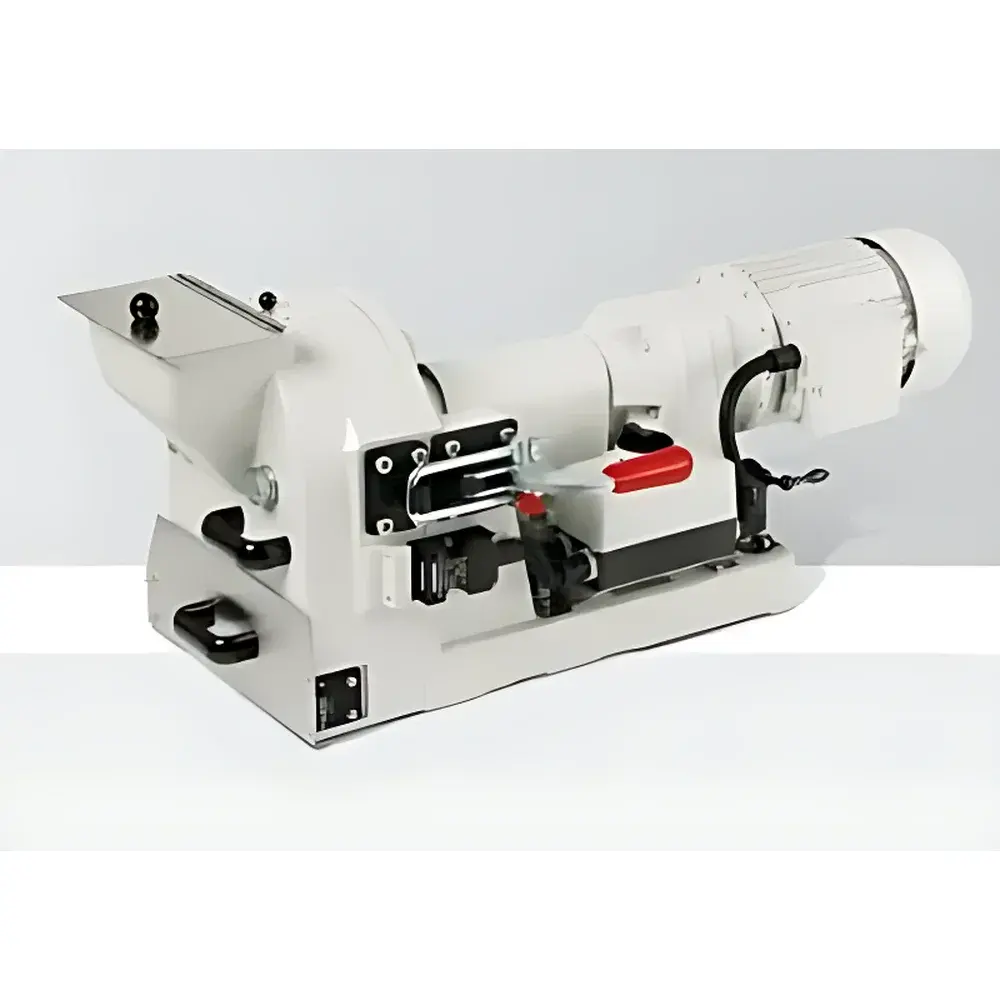
FRITSCH Pulverisette 13 Universal Disc Mill
| Brand | FRITSCH |
|---|---|
| Origin | Germany |
| Model | Pulverisette 13 |
| Final Particle Size | 0.1–12 mm |
| Max. Feed Size | 20 mm |
| Throughput | up to 150 kg/h |
| Motor Speed | 440 rpm |
| Input Power | 1830 W |
| Voltage/Frequency | 400 V / 3~ / 50–60 Hz |
| Net Weight | 140 kg |
| Gross Weight | 170 kg |
| Dimensions (W×H×D) | 44 × 87 × 40 cm |
| Grinding Principle | Shear Force |
| Disc Material Options | Zirconium Oxide, Manganese Steel, Mild Steel, Tungsten Carbide |
| Dust Extraction Interface | Yes |
| Safety Certification | CE-marked per TÜV testing |
| Warranty | 12 months |
Overview
The FRITSCH Pulverisette 13 Universal Disc Mill is an industrial-grade, gravity-fed disc mill engineered for precise, reproducible size reduction of brittle, hard, and medium-hard materials in laboratory and pilot-scale environments. Operating on the principle of controlled shear force between two counter-rotating or fixed/rotating disc assemblies, the Pulverisette 13 delivers consistent particle size distribution without thermal overload—critical for temperature-sensitive or hygroscopic samples. Unlike impact-based mills, its disc geometry minimizes particle fragmentation variability and preserves sample integrity during fine-to-coarse grinding. Designed for continuous or batch operation, it integrates seamlessly into multi-stage sample preparation workflows—particularly where upstream coarse crushing (e.g., with the Pulverisette 1 Jaw Crusher) and downstream analytical characterization (e.g., XRD, SEM, or laser diffraction) are required.
Key Features
- Precision-adjustable disc gap (0.1 mm resolution) via external micrometer scale—enabling real-time optimization of final particle size without interrupting operation.
- Dust-tight grinding chamber with integrated vacuum port compatible with standard laboratory dust extraction systems, ensuring operator safety and compliance with OSHA and EU Directive 2004/37/EC (carcinogens and mutagens).
- Modular disc assembly system: Four interchangeable disc material options—zirconium oxide (for ultra-low contamination), manganese steel (high wear resistance), mild steel (cost-effective general use), and tungsten carbide (extreme abrasion resistance)—allow tailoring to sample chemistry and purity requirements.
- Robust bearing design with sealed, maintenance-free lubrication—engineered for >10,000 hours of continuous service under nominal load conditions.
- Centrally located quick-release clamping mechanism for rapid chamber access and tool-free disc replacement—reducing downtime during method changeovers or cleaning cycles.
- Full CE conformity per Machinery Directive 2006/42/EC and Low Voltage Directive 2014/35/EU, validated by independent TÜV certification; includes emergency stop, interlocked guard doors, and overload protection.
Sample Compatibility & Compliance
The Pulverisette 13 accommodates a broad spectrum of sample types—including hard rocks (granite, basalt), ceramics (alumina, silicon carbide), metallic alloys, glass frits, soil aggregates, and even moderately fibrous or slightly damp materials—provided feed size remains ≤20 mm. Its shear-dominated comminution mechanism avoids the high localized temperatures typical of rotor-beater mills, making it suitable for thermolabile organics and hydrated minerals. The instrument meets GLP documentation requirements when paired with FRITSCH’s optional digital logging module (not included), supporting audit-ready records of operating parameters (gap setting, runtime, motor load). While not intrinsically rated for ATEX Zone 21, it may be operated in classified environments when coupled with certified dust extraction and grounding protocols.
Software & Data Management
The Pulverisette 13 operates as a stand-alone mechanical system with no embedded firmware or touchscreen interface. All operational parameters—including disc gap, feed rate, and runtime—are set manually and recorded externally per SOP. For laboratories requiring traceability, FRITSCH recommends integration with LIMS via external data loggers connected to motor current sensors and timer relays. Optional accessories include a calibrated gap-setting gauge and ISO/IEC 17025-compliant calibration certificate (available upon request). No proprietary software is required; however, FRITSCH provides comprehensive technical documentation—including maintenance schedules, torque specifications for disc mounting, and material compatibility charts—in English, German, and French.
Applications
This disc mill is routinely deployed in geochemical laboratories preparing rock powders for ICP-MS and XRF analysis; in metallurgical R&D for homogenizing slag and ferroalloy samples prior to spectroscopic quantification; in ceramic engineering labs optimizing green-body particle size distributions; and in environmental testing facilities grinding contaminated soils for TCLP or sequential extraction studies. Its ability to process up to 150 kg/h makes it equally viable for pilot-scale mineral beneficiation trials or quality control in refractory manufacturing. When configured with zirconia discs and operated under inert gas purge (via optional adapter), it supports battery cathode material milling for Li-ion R&D under controlled atmosphere.
FAQ
Is the Pulverisette 13 suitable for cryogenic grinding?
No—this model lacks provisions for liquid nitrogen cooling or low-temperature motor insulation. For cryo-milling, FRITSCH recommends the Pulverisette 25 Cryo-Mill.
Can I grind wet or sticky samples?
Only marginally damp (≤5% moisture) non-adhesive materials are recommended. High-moisture or cohesive samples require pre-drying or alternative equipment such as the Pulverisette 14 Planetary Micro Mill.
Are grinding discs included with the base unit?
No—disc sets are ordered separately as accessories. Each disc pair must be matched for material, diameter, and surface geometry (smooth, grooved, or serrated).
What electrical infrastructure is required?
A dedicated 400 V, three-phase, 16 A circuit with proper earthing and residual-current device (RCD) protection is mandatory. Voltage fluctuations beyond ±5% require an active line conditioner.
Does FRITSCH provide method development support?
Yes—application engineers offer remote or on-site feasibility testing using client-supplied samples, including gap optimization studies and contamination profiling (ICP-MS trace metal analysis of blank runs).



