
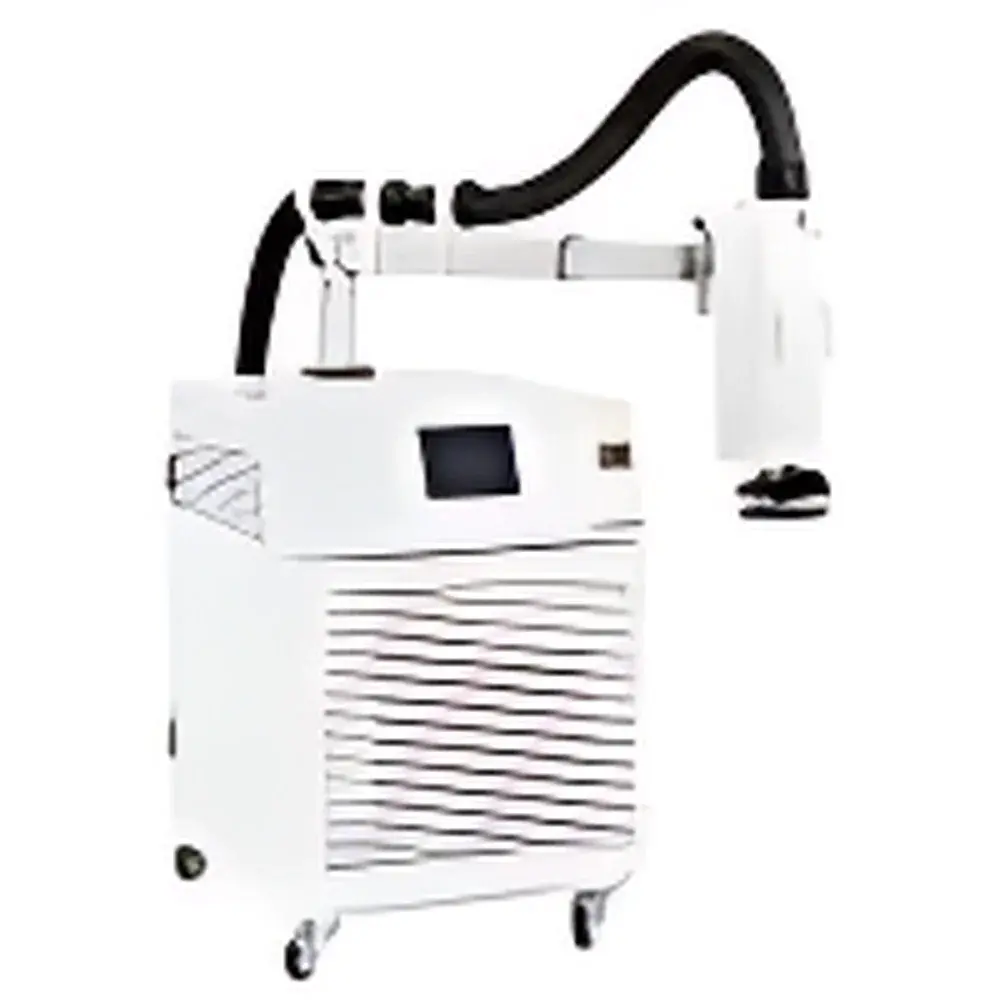
Froilabo Dragon Thermal Shock Test System
| Brand | Froilabo |
|---|---|
| Origin | Guangdong, China (Distributed by Hongzhan Technology Co., Ltd.) |
| Model | Dragon |
| Temperature Range | −80 °C to +250 °C |
| Transition Time | −55 °C ↔ +125 °C in 7 s / 14 s |
| Airflow Rate | 2.2–8.4 L/s |
| Temperature Stability | ±0.1 °C |
| Control Interface | Touchscreen HMI |
| Programmable Profiles | 45 stored programs, up to 20 steps each |
| Compliance | JEDEC JESD22-A104, MIL-STD-883 Method 1010, MIL-STD-750 Method 1037 |
| Operating Modes | Manual, Automatic, Editable Sequence |
Overview
The Froilabo Dragon Thermal Shock Test System is a high-performance, air-based thermal cycling instrument engineered for accelerated reliability assessment of electronic components, materials, and assemblies under extreme and rapidly alternating temperature conditions. Utilizing forced convection with precisely regulated airflow and dual independent refrigeration/heating circuits, the Dragon implements a non-contact, chamberless thermal shock methodology—eliminating thermal mass delays associated with conventional chamber-based systems. Its operational principle relies on rapid, repeatable jet-stream delivery of conditioned air directly onto test specimens, enabling sub-10-second transitions between extreme setpoints. Designed for laboratory and production-line validation environments, the system supports deterministic thermal stress profiling aligned with industry-critical failure mechanisms including intermetallic growth, solder joint fatigue, die attach delamination, and coefficient-of-thermal-expansion (CTE) mismatch-induced cracking.
Key Features
- Wide operational temperature range from −80 °C to +250 °C, achieved via cascaded refrigeration stages and high-efficiency resistive heating elements
- Ultra-fast thermal transition capability: −55 °C to +125 °C in ≤7 seconds; reverse transition in ≤14 seconds—verified per IEC 60068-2-14 Annex A
- Precision airflow control (2.2–8.4 L/s) with laminar flow optimization to ensure uniform thermal flux distribution across DUT surfaces
- Temperature regulation accuracy of ±0.1 °C at steady state, maintained through PID-controlled feedback loops with platinum RTD sensing
- Intuitive 10.1-inch capacitive touchscreen interface supporting multi-language operation and real-time graphical trend display
- Three configurable operating modes: manual step-by-step execution, fully automated sequence run, and editable profile mode with conditional branching logic
- Onboard memory for up to 45 user-defined thermal profiles, each supporting up to 20 discrete temperature/time/soak steps with ramp rate specification
- Integrated Ethernet and USB interfaces for remote monitoring, firmware updates, and secure data export in CSV or XML format
Sample Compatibility & Compliance
The Dragon accommodates a broad spectrum of test specimens—including bare dies, packaged ICs (QFN, BGA, SOIC), PCBAs, MEMS devices, optical modules, and polymer-based sensors—without requiring custom fixtures. Its open-test-zone architecture allows direct mounting on standard thermal interface plates or integration into automated handler platforms via digital I/O triggers. The system is pre-configured to execute standardized thermal shock protocols defined in JEDEC JESD22-A104 (Temperature Cycling), MIL-STD-883 Method 1010.12 (Steady-State Temperature Cycling), and MIL-STD-750 Method 1037.1 (Thermal Shock). All thermal profiles are timestamped and logged with audit-trail metadata compliant with GLP and GMP documentation requirements. Optional 21 CFR Part 11-compliant software module available for regulated pharmaceutical and medical device qualification workflows.
Software & Data Management
The Dragon operates with Froilabo’s proprietary DragonControl™ software suite, which provides full lifecycle test management—from profile creation and validation to real-time monitoring and post-test analysis. Each thermal cycle generates a time-stamped dataset containing temperature, airflow, ramp rate, dwell duration, and system status flags. Raw logs support traceable export in ISO/IEC 17025-aligned formats, including calibrated uncertainty annotations. The software enables comparative overlay of multiple runs, statistical process control (SPC) charting of key parameters (e.g., transition time deviation), and automated pass/fail evaluation against user-specified tolerance bands. All configuration changes, operator logins, and test executions are recorded in an immutable audit trail accessible for internal QA review or regulatory inspection.
Applications
- Qualification testing of automotive-grade semiconductors per AEC-Q200 requirements
- Failure analysis correlation studies linking thermal cycling exposure to solder joint voiding observed via X-ray CT
- Process validation of reflow soldering profiles for advanced packaging technologies (e.g., fan-out wafer-level packaging)
- Material compatibility screening for conformal coatings, underfills, and encapsulants under aggressive thermal gradients
- Reliability growth testing of avionics modules subjected to rapid altitude-driven ambient temperature swings
- Accelerated life testing (ALT) of power electronics modules used in renewable energy inverters
FAQ
Does the Dragon system require liquid nitrogen or external cryogenic supply?
No. It utilizes a closed-loop mechanical refrigeration system with environmentally compliant R-513A/R-1234ze blended refrigerant—no consumables or external infrastructure required.
Can the Dragon perform dwell-and-ramp cycles with variable soak durations?
Yes. Each step within a profile supports independent specification of target temperature, dwell time (0.1–9999.9 min), ramp rate (0.1–50 °C/min), and stabilization criteria.
Is calibration documentation provided with the system?
Yes. Delivered with NIST-traceable calibration certificate for temperature and airflow sensors, valid for 12 months from shipment.
What safety certifications does the Dragon hold?
CE marked per EN 61000-6-2 (immunity) and EN 61000-6-4 (emissions); complies with UL 61010-1 and IEC 61010-1 for laboratory equipment safety.
Can third-party test management software interface with the Dragon?
Yes. Native Modbus TCP and OPC UA server support enable seamless integration into enterprise MES, LIMS, or test automation frameworks.



