
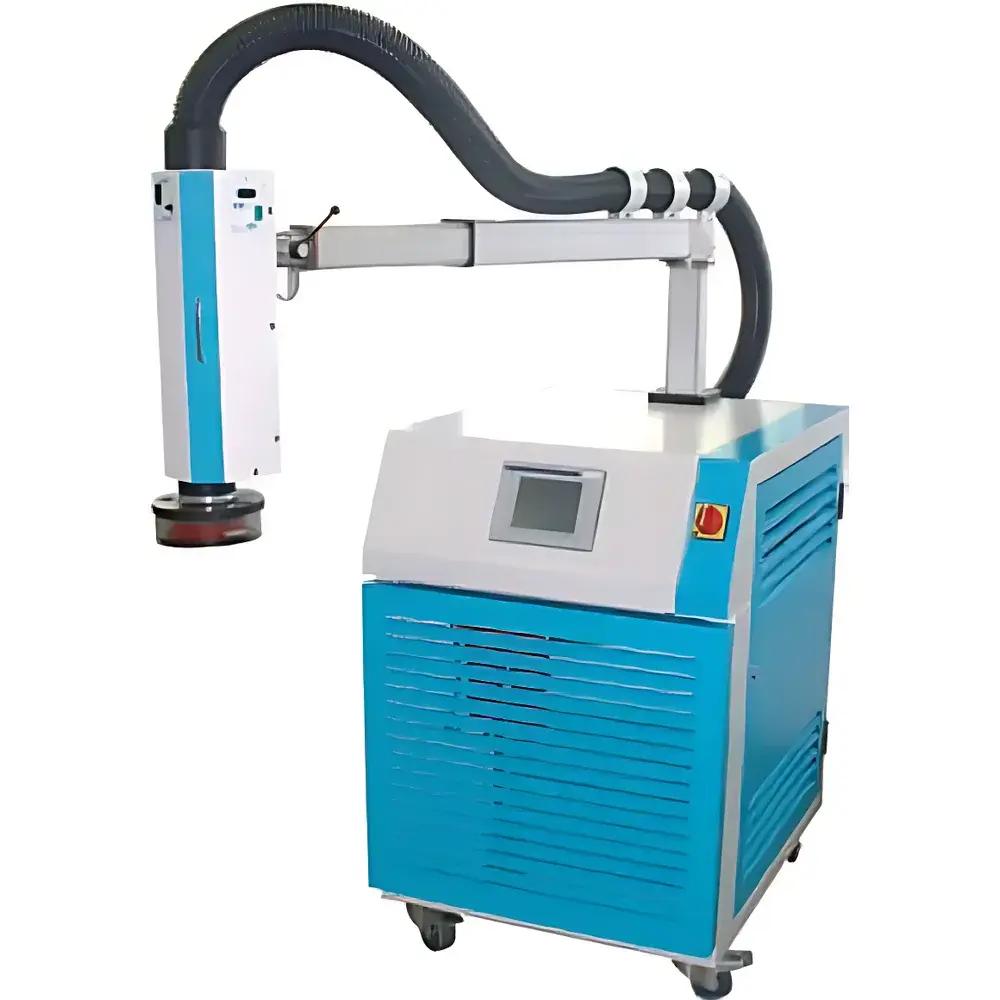
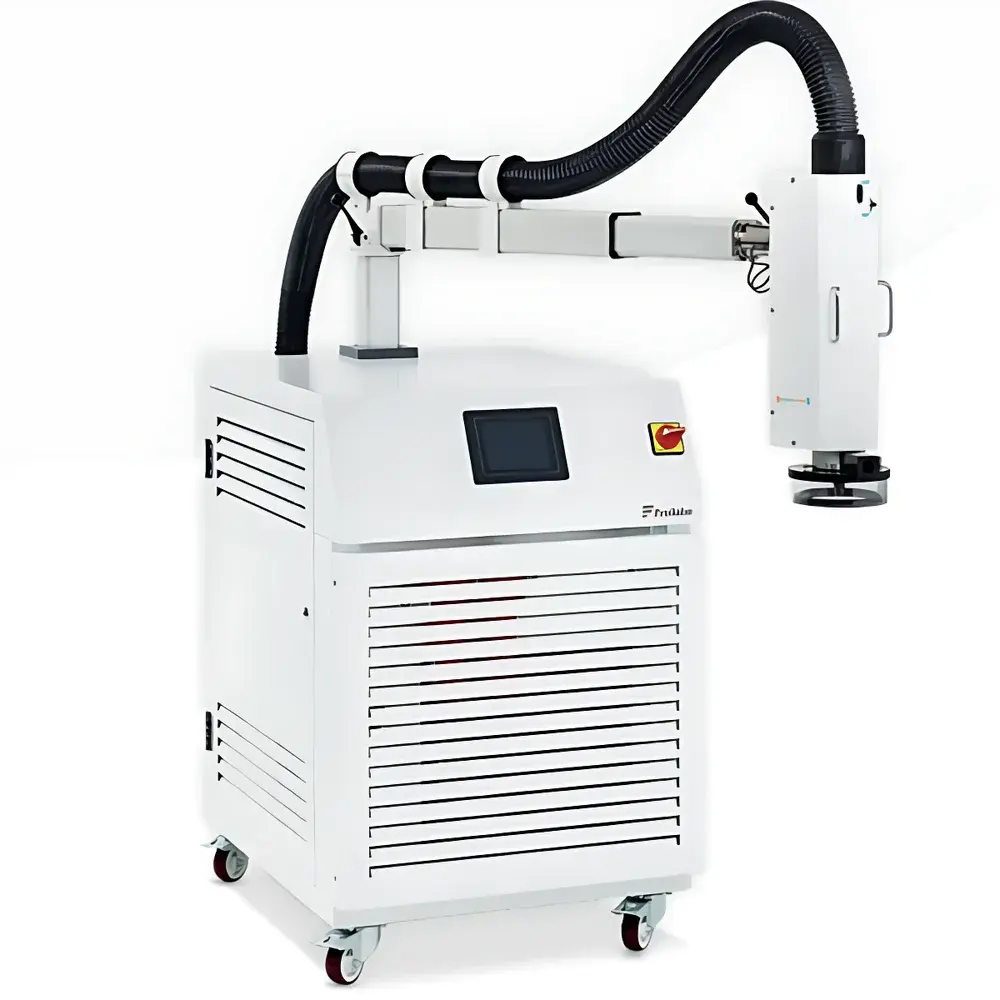
Froilabo Dragon3 Rapid Thermal Cycling System with Hot-Cold Air Stream Hood and Thermal Flux Measurement Capability
| Brand | Froilabo |
|---|---|
| Origin | France |
| Model | Dragon3 |
| High Temperature Range | +250 °C |
| Low Temperature Range | −70 °C |
| Thermal Shock Range | −70 °C to +250 °C |
| Temperature Stability | < ±0.1 °C |
| Ramp Rate (Heating) | ~7 s from −55 °C to +125 °C |
| Ramp Rate (Cooling) | ~14 s from +125 °C to −55 °C |
| Airflow Output | 5–20 SCFM (2.4–9.4 L/s) |
| Temperature Accuracy | ±1.0 °C (calibrated) |
| Setpoint Resolution | 0.1 °C |
| Power Supply | 200–250 VAC, 50/60 Hz, 20 A, single-phase |
| Dimensions (W×D×H) | 57.5 × 92.8 × 136.3 cm |
| Weight (net) | 265 kg |
| Noise Level | < 49 dBA (A-weighted, avg.) |
| Compressed Air Requirement | 15–30 SCFM, dew point ≤ +10 °C, oil content < 0.10 ppm, particulate filtration ≤ 5 µm |
Overview
The Froilabo Dragon3 Rapid Thermal Cycling System is a high-performance, instrument-grade thermal flux delivery platform engineered for precision temperature transient testing in semiconductor device characterization, materials science research, and advanced electronics reliability validation. Unlike conventional thermal shock chambers relying on chamber-based air exchange or liquid nitrogen injection, the Dragon3 employs a closed-loop, variable-speed compressor-driven air stream system with integrated active temperature control—enabling true dynamic thermal flux application directly onto DUTs (Devices Under Test) via a controllable hot-cold air hood. Its core measurement principle centers on real-time convective thermal transfer quantification: by maintaining tightly regulated airflow velocity, temperature setpoint fidelity (< ±0.1 °C stability), and sub-10-second thermal transitions between extremes (−55 °C ↔ +125 °C), the system delivers repeatable thermal stress profiles compliant with JEDEC JESD22-A104 (Temperature Cycling), MIL-STD-883 Method 1010 (Thermal Shock), and IEC 60068-2-14. Designed for benchtop integration and inline production test environments, the Dragon3 operates without cryogenic consumables (LN₂ or CO₂), eliminating operational hazards and regulatory constraints associated with volatile refrigerants.
Key Features
- Zero-frost operation with built-in desiccant air dryer and dew-point-controlled compressed air interface (inlet dew point ≤ +10 °C)
- Patented variable-frequency compressor architecture delivering full-range thermal output (−80 °C to +225 °C) across 50/60 Hz power grids without derating
- Modular, tool-free interchangeable air nozzles—supporting rapid adaptation to DUT geometry without mechanical recalibration
- Dual independent touchscreens: one on main console, one on articulated arm-mounted hood for localized operator access
- Electrostatic-dissipative casters enabling safe repositioning in ESD-sensitive cleanroom and lab environments
- Comprehensive I/O suite including GPIB (IEEE-488), RS-232, LAN (TCP/IP), USB-A (×4), USB-B, VGA, and analog thermocouple inputs (T-type, K-type, RTD)
- Active ramp-rate control with programmable slope limits—essential for simulating realistic thermal gradients in power module packaging
Sample Compatibility & Compliance
The Dragon3 accommodates wafer-level, packaged IC, PCB assemblies, MEMS sensors, battery cells, and optoelectronic modules via its adjustable-height articulating arm (max extension: 139.7 cm) and optional thermal shielding hood (ID: 5.5″–7.0″). All airflow paths are constructed from non-outgassing, low-thermal-mass stainless steel and fluoropolymer-lined ducts to prevent contamination during high-cycle thermal stress testing. The system meets CE marking requirements per EU Machinery Directive 2006/42/EC and Electromagnetic Compatibility Directive 2014/30/EU. Its temperature calibration traceability follows ISO/IEC 17025-accredited procedures, with optional NIST-traceable certificate of calibration available. For regulated industries, the Dragon3 supports audit-ready data logging compliant with FDA 21 CFR Part 11 when paired with validated ACS software—enabling electronic signatures, role-based access control, and immutable audit trails for GLP/GMP workflows.
Software & Data Management
Control and automation are executed through Froilabo’s Advanced Control Suite (ACS) v4.x—a modular, scriptable framework supporting Python and LabVIEW APIs. ACS provides synchronized multi-channel temperature profiling, automated thermal cycle sequencing (including dwell, ramp, hold, and SOT/EOT trigger logic), and real-time overlay of external sensor data (e.g., thermography, resistance, or voltage drift). All thermal profiles and raw sensor logs are stored in vendor-neutral CSV and HDF5 formats; USB flash drives and internal SSD enable offline data export without network dependency. Built-in trend analysis tools compute thermal inertia metrics (dT/dt, ΔT overshoot, stabilization time), facilitating failure mode correlation in HALT/HASS studies. Remote monitoring via secure HTTPS web interface allows cross-site collaboration while preserving local data sovereignty.
Applications
- Wafer-level parametric testing of SiC and GaN power devices under controlled thermal transients
- Thermal fatigue evaluation of solder joints, die attach, and underfill materials per IPC-9701
- Qualification of automotive ADAS sensors (radar, LiDAR) per AEC-Q200 temperature cycling protocols
- Accelerated life testing of solid-state batteries under repeated charge/discharge-induced thermal excursions
- Validation of thermal interface materials (TIMs) using dynamic heat flux boundary conditions
- Calibration reference source for IR thermometers and contact thermocouple systems
FAQ
Does the Dragon3 require liquid nitrogen or CO₂ for low-temperature operation?
No. It utilizes a fully self-contained, environmentally compliant refrigeration circuit with HFC-free refrigerant and integrated air drying—eliminating dependency on cryogenic media.
Can the system operate continuously at extreme setpoints such as −70 °C or +250 °C?
Yes. Continuous operation is supported across the full specified range (−80 °C to +225 °C) at nominal airflow (5–20 SCFM), subject to ambient conditions (15–28 °C, ≤60% RH) and compressed air supply compliance.
Is the temperature accuracy verified across the entire operating range?
Calibration is performed at nine points spanning −70 °C to +250 °C using NIST-traceable PRTs; accuracy specification (±1.0 °C) applies post-calibration across all setpoints.
How is data integrity ensured during long-duration thermal cycling tests?
ACS implements cyclic redundancy checking (CRC32) on all logged datasets, automatic timestamp synchronization via NTP, and dual-write buffering to prevent loss during unexpected power interruption.
What maintenance intervals are recommended for sustained performance?
Compressor oil and desiccant cartridge replacement every 12 months or 2,000 operating hours; compressed air filter elements every 6 months; annual full-system calibration verification recommended.



