
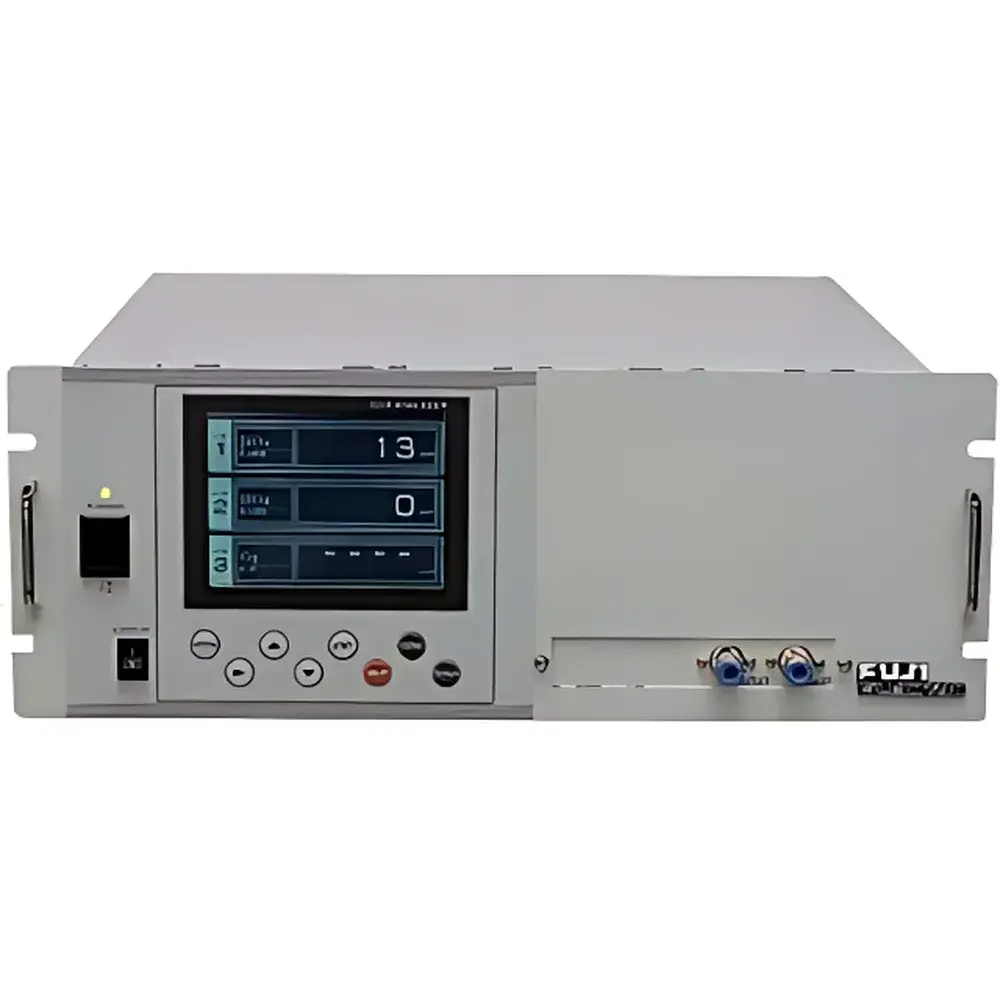
Fuji Electric FG-3000 Online Flue Gas Analyzer
| Origin | Japan |
|---|---|
| Manufacturer Type | Authorized Distributor |
| Origin Category | Imported |
| Model | FG-3000 |
| Pricing | Available Upon Request |
Overview
The Fuji Electric FG-3000 Online Flue Gas Analyzer is an industrial-grade, continuous emission monitoring system (CEMS) engineered for real-time, in-situ analysis of combustion exhaust gases in power plants, waste incinerators, cement kilns, and chemical process facilities. It employs dual-sensor measurement architecture: non-dispersive infrared (NDIR) spectroscopy for quantitative detection of SO2, NO, CO, CO2, and CH4, coupled with a high-stability zirconia (ZrO2) electrochemical cell for direct, paramagnetic-free O2 measurement. Unlike extractive systems requiring sample conditioning, the FG-3000 supports both in-situ probe installation and hot/wet extractive configurations—minimizing condensation artifacts and preserving gas-phase integrity. Its optical path design complies with ISO 12039 and EN 15267-3 for flue gas analyzers, ensuring traceable performance under varying temperature, pressure, and particulate load conditions.
Key Features
- Multi-component simultaneous analysis: SO2, NO, CO, CO2, CH4, and O2 measured in a single integrated platform
- NDIR optical modules with thermoelectrically cooled detectors and precision interference filters—optimized for long-term drift stability (<0.5% FS/month typical)
- Zirconia-based O2 sensor with automatic reference air compensation and temperature-controlled measurement chamber
- Configurable dual-range capability per gas channel (e.g., 0–100 ppm / 0–1000 ppm for SO2), enabling high-resolution low-concentration monitoring and robust high-load operation
- Integrated diagnostics: self-calibration verification, mirror contamination monitoring, flow/pressure validation, and fault-code logging compliant with IEC 61508 SIL 2 functional safety principles
- Standard 4–20 mA analog outputs (isolated, HART-enabled) plus RS-485 Modbus RTU and optional Ethernet/IP interface for SCADA integration
Sample Compatibility & Compliance
The FG-3000 is designed for hot, humid, and particulate-laden flue gas streams with temperatures up to 200 °C (probe version) or conditioned sample gas at 40–60 °C (extractive version). It accommodates gas matrices containing up to 25% vol. water vapor, <5 g/m³ dust loading (with optional ceramic filter), and trace halogen compounds common in municipal solid waste combustion. The analyzer meets EU Directive 2010/75/EU (IED) requirements for CEMS, conforms to EPA Method 3A and Method 7E for SO2/NOx measurement, and supports QA/QC protocols aligned with ISO 14064-3 and EN 14181 (QAL1–QAL3 certification framework). All firmware and calibration records are timestamped and audit-trail enabled per FDA 21 CFR Part 11 and GLP data integrity guidelines.
Software & Data Management
Local operation is managed via a ruggedized 7-inch TFT touchscreen HMI with multilingual UI (English, German, Chinese, Japanese). The embedded firmware supports automated zero/span checks using certified calibration gases, configurable alarm thresholds (high/low, rate-of-change), and event-triggered data logging at user-defined intervals (1 s to 1 h resolution). Raw sensor outputs, diagnostic flags, and environmental parameters (sample temp, pressure, flow) are stored internally for ≥30 days and exportable via USB or network transfer in CSV/Excel-compatible format. Optional Fuji Electric CEMS Manager software provides remote configuration, trend visualization, compliance reporting (including daily/weekly/monthly emission summaries), and electronic signature workflows for calibration logs—fully traceable for regulatory audits.
Applications
- Continuous emissions monitoring (CEM) for regulatory reporting under EU IED, US EPA 40 CFR Part 60/75, and China’s GB 13223–2011
- Combustion optimization in coal-, biomass-, and gas-fired boilers through real-time O2/CO ratio feedback
- De-NOx SCR/SNCR system control and efficiency verification
- Waste-to-energy plant stack compliance verification with simultaneous acid gas (SO2, NO) and greenhouse gas (CO2, CH4) quantification
- Process safety interlocks based on combustible gas (CH4, CO) concentration thresholds
FAQ
Does the FG-3000 require external sample conditioning for wet flue gas?
Yes—when deployed in extractive mode, it requires a heated sampling line, particulate filter, and optional chiller or permeation dryer depending on moisture content. In-situ probe variants eliminate conditioning but require periodic optical window cleaning.
What calibration gases are required for routine QAL2 verification?
Certified NIST-traceable gas mixtures in nitrogen: SO2 (e.g., 50 ppm), NO (100 ppm), CO (200 ppm), CO2 (10%), CH4 (1%), and O2 (span gas at 10% or 21%). Zero gas must be ultra-high-purity nitrogen (<0.1 ppm hydrocarbons).
Is the analyzer suitable for ammonia (NH3) slip measurement?
No—the FG-3000 does not include NH3 detection capability. Fuji Electric offers the separate FG-3100 model with tunable diode laser (TDLAS) for NH3 monitoring.
Can data be integrated into existing DCS or cloud-based environmental dashboards?
Yes—via native Modbus RTU over RS-485, optional OPC UA server, or third-party middleware supporting MQTT/REST APIs. All communication protocols support secure authentication and TLS encryption where applicable.
What is the recommended maintenance interval for optical path cleaning and sensor replacement?
Optical windows should be inspected and cleaned every 3 months in high-dust environments; zirconia O2 cells have a typical service life of 24–36 months; NDIR sources and detectors are rated for >5 years MTBF under continuous operation.







