
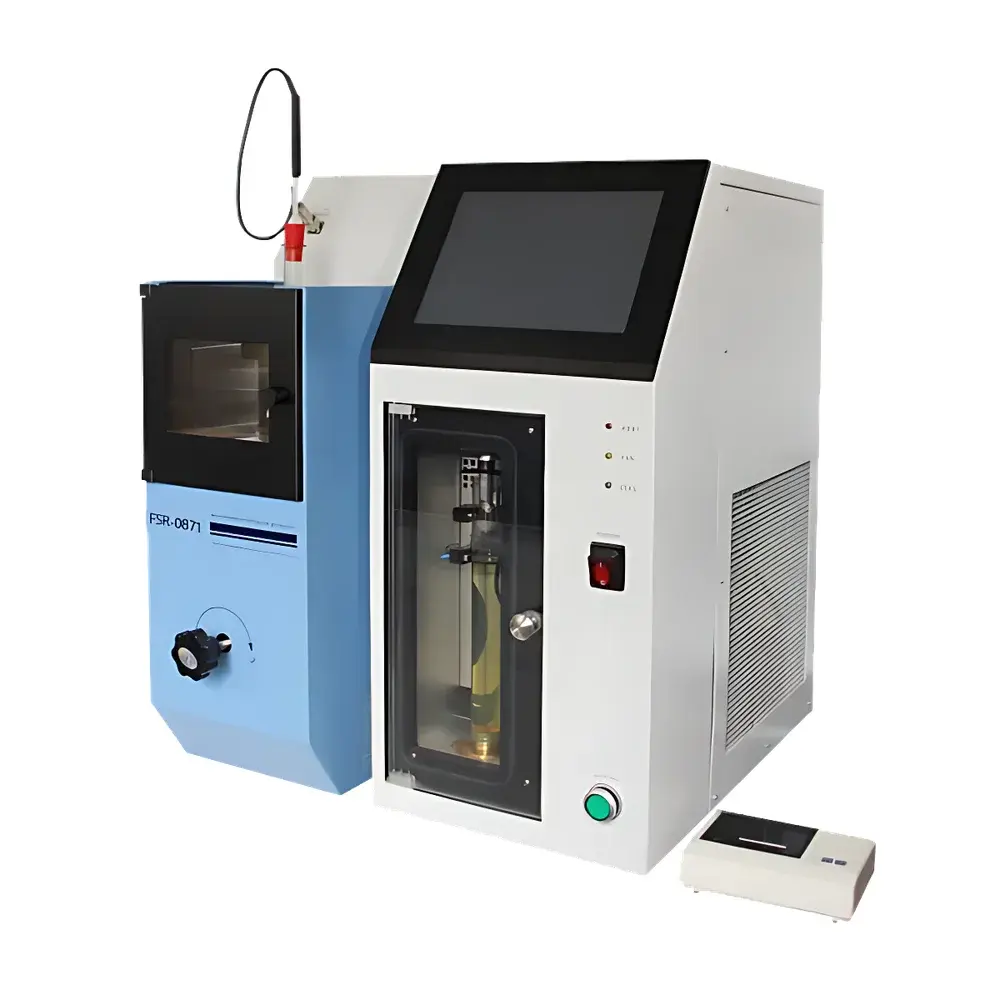
Fulande FDR-4371 Fully Automated Crude Oil Distillation Analyzer
| Brand | Fulande (csfriend) |
|---|---|
| Model | FDR-4371 |
| Origin | Hunan, China |
| Display | 7-inch color LCD touchscreen |
| Distillation Rate | 4–5 mL/min |
| Cold Bath Temperature Range | −10 to +70 °C |
| Heating Temperature Range | Ambient to +400 °C, Resolution: 0.1 °C |
| Volume Detection Range | 0–100 mL, Resolution: 0.1 mL |
| Power Supply | AC 220 V, 50 Hz, 1.5 kW |
| Operating Environment | 0–60 °C, RH ≤ 80% |
| Detection System | Imported XEC infrared cylinder reading sensor |
| Tracking System | HP precision linear tracking mechanism, positional resolution: 0.1 mL |
| Compliance | Designed to support ASTM D86, ASTM D1078, ISO 3405, and GB/T 6536 methodologies |
Overview
The Fulande FDR-4371 Fully Automated Crude Oil Distillation Analyzer is an engineered solution for standardized atmospheric distillation testing of petroleum products in accordance with internationally recognized test methods—including ASTM D86 (Standard Test Method for Distillation of Petroleum Products at Atmospheric Pressure), ASTM D1078 (Volatility of Volatile Organic Liquids), ISO 3405 (Petroleum Products—Determination of Distillation Characteristics at Atmospheric Pressure), and China’s national standard GB/T 6536. The instrument employs a dual-zone thermal control architecture: a programmable heating assembly with precise PID-regulated temperature ramping (0.1 °C resolution) and an independently controlled cold bath system (−10 to +70 °C) for condensate collection. Distillate volume is measured in real time using a high-stability infrared optical detection system (XEC-sourced), eliminating mechanical contact and ensuring long-term repeatability across repeated cycles. The core measurement principle relies on controlled vaporization kinetics, condensate volumetric accumulation, and synchronized thermal profiling—enabling traceable, method-compliant boiling point distribution analysis from initial boiling point (IBP) through final boiling point (FBP).
Key Features
- 7-inch full-color capacitive touchscreen interface with intuitive Chinese-language operating system and multi-mode programmability (manual, semi-automated, fully automated)
- Integrated HP-derived linear tracking mechanism with wear-free rail guidance; volumetric positioning accuracy of ±0.1 mL over the full 0–100 mL range
- One-touch calibration workflow reduces operator dependency and eliminates manual alignment drift common in legacy analog systems
- Intelligent anti-bumping algorithm dynamically modulates heating power during volatile fractions to suppress vapor-phase overpressure and prevent violent boiling events
- Dual independent thermal zones: main heater (ambient to 400 °C) and refrigerated condensate bath (−10 to +70 °C), each governed by adaptive PID controllers with real-time thermal feedback
- Embedded method management engine supports creation, storage, recall, and versioning of test protocols—including custom ramp rates, hold times, and endpoint logic
- Onboard data logging with non-volatile memory retains ≥1,000 complete test records with full metadata (operator ID, timestamp, ambient conditions, raw thermal/volume curves)
Sample Compatibility & Compliance
The FDR-4371 is validated for use with crude oils, naphthas, gasoline blends, kerosene, diesel fuels, and other light-to-medium distillates meeting ASTM D1298 density specifications (<1.0 g/cm³). Sample volume requirements align with ASTM D86: 100 mL ± 0.5 mL. All thermal sensors utilize certified platinum resistance elements (Pt100-class equivalent), traceable to NIST standards. The instrument architecture supports audit-ready operation under GLP and GMP frameworks: event logs record all user actions, parameter changes, and system alarms with timestamps; optional computer integration enables 21 CFR Part 11–compliant electronic signatures and secure data export (CSV, PDF, XML). Regulatory alignment includes full functional compatibility with ASTM D86 Annex A1 (precision statements), ISO/IEC 17025 clause 5.4.2 (equipment verification), and CNAS-CL01:2018 requirements for analytical instrument qualification.
Software & Data Management
The embedded firmware provides native support for method-driven test execution, including pre-defined templates for ASTM D86 Group 0–4 classifications. Real-time graphical overlays display simultaneous temperature vs. time and volume vs. temperature curves during distillation. Data output includes IBP, 10%, 50%, 90%, FBP, loss, and recovery percentages—all calculated per ASTM D86 Section 11. Export options include direct USB printing (thermal receipt or inkjet), CSV for LIMS ingestion, and encrypted PDF reports with digital watermarking. Optional PC-based control (via RS232 or Wi-Fi module, sold separately) adds remote monitoring, batch reporting, statistical process control (SPC) charting, and integration with enterprise laboratory information management systems (LIMS). All software modules undergo annual validation against reference distillation datasets certified by NIM (National Institute of Metrology, China).
Applications
This analyzer serves quality control laboratories in upstream oilfield operations, refinery QC/QA departments, fuel blending facilities, and third-party testing agencies performing routine specification compliance checks. Typical use cases include: verifying gasoline volatility (RVP correlation), assessing kerosene flash point safety margins, evaluating diesel fractional composition for cetane improver dosing, monitoring crude assay variability between batches, and supporting refinery process optimization via real-time distillation curve trending. Its robust thermal design and IR-based volume sensing make it particularly suitable for high-throughput environments where mechanical wear and calibration drift compromise data integrity in conventional glassware-based setups.
FAQ
Does the FDR-4371 comply with ASTM D86 revision 2023?
Yes—the instrument’s thermal control algorithms, data acquisition timing, and endpoint logic are aligned with ASTM D86-23 Annex A1 requirements for automated systems.
Can the cold bath temperature be set below 0 °C for low-volatility samples?
Yes, the refrigerated bath operates continuously from −10 °C to +70 °C, enabling accurate condensation of light ends (e.g., butanes, pentanes) without dry ice supplementation.
Is calibration traceable to international standards?
All temperature sensors are factory-calibrated against NIST-traceable references; users receive a calibration certificate with each unit, valid for 12 months under normal operation.
What is the minimum sample volume required for valid ASTM D86 testing?
The system requires exactly 100 mL ± 0.5 mL of homogenized, water-free sample—as mandated by ASTM D86 Section 7.1.
Can test data be exported to LIMS without additional middleware?
Yes—native CSV export supports direct import into most LIMS platforms; optional OPC UA or REST API modules enable real-time data streaming (custom quotation required).




