
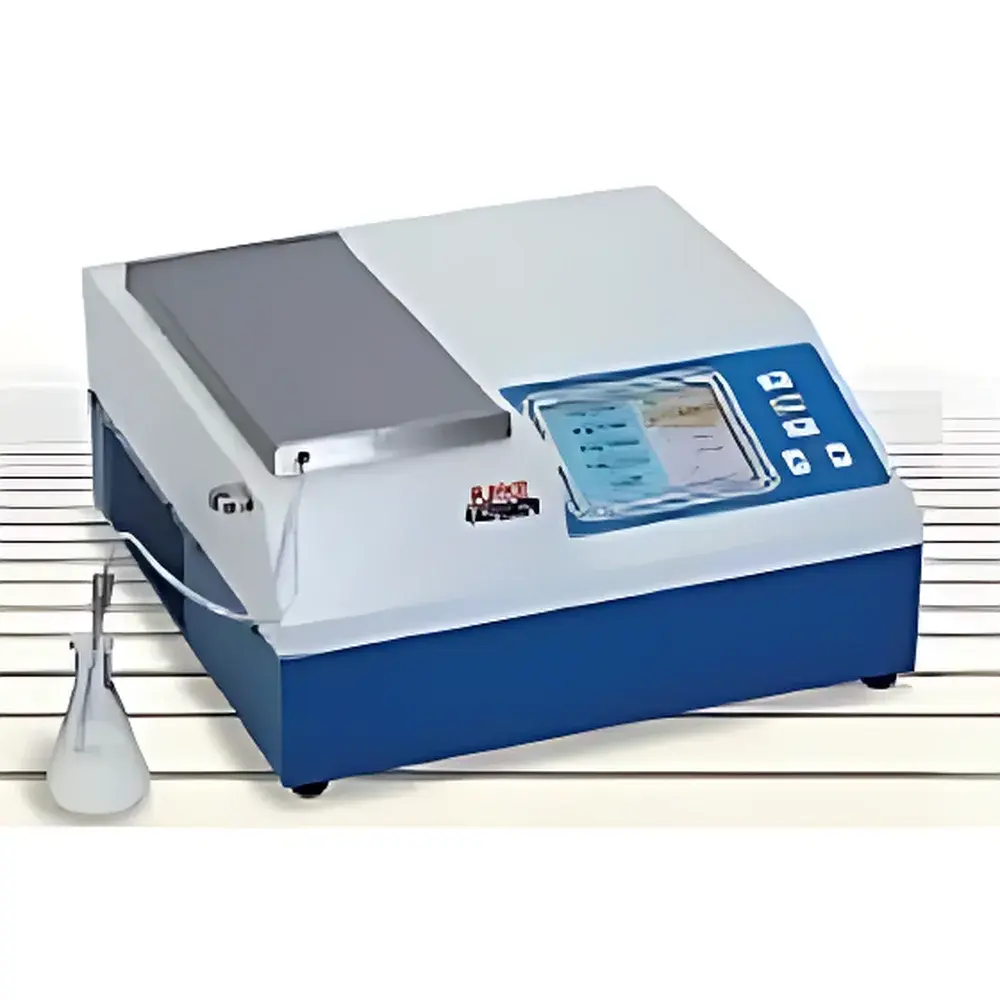
Funke-Gerber LACTOSTAR Human Milk Analyzer
| Origin | Germany |
|---|---|
| Manufacturer Type | Authorized Distributor |
| Origin Category | Imported |
| Model | LACTOSTAR |
| Detection Parameters | Fat, Protein, Lactose, SNF (Solids-Not-Fat), Minerals, Freezing Point |
| Automation Level | Fully Automatic |
| Sample Throughput | 90 samples/hour |
| Sample Volume | 12 mL per test |
| Measurement Ranges | Fat 0–35%, Protein 0–10%, Lactose 0–10%, SNF 0–15%, Minerals 0–5%, Freezing Point –0.500 to –0.750 °C |
| Repeatability | Fat & Minerals < 0.02%, Protein & Lactose < 0.03%, SNF < 0.04% |
| Accuracy | All parameters ±0.01% (w/w) or ±0.001 °C (Freezing Point) |
| Dimensions | 44 × 44 × 20 cm (W × L × D) |
| Weight | 15.5 kg |
| Power Supply | 230 V / 180 V, 50–60 Hz or 12 V DC |
| Interface | RS232 serial port |
| Display | Full-color LCD touchscreen with intuitive 5-key navigation |
| Calibration | 20 preloaded calibration profiles for human milk, bovine milk, goat milk, raw milk, skim milk, and cream |
| Certifications | CE, ISO 9001 |
Overview
The Funke-Gerber LACTOSTAR Human Milk Analyzer is a fully automated, benchtop near-infrared (NIR) and thermooptical dual-mode analyzer engineered for precise, rapid compositional assessment of human breast milk and other mammalian milks. Unlike conventional wet-chemistry or single-principle instruments, the LACTOSTAR integrates synchronized optical turbidimetry (via its proprietary “Blue Box” module) and differential thermal analysis (via the “Red Box” module) to simultaneously quantify fat, protein, lactose, solids-not-fat (SNF), minerals, and freezing point in a single 12 mL sample—without reagents, derivatization, or centrifugation. Its measurement principle is grounded in established physicochemical correlations: turbidity correlates with dispersed fat globules and casein micelles; thermal response curves reflect phase-transition behavior linked to total solids and solute concentration. This hybrid methodology delivers clinical-grade reproducibility while complying with foundational principles referenced in ISO 9622 (milk fat determination), ISO 8968 (milk protein by Kjeldahl), and AOAC 991.22 (lactose in dairy products), enabling traceable, method-validated results suitable for maternal nutrition counseling, neonatal research, and lactation clinic quality assurance.
Key Features
- Fully automated workflow: integrated sample aspiration, zero-point calibration, multi-stage cleaning (using dedicated wash pump and 5 L detergent reservoir), and thermal stabilization—all executed without manual intervention.
- Dual-sensor architecture: Blue Box (620–680 nm LED-based turbidimetric detection) and Red Box (precision Peltier-controlled thermal profiling) operate in parallel to decouple overlapping spectral interferences and enhance multivariate resolution.
- Clinical-grade precision: certified accuracy of ±0.01% (w/w) across all major macronutrients and ±0.001 °C for freezing point—meeting requirements for longitudinal tracking of lactation dynamics per WHO/UNICEF breastfeeding monitoring guidelines.
- Intuitive operator interface: 7-inch full-color LCD with tactile 5-key navigation (up/down/left/right/enter); menu-driven calibration selection, real-time status feedback, and on-screen troubleshooting prompts reduce training time and minimize operator error.
- Regulatory-ready data handling: RS232 interface supports bidirectional communication with LIS/HIS systems; built-in thermal printer provides immediate hardcopy audit trail compliant with GLP documentation standards.
- Multi-species adaptability: 20 factory-loaded calibration models cover human milk (colostrum, transitional, mature), bovine, caprine, and buffalo milk—enabling cross-population studies without recalibration.
Sample Compatibility & Compliance
The LACTOSTAR is validated exclusively for unadulterated, non-fermented, non-homogenized mammalian milk samples. It accepts raw expressed breast milk, manually or pump-collected, provided it is free from visible clots, excessive cream layer (>20% volume), added preservatives, acidifiers, dyes, or particulate contaminants (e.g., residual formula powder). Fermented products (yogurt, kefir), whey fractions, cheese curds, or reconstituted powders are incompatible due to altered colloidal structure and solute dissociation profiles. All measurements adhere to Good Laboratory Practice (GLP) and support FDA 21 CFR Part 11-compliant data integrity when paired with validated third-party software. The instrument carries CE marking under Directive 2014/30/EU (EMC) and 2014/35/EU (LVD), and its quality management system is certified to ISO 9001:2015 by TÜV Rheinland.
Software & Data Management
While the LACTOSTAR operates autonomously via embedded firmware, its RS232 port enables integration with external laboratory information systems (LIS) or custom databases using ASCII protocol. Each result includes timestamp, operator ID (manually entered), calibration profile ID, sample ID, and all six measured parameters with associated uncertainty flags. Raw thermal and optical signal logs are not user-accessible, preserving method integrity; however, summary reports—including trend charts for longitudinal maternal monitoring—can be exported as CSV or PDF via connected PCs. Audit trails record all calibration events, cleaning cycles, and critical error states, satisfying internal QA audits and external accreditation reviews (e.g., CAP, JCI, or national maternal health program inspections).
Applications
- Clinical lactation support: objective quantification of breast milk macronutrient shifts during early lactation, postpartum recovery, or maternal dietary interventions—supporting evidence-based nutritional counseling.
- Neonatal intensive care units (NICUs): rapid assessment of donor milk composition prior to fortification, ensuring optimal caloric and protein delivery to preterm infants.
- Maternal-infant cohort studies: high-throughput phenotyping of milk composition across demographic, geographic, or dietary variables—facilitating epidemiological analysis of lactation biology.
- Human milk banking: batch screening for compositional consistency, contamination detection (via anomalous freezing point depression), and inventory stratification by energy density.
- Research laboratories: method comparison studies against reference techniques (e.g., GC for fatty acids, HPLC for oligosaccharides), serving as a primary screening tool prior to targeted biochemical assays.
FAQ
What sample volume is required per analysis?
12 mL of undiluted, uncentrifuged milk is required. No pre-treatment—such as heating, filtering, or homogenization—is necessary.
Can the LACTOSTAR analyze frozen-thawed breast milk?
Yes, provided the sample is fully thawed at 4 °C and gently mixed to re-suspend fat globules without introducing air bubbles or foam.
How often must the instrument be calibrated?
Factory calibrations are stable for ≥12 months under routine use. Daily zero-point verification is automated; full recalibration is only required after maintenance, sensor replacement, or if QC control samples deviate beyond ±0.02% for fat or ±0.002 °C for freezing point.
Is the LACTOSTAR suitable for regulatory submission data?
Results meet ISO/IEC 17025 method validation criteria for screening-level analysis. For definitive regulatory filings (e.g., FDA IND submissions), orthogonal confirmation with reference methods is recommended per ICH M10 guidance.
Does the system support multi-user access with role-based permissions?
No—the embedded OS does not include user authentication. For environments requiring access control, integration with upstream LIS or middleware is advised to enforce operator-level permissions and audit logging.




