
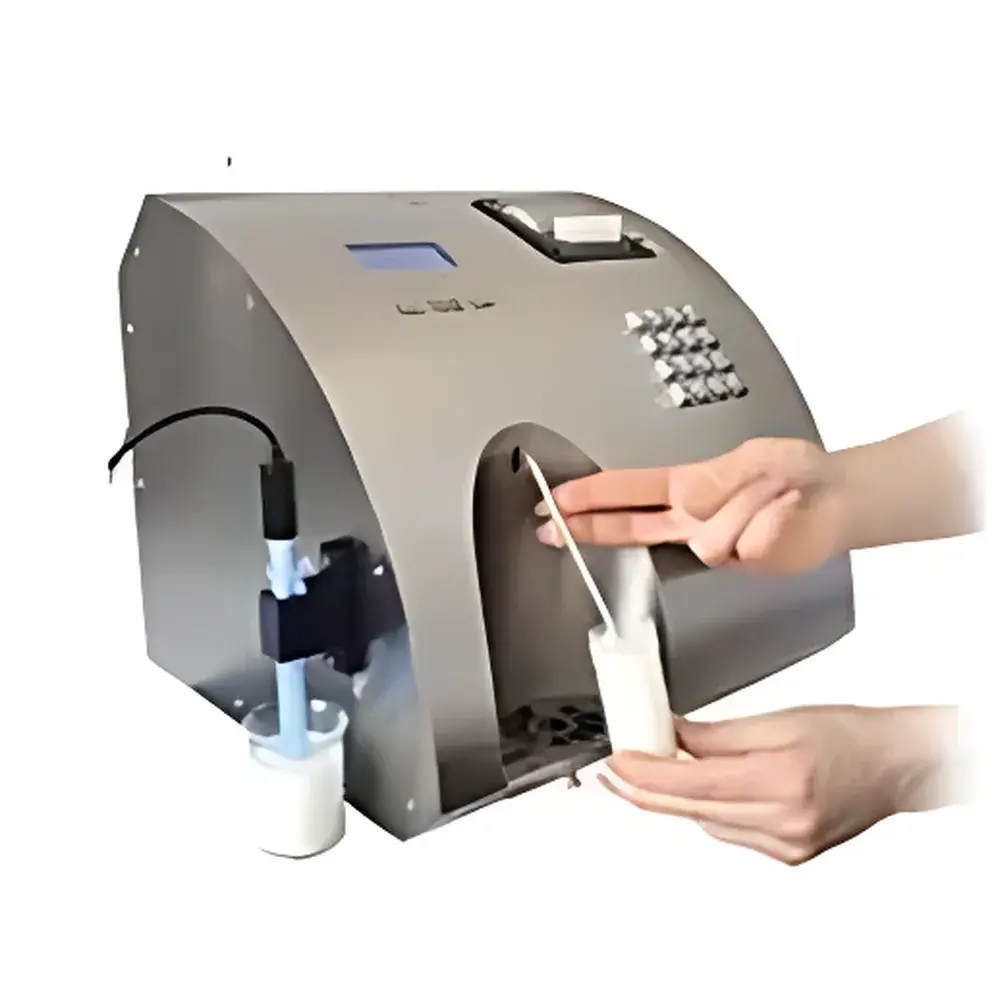
Funke MCC Dairy Composition Analyzer
| Brand | Funke |
|---|---|
| Origin | Bulgaria |
| Model | MCC |
| Sample Throughput | ≥40 samples/hour |
| Power Consumption | Low-power design, no hazardous chemicals required |
| Interface | RS232 |
| Operating Ambient Temperature | 10–40 °C (optional up to 43 °C) |
| Milk Sample Temperature Range | 15–40 °C |
| Relative Humidity | 30–80% RH |
| Fat | 0.01–45%, ±0.06% |
| Non-Fat Solids | 3–40%, ±0.15% |
| Density | 1000–1160 kg/m³, ±0.3 kg/m³ |
| Protein | 2–15%, ±0.15% |
| Lactose | 0.01–20%, ±0.2% |
| Water Adulteration | 0–70%, ±3% |
| Sample Temperature Measurement | 5–40 °C, ±1 °C |
| Freezing Point | −0.4 to −0.7 °C, ±0.005 °C |
| Ash Content | 0.4–4%, ±0.05% |
| pH | 0–14, ±0.05 |
| Conductivity | 2–14 mS/cm, ±0.05 mS/cm |
| Weight Measurement | 0–150 kg, ±0.10 kg |
| Total Solids | 0–50%, ±0.17% |
Overview
The Funke MCC Dairy Composition Analyzer is a benchtop near-infrared (NIR) and integrated physical property measurement system engineered for rapid, non-destructive, and reagent-free analysis of raw and processed bovine milk, human breast milk, and dairy-based formulations. It employs multi-wavelength NIR spectroscopy combined with precision density, freezing point depression, electrical conductivity, and pH sensing to simultaneously quantify compositional parameters in accordance with internationally recognized dairy testing protocols. Designed for compliance with ISO 9622:2013 (Milk — Determination of fat, protein, lactose, total solids and other constituents — Guidance on the use of mid-infrared spectrometry), the MCC analyzer delivers laboratory-grade reproducibility in field-deployable form factor. Its architecture supports routine quality control in collection centers, processing plants, research laboratories, and mobile veterinary or nutritional assessment units.
Key Features
- Integrated multi-sensor platform combining NIR spectroscopy, oscillating U-tube density measurement, cryoscopic freezing point determination, conductometric analysis, and potentiometric pH sensing
- Peristaltic pump-driven fluid handling with automated rinse cycle between samples—eliminates cross-contamination and reduces operator intervention
- Compact, lightweight chassis (under 12 kg) with shock-absorbing housing; certified for operation in moving vehicles per EN 60068-2-6 (vibration) and EN 60068-2-27 (shock)
- Dual-reference self-calibration using two standardized milk reference samples—no external calibration kits required for daily operation
- Minimal sample requirement: ≤2 mL per analysis, enabling high-throughput screening without waste or dilution
- Built-in thermal printer with timestamped output—supports GLP-compliant hardcopy record generation without external peripherals
- Low-power consumption (≤25 W nominal) and passive cooling—suitable for off-grid or battery-backed operation in remote locations
- RS232 serial interface compliant with EIA/TIA-232-F standard; compatible with legacy LIMS and SCADA systems via ASCII command protocol
Sample Compatibility & Compliance
The MCC analyzer accepts raw cow, goat, sheep, and human breast milk without pre-filtration or homogenization. It accommodates viscous or partially coagulated samples through optimized flow-path geometry and pulse-modulated peristaltic actuation. All measurement algorithms are validated against reference methods defined in ISO 5725 (accuracy and precision), ISO/IEC 17025 (testing laboratory competence), and AOAC Official Method 2012.01 (NIR milk analysis). The instrument meets CE marking requirements under Directive 2014/30/EU (EMC) and 2014/35/EU (LVD), and its software architecture supports audit trails and electronic signature functionality aligned with FDA 21 CFR Part 11 for regulated environments.
Software & Data Management
Embedded firmware (v4.2+) provides real-time data visualization, trend logging, and configurable pass/fail thresholds per parameter. Data export is supported in CSV and XML formats with embedded metadata (operator ID, sample ID, ambient conditions, instrument serial number). Optional PC-based software enables method transfer, multivariate calibration model management (PLS regression), and integration with enterprise-level QMS platforms via OPC UA or RESTful API. All stored measurements include cryptographic hash integrity verification and time-stamped revision history, satisfying traceability requirements under ISO/IEC 17025 Clause 7.7 and EU Annex 11.
Applications
- On-farm and collection center milk payment grading based on fat, protein, and somatic cell proxy indicators (conductivity, freezing point)
- Human milk banking—quantification of macronutrient composition for neonatal fortification protocols
- R&D of infant formula, fermented dairy products, and plant-milk analogs requiring precise baseline characterization
- Regulatory surveillance for adulteration detection (water dilution, reconstitution, foreign fat addition)
- Process validation during pasteurization, homogenization, and ultrafiltration—monitoring compositional drift in real time
- Academic research in lactation physiology, dairy microbiology, and nutritional biochemistry
FAQ
Does the MCC analyzer require daily calibration with certified reference standards?
No—dual-sample self-calibration eliminates the need for daily external standards. Annual verification against NIST-traceable reference materials is recommended per ISO/IEC 17025.
Can it analyze frozen or refrigerated milk samples directly?
Yes—sample temperature sensor auto-compensates for thermal effects within 5–40 °C range; however, optimal accuracy is achieved when samples equilibrate to 20–30 °C prior to loading.
Is the instrument suitable for GMP-regulated production environments?
Yes—when configured with optional audit trail module and electronic signature capability, it fulfills FDA 21 CFR Part 11 and EU GMP Annex 11 requirements for electronic records.
What maintenance intervals are specified for the peristaltic pump tubing?
Tubing replacement is scheduled every 6 months under continuous operation (≥8 h/day) or after 10,000 cycles, documented in the built-in service log.
How is data security ensured during RS232 transmission?
All serial communication uses hardware handshaking (RTS/CTS) and configurable parity/error-checking (even/odd/mark/space); no encryption is applied at the transport layer, consistent with industrial serial protocol conventions.





