
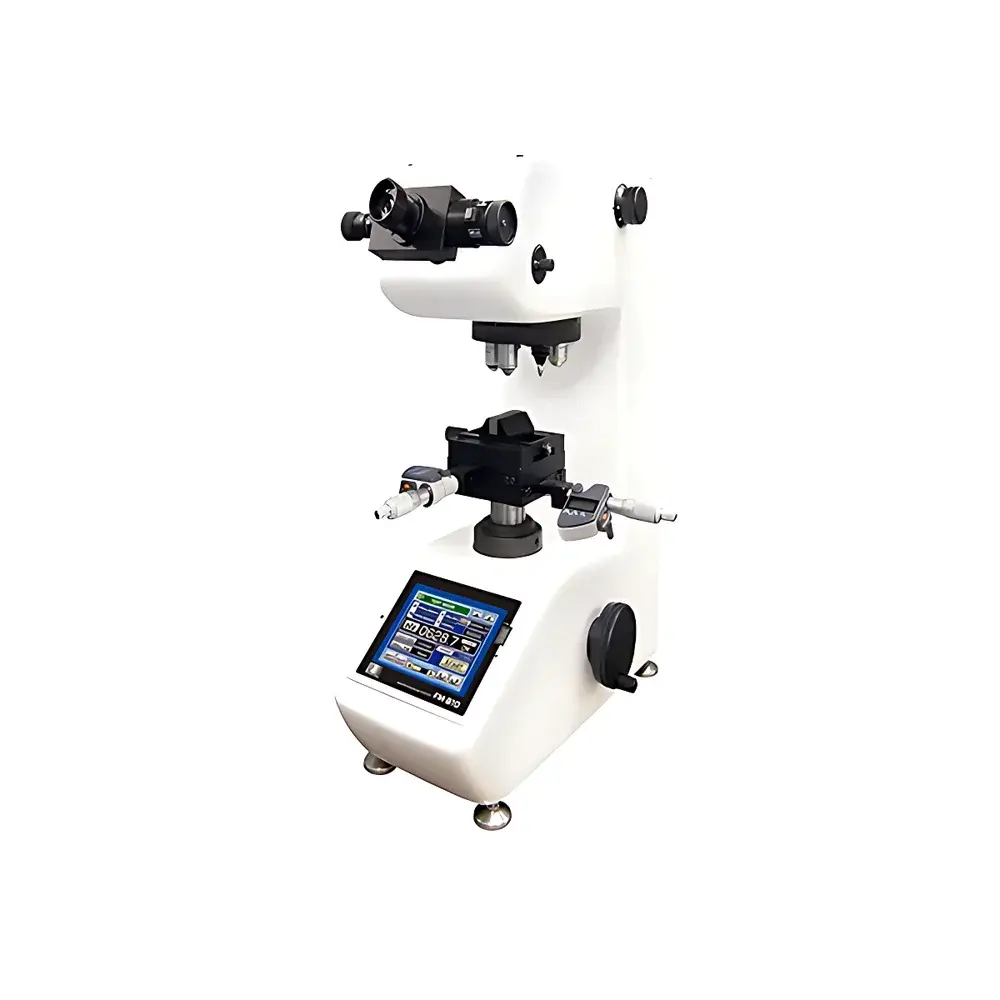
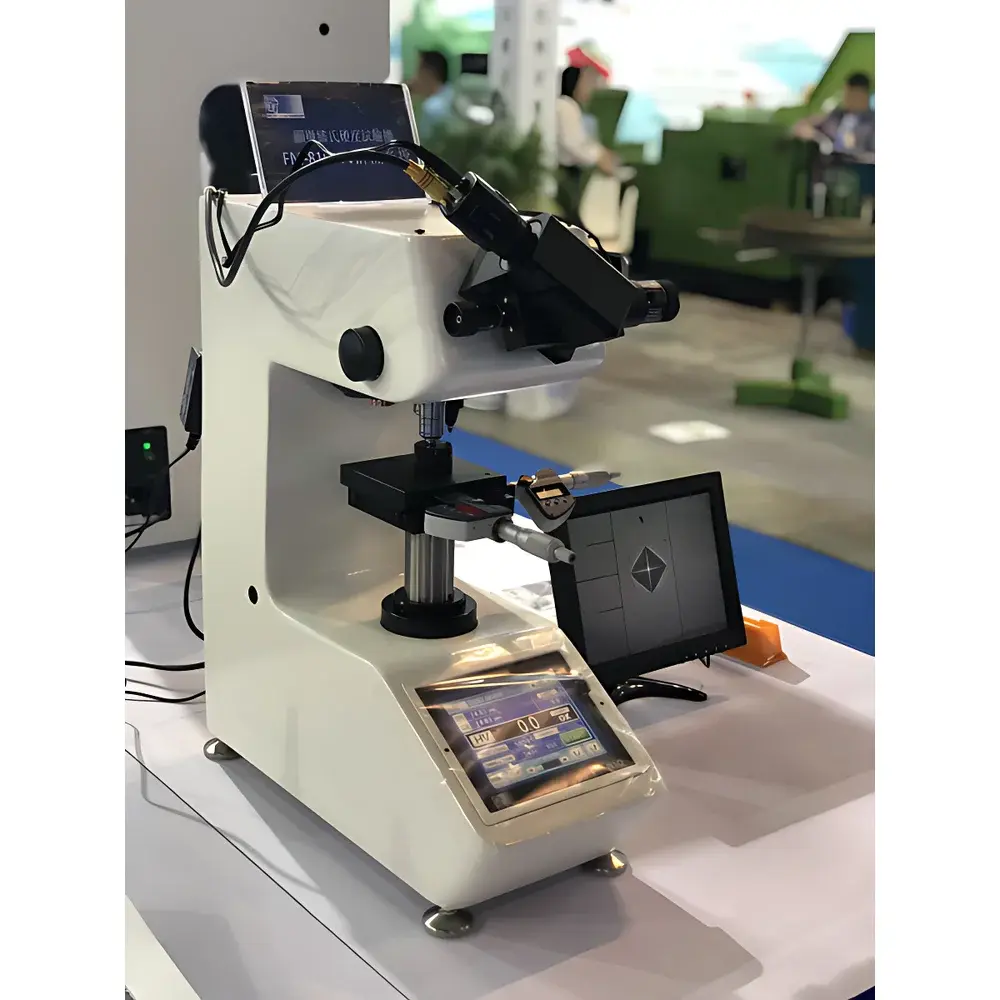
Future-Tech FM-810 Advanced Micro-Vickers Hardness Tester
| Brand | Future-Tech |
|---|---|
| Origin | Japan |
| Model | FM-810 |
| Indentation Load Range | 1 g to 2000 g (selectable combinations) |
| Maximum Test Load | 2000 g |
| Specimen Height Clearance | 95 mm (H) × 115 mm (D) |
| Optical System | Dual-standard objective lenses (10× & 50×), expandable up to four objectives (5×, 20×, 40×, 100×) |
| Measurement Resolution | 0.01 µm (at 500× magnification) |
| Display | 7-inch full-color LCD touch interface |
| Compliance | JIS B 7734 / B 7735, ASTM E384, ISO 6507-2, ISO 8507-2, SAE J417b, ASTM E140 |
Overview
The Future-Tech FM-810 is a precision-engineered micro-Vickers hardness tester designed for high-accuracy indentation hardness measurement in metallurgical laboratories, R&D centers, and quality control environments. Based on the established principles of Vickers hardness testing—where a diamond pyramid indenter (136° apex angle) is applied under controlled static load to produce a geometrically reproducible impression—the FM-810 delivers traceable, repeatable results across a broad load range (1 g to 2000 g). Its optical-mechanical architecture integrates Japanese manufacturing rigor with metrological best practices, ensuring long-term stability and minimal operator-induced variability. The instrument is calibrated and verified per JIS B 7725 (hardness tester verification), JIS B 7734 (microhardness testing methods), and ISO 6507-2 (calibration of reference blocks), supporting compliance with GLP and GMP documentation requirements.
Key Features
- 7-inch full-color LCD touchscreen interface with intuitive navigation, enabling direct access to test setup, real-time load monitoring, D1/D2 diagonal measurement display, dwell time adjustment (5–99 s), and on-screen hardness calculation (HV, HK, HBW, HBS, KC fracture toughness).
- Motorized turret with automatic objective lens switching (up to four positions), compatible with 5×, 10×, 20×, 40×, 50×, and 100× objectives for optimized resolution and field-of-view selection.
- High-rigidity monolithic frame with vibration-damped base and proprietary anti-corrosion coating, validated through repeated thermal and mechanical stability testing over 500-hour operational cycles.
- Advanced surface correction algorithms—including cylindrical and spherical curvature compensation—enabling accurate hardness evaluation on non-planar specimens without manual geometric correction factors.
- Integrated digital coordinate input via optional digital micrometer (X-Y stage), allowing precise positional referencing and automated multi-point mapping when upgraded with motorized XY stages.
- Comprehensive hardness conversion engine compliant with SAE J417b and ASTM E140, supporting cross-scale correlation between Vickers (HV), Knoop (HK), Brinell (HBW/HBS), and fracture toughness (KC) values.
Sample Compatibility & Compliance
The FM-810 accommodates specimens up to 95 mm in height and 115 mm in depth, accommodating standard metallographic mounts, turbine blades, thin-film coatings, and small-scale additive manufacturing parts. Its LED illumination system features adaptive brightness control during indentation—dimming automatically upon load application to reduce glare and improve contrast for precise diagonal measurement. All hardness measurements adhere to international standards: ASTM E384 (microindentation hardness of materials), ISO 6507-2 (verification of hardness testers), and JIS B 7735 (testing of thin films and surface layers). The system supports audit-ready data integrity via timestamped test records, operator ID tagging, and configurable pass/fail thresholds (HI/OK/LOW) aligned with internal QC protocols or ISO/IEC 17025 reporting frameworks.
Software & Data Management
The FM-810 operates with FT-ZERO hardness analysis software, which provides post-test image capture, semi-automated diagonal measurement (with user-confirmed edge detection), statistical reporting (mean, SD, CV%), and customizable certificate generation. USB and RS232C interfaces enable seamless integration into LIMS or enterprise QA systems. When paired with the optional AR-based automatic indentation recognition module (1.3 MP CMOS imaging system), the platform supports fully automated measurement sequences—including auto-focus, auto-lighting, auto-indentation, and auto-measurement—with traceability logs meeting FDA 21 CFR Part 11 requirements (electronic signatures, audit trails, data immutability). All firmware updates and calibration certificates are digitally signed and version-controlled.
Applications
- Metallographic evaluation of heat-treated steels, aluminum alloys, and titanium components in aerospace and automotive supply chains.
- Thin-film hardness profiling (e.g., PVD/CVD coatings, nitrided surfaces) using low-load indentation (1–10 g) with 100× objective and digital micrometer registration.
- Fracture toughness assessment (KC value) of brittle ceramics and intermetallics via crack-length measurement from Vickers indentations.
- Quality assurance of medical device substrates (e.g., stainless steel surgical tools, cobalt-chromium dental alloys) under ISO 13485-compliant workflows.
- Academic research in nanomechanics, where load-dependent hardness behavior (indentation size effect) is analyzed across multiple loads with identical tip geometry.
FAQ
Does the FM-810 support automated indentation measurement out of the box?
No—standard configuration includes manual diagonal measurement via eyepiece or digital micrometer. Fully automated indentation analysis requires the optional AR-based image acquisition module and FT-ZERO software license.
Can the FM-810 perform Knoop hardness testing?
Yes—the instrument supports both Vickers and Knoop indenters; HK testing is selectable directly on the touchscreen interface, with dedicated calculation algorithms per ASTM E384 Annex A2.
Is calibration traceable to national standards?
Yes—each unit ships with a NIST-traceable hardness certificate (via JCSS-accredited calibration lab in Japan) and includes built-in self-diagnostic routines for load cell, optical alignment, and encoder verification.
What upgrade paths are available for high-throughput labs?
Motorized XY stage (100 × 100 mm travel), automatic turret with dual-indenter capability (Vickers + Knoop), and networked FT-ZERO Enterprise software with remote monitoring and batch report scheduling.
How is specimen thickness accounted for in hardness calculations?
The FM-810’s embedded calculator applies the ASTM E384 thickness correction factor (t ≥ 2.5 × d, where d = diagonal length) and displays real-time compliance status during test setup to prevent subsurface deformation artifacts.



