
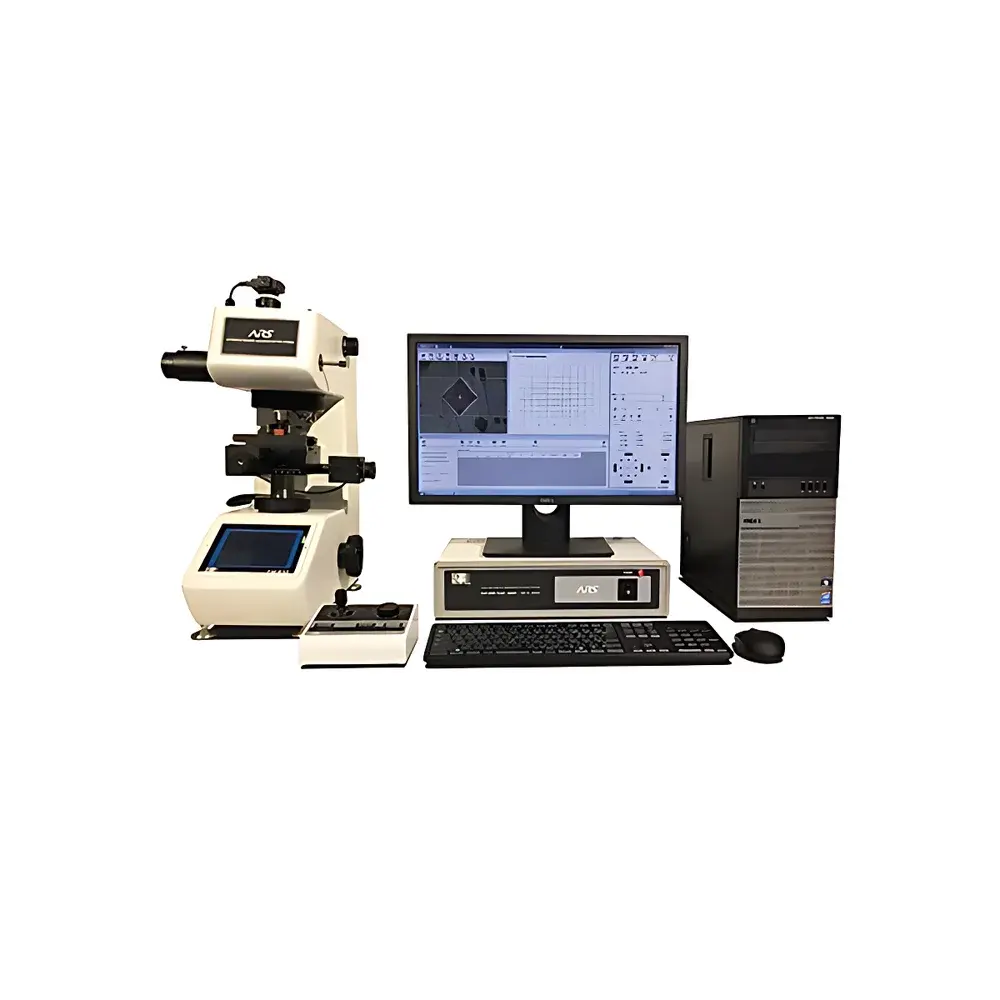
Future-Tech FM810-ARSF Fully Automated Vickers Microhardness Tester
| Brand | Future-Tech |
|---|---|
| Origin | Japan |
| Model | FM810-ARSF |
| Indentation Force Range | 1 g–2000 g (selectable) |
| Maximum Test Load | 2000 g |
| Test Height | 95 mm |
| Test Depth | 115 mm |
| Minimum Indentation Size | 16 µm (diagonal) |
| Measurement Resolution | 0.1 µm |
| Repeatability | ±0.5% at HV500 (~500 gf) |
| Hardness Scales | HV, HK |
| XY Stage Travel (FM/FV series) | 50 mm × 50 mm |
| Minimum Stage Step | 1 µm |
| Camera | 1.3 MP CMOS |
| Software | FT-ZERO |
| Compliance | ASTM E384, ISO 6507-1, JIS Z 2244 |
Overview
The Future-Tech FM810-ARSF is a fully automated Vickers microhardness testing system engineered for high-precision, unattended hardness evaluation in R&D laboratories, quality control environments, and metallurgical research facilities. It operates on the principle of optical indentation measurement following standardized diamond pyramid indentation under controlled static load—compliant with ASTM E384 (Standard Test Method for Microindentation Hardness of Materials), ISO 6507-1 (Metallic materials — Vickers hardness test — Part 1: Test method), and JIS Z 2244 (Vickers hardness test methods). The system integrates a motorized Z-axis with closed-loop auto-focusing, an intelligent ARS-F (Automated Recognition & Scanning – Full) platform, and advanced image-processing algorithms optimized for metallic microstructures—including specimens with surface scratches, grain boundaries, or heterogeneous phase distributions. Unlike conventional manual or semi-automated systems, the FM810-ARSF eliminates operator-dependent variability by automating indentation formation, focus optimization, image acquisition, and geometric analysis—all within a single workflow.
Key Features
- Fully automated indentation measurement using shadow-based image processing—robust against surface artifacts such as machining marks, oxidation layers, or grain contrast variations.
- ARS-F dual-axis motorized XY stage (50 mm × 50 mm travel, 1 µm resolution) with joystick-controlled fine positioning and double-click centering for rapid sample alignment.
- Auto-focus Z-axis with tilt-surface tracking compensation—user-defined inclination angle input enables adaptive focal plane adjustment along non-planar surfaces, improving load application accuracy and reducing autofocus cycle time.
- 1.3 MP high-resolution CMOS camera with real-time digital imaging and on-the-fly contrast enhancement for reliable detection of sub-16 µm Vickers indentations.
- FT-ZERO control and data analysis software supporting multi-point sequential, contour-following, radial arc, random matrix, and teach-mode measurement routines.
- Safety interlock system with mechanical and optical limiters to prevent objective lens or indenter collision with specimen surfaces during automated traversal.
- On-board image storage with timestamped metadata; allows retrospective re-measurement of saved indentation images without retesting the sample.
Sample Compatibility & Compliance
The FM810-ARSF accommodates a wide range of metallic and ceramic specimens—including heat-treated steels, case-hardened components, thin coatings, sintered powders, and small-scale weld zones—within its 95 mm vertical clearance and 115 mm depth envelope. Its modular stage configuration supports both standard FM/FV-series (50 × 50 mm travel) and extended FLV-series platforms (180 × 110 mm). All hardness calculations adhere to internationally recognized traceability frameworks. Data audit trails, user access logs, and electronic signature support align with GLP and GMP documentation requirements. Optional 21 CFR Part 11 compliance modules are available for regulated pharmaceutical and aerospace applications requiring FDA-auditable records.
Software & Data Management
FT-ZERO software provides comprehensive post-test analysis capabilities including hardness distribution mapping, effective case depth determination (e.g., for carburized or induction-hardened layers), statistical summaries (mean, min/max, standard deviation, unbiased variance), and pass/fail threshold evaluation. Hardness profiles are rendered in full-color gradient plots synchronized with coordinate-position overlays. Export functions include native Excel (.xlsx) output with embedded charts, CSV for third-party statistical packages, and PDF report generation with customizable templates. Distance and angular measurements between arbitrary points are performed via intuitive screen-click interface. Image programming mode enables simultaneous multi-origin alignment across large fields-of-view without physical stage movement—reducing setup overhead by up to 70% in batch analysis workflows.
Applications
- Case depth profiling of gear teeth, bearing races, and transmission components per ASTM E1077 and ISO 2639.
- Thin-film and PVD/CVD coating hardness validation on substrates with thermal expansion mismatch.
- Microstructural hardness gradients in additive-manufactured alloys and functionally graded materials.
- Quality assurance of brazed joints, solder interfaces, and dissimilar metal welds.
- Research-grade indentation mapping for creep-resistant superalloys and nuclear-grade stainless steels.
- Calibration verification and inter-laboratory round-robin studies under ISO/IEC 17025-accredited conditions.
FAQ
What hardness scales does the FM810-ARSF support?
HV (Vickers) and HK (Knoop) scales are natively supported, with automatic scale conversion and cross-calibration options.
Can the system measure on curved or inclined surfaces?
Yes—the ARS-F variant includes programmable Z-axis tilt compensation, allowing accurate indentation placement and focus maintenance on angled or cylindrical specimens.
Is remote operation or network integration possible?
FT-ZERO supports LAN-based remote monitoring and control; optional OPC UA and TCP/IP interfaces enable integration into factory MES or LIMS environments.
How is measurement repeatability verified?
Built-in reference block routines execute periodic calibration checks using NIST-traceable hardness standards, logging deviations and triggering alerts if ±0.5% repeatability thresholds are exceeded.
Does the system comply with regulatory documentation requirements?
With optional audit trail and electronic signature modules, the FM810-ARSF meets 21 CFR Part 11, EU Annex 11, and ISO 17025 data integrity specifications.



