
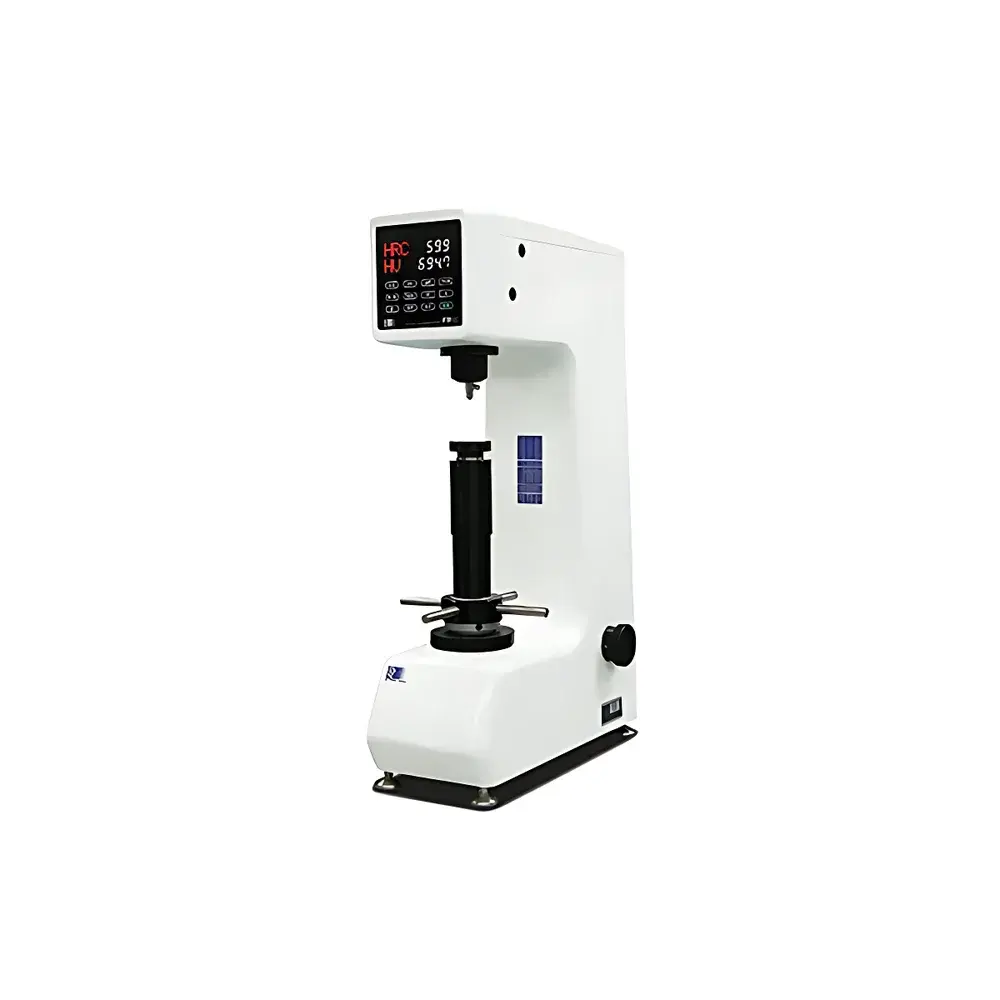
Future-Tech FR-1E Rockwell Hardness Tester
| Brand | Future-Tech |
|---|---|
| Origin | Japan |
| Manufacturer Status | Authorized Distributor |
| Product Origin | Imported |
| Model | FR-1E |
| Instrument Type | Rockwell Hardness Tester |
| Hardness Range | 20–80 HRC (typical scale) |
| Total Test Force | 150 kgf (1471 N) |
| Maximum Specimen Height | 255 mm |
| Vertical Travel | 255 mm |
| Load Axis Stability | High-sensitivity vertical load column with anti-lateral displacement guide rods |
| Calibration | Multi-point reference correction (low/medium/high), compliant with JIS Z 2245, ISO 6508-1, ASTM E18 |
| Geometry Correction | Spherical & cylindrical specimen diameter input for curvature compensation |
| Indentation Depth Display | Max. penetration depth shown simultaneously with hardness value |
| Data Output | RS-232C + USB adapter supported |
| Power Supply | AC 100 / 115 / 220 V, 50 / 60 Hz |
| Net Weight | 82 kg |
| Dimensions (W×D×H) | 196 × 487 × 820 mm |
Overview
The Future-Tech FR-1E Rockwell Hardness Tester is a precision-engineered, fully automatic benchtop hardness testing system designed for rigorous industrial quality control and materials R&D laboratories. Based on the classical Rockwell principle—measuring permanent indentation depth under major and minor loads—the FR-1E delivers high reproducibility across standardized scales (e.g., HRC, HRB, HRA) through rigorously controlled force application, thermal-stable mechanical architecture, and real-time depth monitoring. Its reinforced monolithic frame minimizes vibration transmission and structural flexure during loading, ensuring measurement stability even under extended operational cycles or in non-ideal lab environments. The instrument complies with international metrological standards including ISO 6508-1:2016, ASTM E18-23, and JIS Z 2245, making it suitable for GLP/GMP-regulated environments where traceability and audit readiness are mandatory.
Key Features
- High-stability vertical load column with precision-ground guide rods to suppress lateral displacement—critical for accurate testing of curved surfaces (cylindrical and spherical specimens).
- Integrated geometry correction algorithm: users input specimen diameter to automatically adjust hardness values per ISO 6508-1 Annex B, enabling compliant measurements on non-flat geometries without manual interpolation.
- Real-time maximum indentation depth display synchronized with hardness result—enabling concurrent evaluation of material plasticity and elastic recovery behavior.
- Dual-mode illumination navigation system: LED-guided preload positioning combined with audible feedback ensures repeatable initial contact detection, reducing operator dependency and setup variability.
- Pass/fail judgment engine with configurable upper/lower tolerance limits (displayed as HL/OK/LO); supports statistical analysis via mean value calculation across user-defined test points.
- Multi-point reference calibration (low/medium/high range) aligned with Tatsumi-certified verification protocols—ensuring long-term accuracy drift compensation without external recalibration services.
- RS-232C interface with optional USB conversion adapter for seamless integration into LIMS or MES platforms; raw data export includes timestamp, load sequence, depth trace, and final hardness value.
Sample Compatibility & Compliance
The FR-1E accommodates specimens up to 255 mm in height and 165 mm in depth, supporting common industrial components such as bearing races, valve seats, gear teeth, and heat-treated shafts. Its optimized anvil clearance and robust crosshead design permit testing of both flat plates and curved parts—including cylinders down to Ø10 mm and spheres down to Ø6 mm—without fixture modification. All hardness calculations adhere strictly to the definitions and tolerances specified in ISO 6508-1 and ASTM E18. The system supports full audit trail generation when paired with compliant third-party software, satisfying FDA 21 CFR Part 11 requirements for electronic records and signatures in regulated manufacturing settings.
Software & Data Management
While the FR-1E operates autonomously via its built-in microprocessor-based controller, its RS-232C port enables bidirectional communication with external PCs running validated hardness data management software. Exported datasets include full load-displacement curves, dwell time stamps, environmental metadata (if sensor-integrated), and pass/fail flags. Users may configure automated report templates compliant with ISO/IEC 17025 documentation requirements—including instrument ID, calibration due date, operator ID, and uncertainty estimation fields. No proprietary cloud platform is required; raw ASCII or CSV output ensures compatibility with Excel, MATLAB, Minitab, and enterprise QMS systems.
Applications
- Verification of case depth and core hardness in carburized or nitrided steel components.
- In-process hardness monitoring for aerospace fasteners and turbine blade substrates.
- Supplier qualification testing per automotive OEM specifications (e.g., GMW14872, Ford WSK-M2G326-A2).
- Research into heat treatment effects on alloy steels, tool steels, and stainless grades.
- Calibration laboratory use as a reference standard tester for secondary hardness blocks (Class A per ISO 6508-2).
- Failure analysis labs assessing localized softening or embrittlement after welding or thermal exposure.
FAQ
Does the FR-1E support all Rockwell scales?
Yes—it is configured for standard Rockwell scales including HRA, HRB, HRC, HRD, HRF, HRG, HRH, HRR, and HR15N–HR45N, subject to appropriate indenter and load selection per ISO 6508-1 Table 1.
Can curvature correction be applied outside nominal hardness ranges?
No—geometry compensation is only valid within the calibrated hardness range (20–80 HRC for typical applications) and requires user-input diameter values conforming to ISO 6508-1 Annex B constraints.
Is firmware update capability available?
Firmware updates are performed via RS-232C using authorized service tools; no over-the-air or USB-based update path is provided to maintain regulatory integrity.
What maintenance intervals are recommended?
Annual verification against certified reference blocks is advised; daily cleaning of indenter and anvil surfaces, quarterly mechanical alignment checks, and biannual load cell validation per ISO 6508-2 are part of standard preventive maintenance protocols.



