
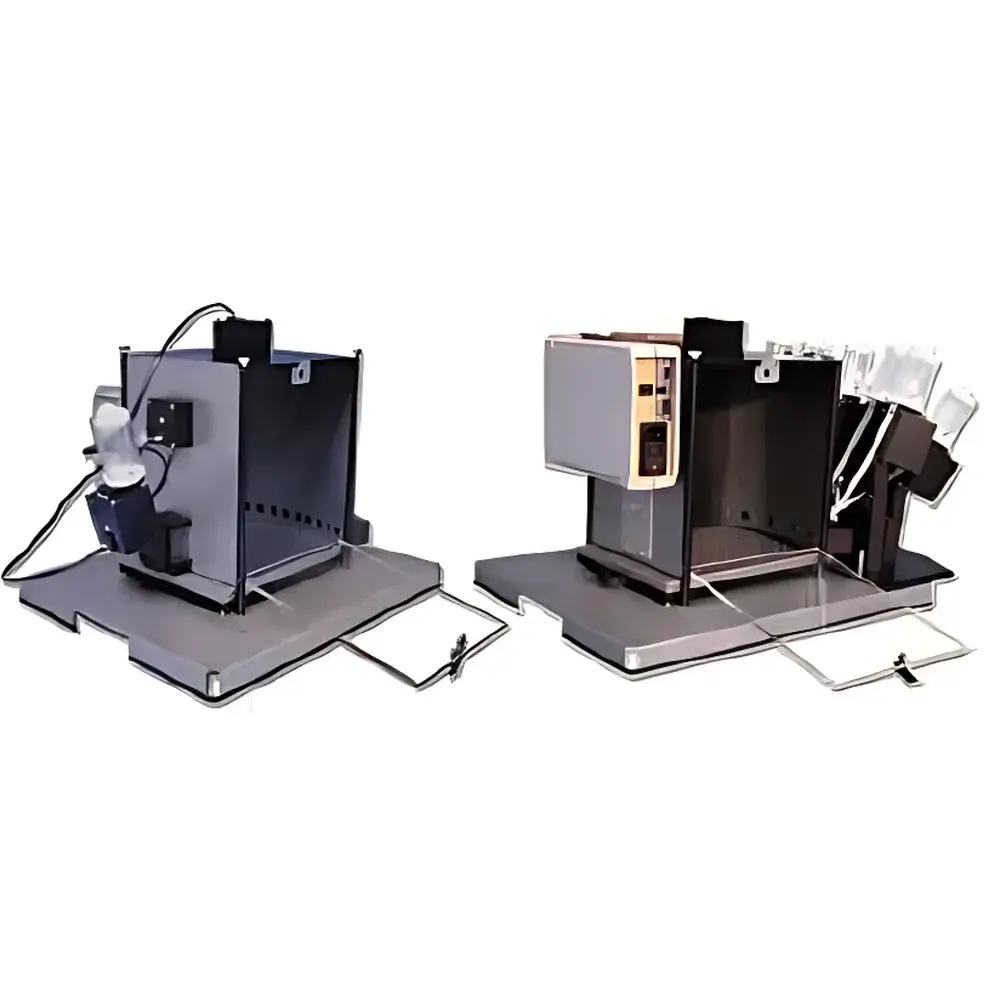
Harvard Apparatus LE507/LE509/LE512 5- or 9-Hole Attentional Set-Shifting Chamber for Rodent Behavioral Neuroscience
| Brand | Harvard Apparatus |
|---|---|
| Origin | USA |
| Model | LE507 / LE509 / LE512 |
| Dimensions (LE509 internal) | 252 × 280 × 240 mm |
| Dimensions (LE507 internal) | 190 × 220 × 240 mm |
| Aperture diameter (rat) | 23 mm, depth: 14 mm |
| Aperture diameter (mouse) | 13 mm, depth: 10 mm |
| Construction | Acrylic, aluminum alloy, stainless steel |
| Max simultaneous chambers per software instance | 8 |
| Sensor type | Infrared nose-poke detectors (per aperture and food tray) |
| Visual cue | Adjustable-brightness LED stimulus lights (per aperture) |
| Actuation | Motorized aperture shutters (individually controllable) |
| Reward delivery | Pellet dispenser (LE507/LE509), integrated per-aperture reward dispensers (LE512) |
| Software | Panlab PackWin v3.x (Windows-based, GLP-compliant experimental control & data acquisition) |
Overview
The Harvard Apparatus LE507, LE509, and LE512 are modular, computer-controlled operant chambers engineered for high-fidelity assessment of sustained and selective attention, response inhibition, and cognitive flexibility in rodents. These systems implement the well-validated 5-Choice Serial Reaction Time Task (5-CSRTT) and its extensions—including the 9-hole variant—to quantify attentional capacity, impulsivity, and learning under controlled sensory and temporal constraints. Each chamber employs a semi-arcuate front panel precisely machined with either five or nine identical apertures—configurable via motorized shutters—allowing seamless transition between 5-hole and 9-hole paradigms without hardware modification. The core measurement principle relies on infrared photobeam interruption (nose-poke detection) at each aperture and the food tray, synchronized with millisecond-accurate LED visual cue presentation and automated pellet delivery. This architecture supports precise temporal control over stimulus onset, response window, inter-trial interval, and reinforcement contingencies—critical parameters for modeling attentional deficits in translational neuroscience models of Alzheimer’s disease, schizophrenia, ADHD, and age-related cognitive decline.
Key Features
- Modular aperture configuration: Nine apertures pre-installed; user-selectable activation of 5 or 9 holes via software-controlled motorized shutters—enabling within-subject paradigm switching.
- Dual-species compatibility: Optimized aperture geometry (23 mm Ø × 14 mm depth for rats; 13 mm Ø × 10 mm depth for mice) ensures reliable nose-poke detection across strain and age groups.
- Integrated multimodal sensing: Independent infrared beam arrays at each aperture and food tray provide unambiguous detection of both operant responses and reward consumption.
- Programmable visual stimuli: High-intensity, spectrally neutral LEDs mounted coaxially within each aperture deliver temporally precise, intensity-adjustable cues—calibrated to avoid retinal adaptation or aversive glare.
- Differential reinforcement architecture: LE512 model features per-aperture pellet dispensers, enabling spatially distinct reward assignment (e.g., differential reinforcement of correct vs. incorrect locations) to probe associative memory and rule learning.
- Rugged industrial construction: Frame fabricated from anodized aluminum alloy; viewing panels from optically clear, scratch-resistant acrylic; food tray and internal components from medical-grade stainless steel—designed for repeated cleaning, disinfection, and long-term stability in vivarium environments.
Sample Compatibility & Compliance
The LE-series chambers are validated for use with C57BL/6, Sprague-Dawley, Wistar, and transgenic rodent models aged 8–24 weeks. Aperture dimensions and force thresholds comply with NIH Office of Laboratory Animal Welfare (OLAW) guidelines for minimally invasive operant interaction. All electronic subsystems meet IEC 61000-6-3 (EMC emission) and IEC 61000-6-2 (immunity) standards. The PackWin software platform supports audit trail generation, electronic signatures, and user-access-level management—facilitating compliance with FDA 21 CFR Part 11 requirements for regulated behavioral pharmacology studies. Experimental protocols adhere to established standards outlined in ASTM E2528-22 (Standard Guide for Behavioral Testing in Preclinical Neuroscience) and ISO/IEC 17025:2017 (for accredited testing laboratories conducting cognitive phenotyping).
Software & Data Management
Control and data acquisition are managed exclusively through Panlab PackWin v3.x—a Windows-based, real-time deterministic software suite designed for behavioral neuroscience. PackWin enables full parametric definition of trial structure (stimulus duration, ITI, timeout windows, punishment contingencies), automatic calibration of photobeam sensitivity, and dynamic adjustment of difficulty (e.g., variable stimulus duration or location probability). Raw event timestamps (cue onset, nose-poke, pellet release, tray entry) are logged at 1 kHz resolution with microsecond synchronization across all connected chambers. Export formats include CSV, MATLAB (.mat), and Neurodata Without Borders (NWB) 2.0-compliant files. Built-in statistical modules compute primary endpoints: percent accuracy, premature responses (%), perseverative responses, omissions, correct/incorrect latency distributions, and reward collection latency—all stratified by session, block, or phase. Data provenance is preserved via embedded metadata (hardware ID, firmware version, operator ID, environmental log tags).
Applications
These chambers serve as primary platforms for investigating neural substrates of executive function. Core applications include: validation of pharmacological agents targeting nicotinic acetylcholine receptors (e.g., α7-nAChR agonists) in attentional enhancement; longitudinal tracking of attentional decay in APP/PS1 and TauP301L mouse models; assessment of dopaminergic modulation in rodent analogues of schizophrenia (e.g., subchronic PCP or amphetamine sensitization); evaluation of non-invasive neuromodulation (tDCS, focused ultrasound) on cognitive control circuits; and cross-species translation of attentional biomarkers for clinical trial endpoint development. The LE512’s per-aperture reward capability further extends utility into set-shifting paradigms (e.g., attentional set-shifting task, ASST) requiring rule reversal and intra-dimensional/extra-dimensional shift discrimination.
FAQ
What distinguishes the LE507, LE509, and LE512 models?
The LE507 is configured for mice (smaller aperture geometry), the LE509 for rats (larger aperture geometry), and the LE512 adds per-aperture pellet dispensers to either species variant—enabling spatially resolved reinforcement and complex contingency learning.
Can multiple chambers be run simultaneously with independent protocols?
Yes. A single PackWin installation controls up to eight chambers concurrently, each executing fully independent schedules—including different stimulus durations, reward contingencies, and trial structures—synchronized to a common master clock.
Is the system compatible with third-party electrophysiology or imaging hardware?
Yes. PackWin provides TTL pulse outputs (cue onset, response, reward) and accepts external TTL inputs (e.g., from EEG amplifiers or behavior-triggered microscope shutters) via DB-25 I/O expansion modules, supporting closed-loop behavioral-electrophysiological integration.
How is calibration and maintenance performed?
Infrared beam alignment is factory-set and verified using NIST-traceable optical alignment jigs; routine verification requires only the included calibration rod and software diagnostic mode. Aperture shutters and pellet dispensers are rated for >1 million actuations and require no scheduled lubrication.
Does the system support GLP-compliant study documentation?
Yes. PackWin generates timestamped, immutable audit logs—including protocol version history, operator login/logout events, parameter change records, and raw binary data archives—meeting ALCOA+ (Attributable, Legible, Contemporaneous, Original, Accurate, Complete, Consistent, Enduring, Available) principles for regulatory submissions.




