
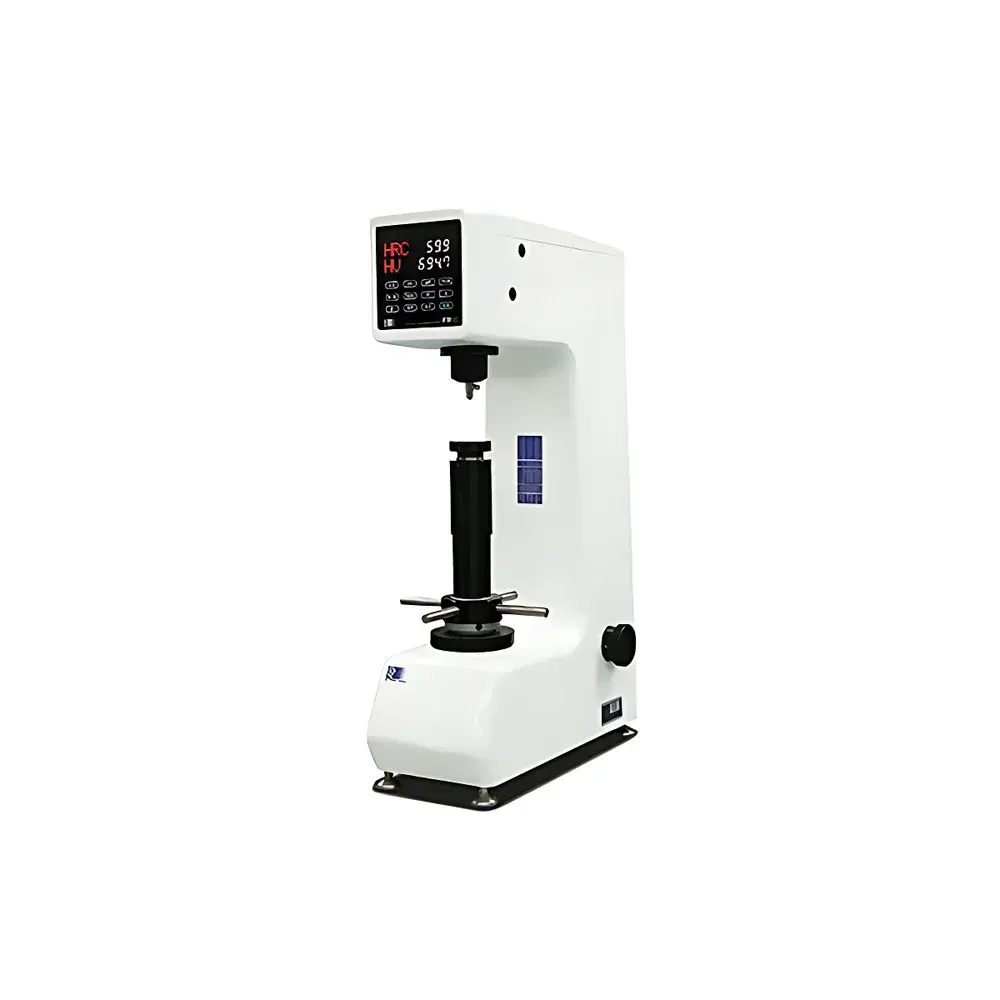
Future-Tech FR-X1 Rockwell Hardness Tester
| Brand | Future-Tech |
|---|---|
| Origin | Japan |
| Manufacturer Status | Authorized Distributor |
| Product Origin | Imported |
| Model | FR-X1 |
| Instrument Type | Rockwell Hardness Tester |
| Hardness Range | 20–88 HRC (typical scale) |
| Total Test Force | 150 kgf (1.471 kN) |
| Maximum Specimen Height | 255 mm |
| Depth of Throat | 165 mm |
| Power Supply | AC 100/115/220 V, 50/60 Hz |
| Net Weight | 82 kg |
| Dimensions (W×D×H) | 196 × 487 × 820 mm |
Overview
The Future-Tech FR-X1 Rockwell Hardness Tester is an industrial-grade, fully automated hardness measurement system engineered for precision, repeatability, and compliance with international Rockwell hardness testing standards—including ASTM E18, ISO 6508-1, and JIS Z 2245. Utilizing the classical Rockwell principle—indentation depth measurement under major and minor loads—the FR-X1 delivers high reproducibility across the full HRA, HRB, HRC, and HRD scales. Its rigid monolithic frame, reinforced with vibration-damping cast iron construction and vertically aligned high-sensitivity load axis, minimizes lateral deflection during loading, ensuring stable indentation geometry even on curved or irregular surfaces. Designed for quality control laboratories, heat treatment facilities, and metal fabrication plants, the FR-X1 supports routine verification of hardened steels, case-hardened components, tooling alloys, and nonferrous materials in accordance with GLP and GMP-aligned workflows.
Key Features
- Rigid mechanical architecture with vertical load axis guided by precision linear bearings—suppresses transverse displacement and improves indentation consistency.
- Large specimen capacity: 255 mm maximum height clearance (without screw cover), enabling testing of shafts, forgings, and large-diameter cylindrical parts.
- Integrated reference correction function supporting multi-point calibration (low/mid/high range) traceable to Tatsumi-certified reference blocks per JIS Z 2243.
- Geometric shape compensation: automatic hardness correction for spherical and cylindrical specimens via user-input diameter values—ensuring conformance to ASTM E18 Annex A3 and ISO 6508-1 Clause 7.4.
- Real-time display of maximum indenter penetration depth alongside hardness value—enabling empirical estimation of relative elastic modulus trends (non-quantitative, for comparative analysis only).
- Dual-stage LED illumination system with guided positioning feedback: blue navigation light and audible tone assist accurate preload alignment, reducing operator dependency and setup variability.
- Pass/fail judgment logic with configurable upper/lower tolerance limits (displayed as HI/OK/LO); optional statistical averaging across up to 9 test points shown on secondary information panel.
- Standard RS-232C interface with included USB-to-RS232 adapter for seamless data export to LIMS, Excel, or SPC software—supporting audit-ready record retention.
Sample Compatibility & Compliance
The FR-X1 accommodates flat, convex, and concave surfaces within its 255 mm vertical travel and 165 mm throat depth. Cylindrical specimens down to Ø6 mm and spherical samples as small as Ø10 mm are supported using optional ball/cylinder fixtures and geometric correction algorithms. All hardness readings comply with the force application timing requirements of ASTM E18 (1–8 s dwell time at major load) and maintain < ±0.5 HRC repeatability under controlled environmental conditions (23 ± 2 °C, <60% RH). The instrument meets CE marking requirements for electromagnetic compatibility (EN 61326-1) and safety (EN 61010-1), and its firmware architecture supports 21 CFR Part 11-compliant data integrity when paired with validated third-party data management systems.
Software & Data Management
While the FR-X1 operates as a standalone instrument with embedded firmware, its RS-232C serial output enables integration with laboratory informatics platforms. Raw ASCII-formatted data packets include timestamp, test sequence number, hardness value, scale identifier (e.g., HRC), indenter type (120° diamond or 1.588 mm steel ball), applied loads, and penetration depth—all transmitted in real time. Optional PC-based software (sold separately) provides graphical trend analysis, CPK/PPK calculation, PDF report generation, and electronic signature support for regulated environments. Audit trail functionality—including operator ID, parameter changes, and calibration event logs—is retained onboard for ≥10,000 test records.
Applications
- Verification of surface hardness after carburizing, nitriding, induction hardening, or laser cladding processes.
- In-process quality assurance of bearing races, gear teeth, cutting tools, and valve components.
- Material lot acceptance testing per ASME BPVC Section II, ASTM A370, or MIL-STD-150A specifications.
- Failure analysis labs performing comparative hardness profiling across cross-sections or heat-affected zones.
- Academic metallurgy research requiring repeatable Rockwell-scale benchmarking under standardized loading protocols.
FAQ
What Rockwell scales does the FR-X1 support?
The FR-X1 supports all standard Rockwell scales including HRA, HRB, HRC, HRD, HRF, HRG, HRH, HRR, and HR15N–HR45N, configured via front-panel selection and verified through certified reference blocks.
Is geometric correction applicable to all hardness scales?
Shape compensation is available for HRA, HRB, HRC, and HRD scales only; it is not implemented for superficial scales (e.g., HR15N) due to inherent depth limitations and standard exclusions per ISO 6508-1.
Can the FR-X1 be integrated into a networked QA system?
Yes—via RS-232C serial communication (with optional USB adapter), the FR-X1 exports timestamped, ASCII-encoded results compatible with common SPC and MES platforms; custom API integration requires middleware configuration.
Does the instrument meet FDA or ISO 17025 calibration traceability requirements?
The FR-X1 itself is not a certified calibration standard; however, its operation and periodic verification align with ISO/IEC 17025 clause 6.4.3 when used with NIST-traceable reference blocks and documented maintenance logs.
What is the recommended calibration frequency?
Per ASTM E18 Section 8.2, daily verification using at least two reference blocks spanning the expected hardness range is required; full system calibration by an accredited service provider is recommended annually or after any mechanical impact or relocation.
Related Products



