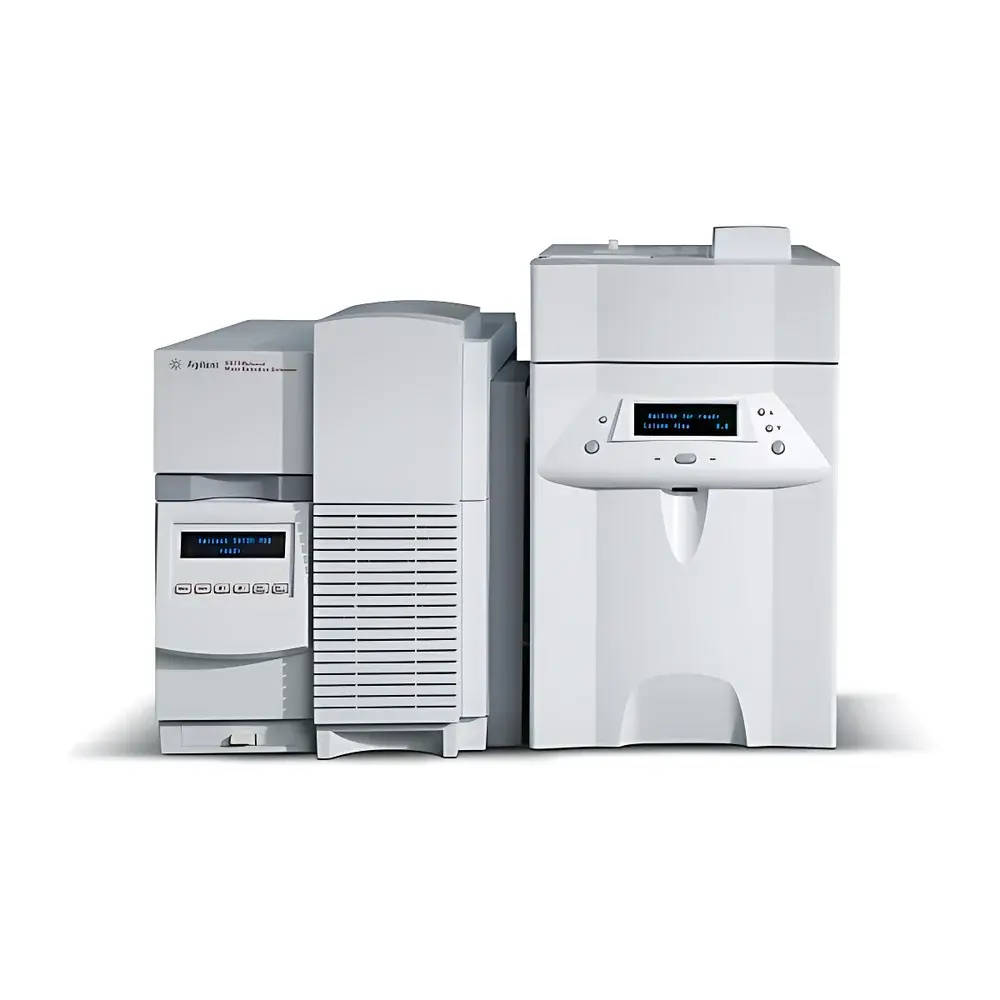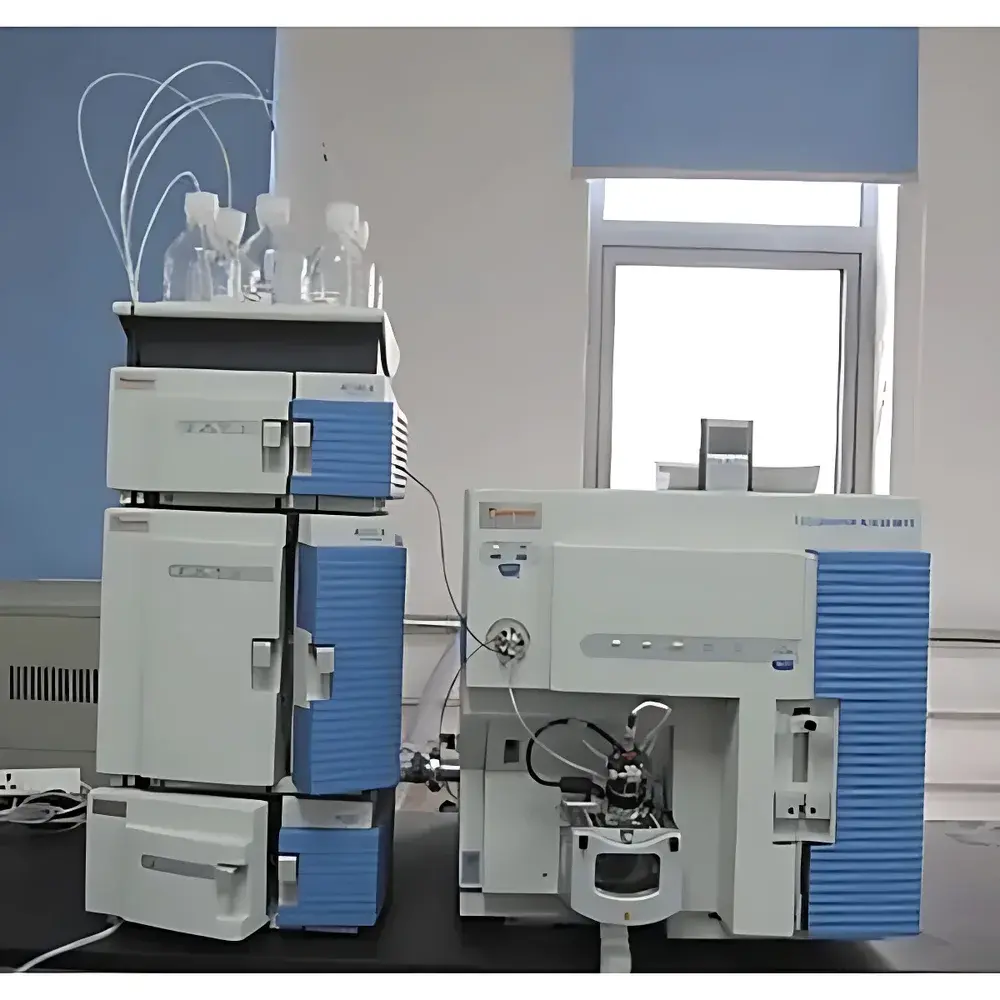
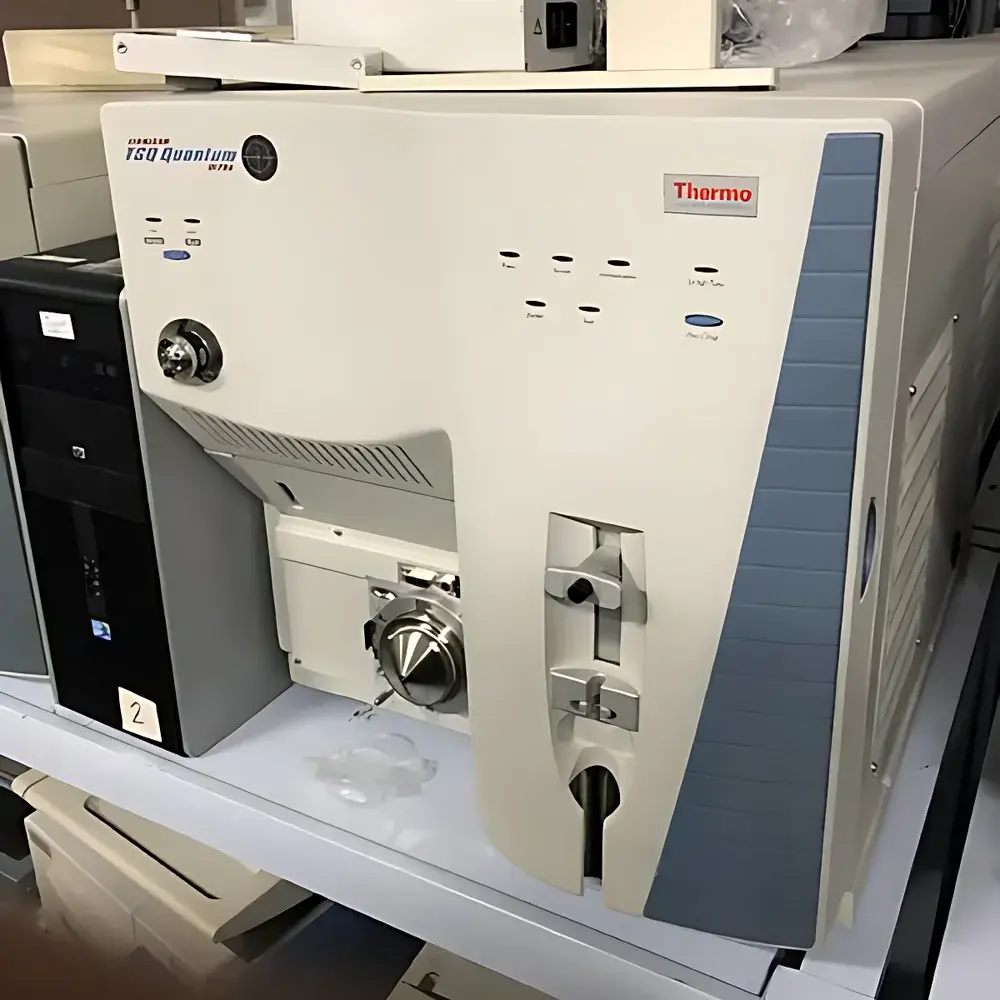
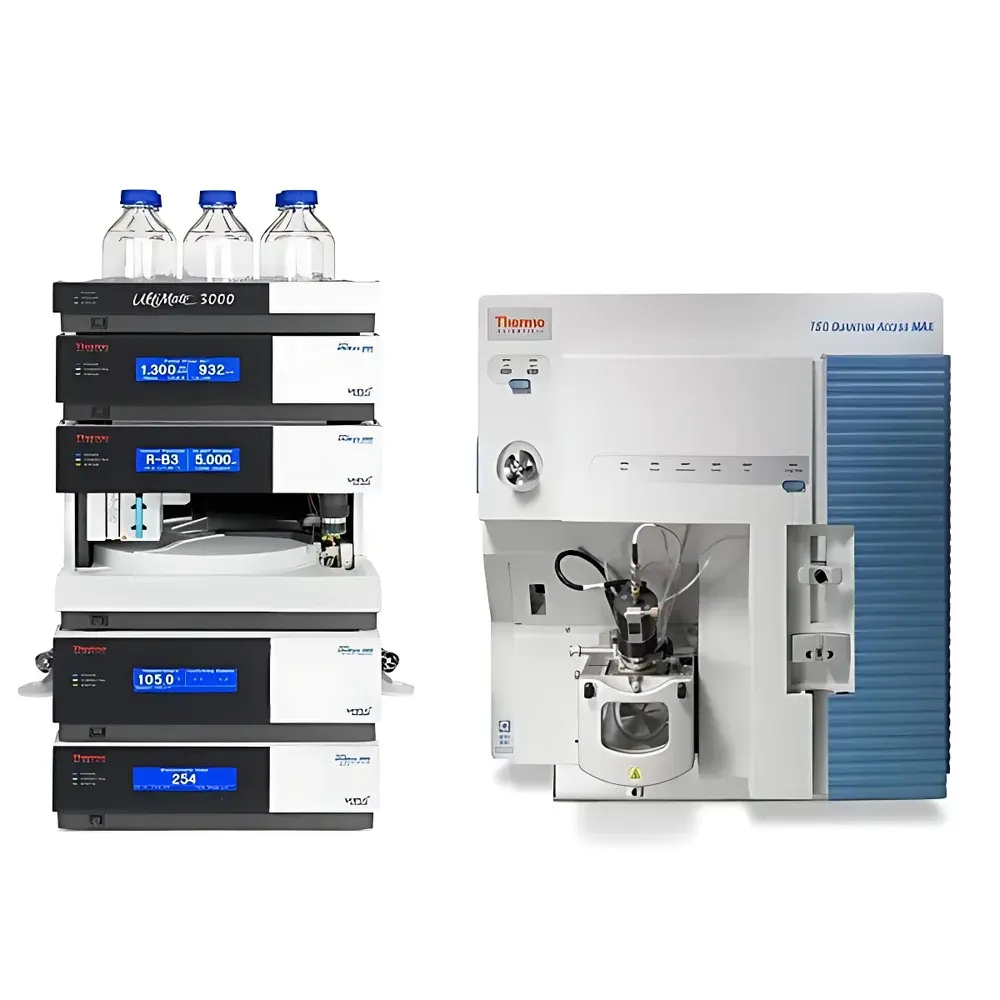
Thermo Fisher TSQ Quantum Access MAX Triple Quadrupole Mass Spectrometer (Refurbished)
| Brand | Thermo Fisher |
|---|---|
| Origin | USA |
| Model | TSQ Quantum Access MAX |
| Mass Range | m/z 10–3000 |
| Resolution | ≥10,000 (FWHM) |
| H-SRM Dwell Time | <2 ms |
| Polarity Switching Time | <25 ms |
| Scan Speed | 5000 u/sec (full range) |
| Mass Stability | ±0.050 amu/24 h |
| Sensitivity (ESI/APCI) | 1 pg reserpine, S/N >200:1 (peak-to-peak) |
| Ion Source | H-ESI II & APCI |
| Vacuum System | Three-stage oil-free turbomolecular pumps (400 L/sec in Q2 region) |
| Detection | ±15 kV post-acceleration, 90° electron multiplier |
| Software | LC Quan 2.5, QED-MS/MS™, RER™, real-time isotope correlation, dynamic exclusion, >700-compound LC/MS/MS spectral library |
Overview
The Thermo Fisher TSQ Quantum Access MAX Triple Quadrupole Mass Spectrometer (refurbished) is a high-performance, purpose-engineered platform for targeted quantitative and qualitative analysis in regulated and research laboratories. Built upon a robust triple quadrupole architecture, it operates on the principle of tandem mass spectrometry (MS/MS) using collision-induced dissociation (CID) in the pressurized curved Q2 collision cell. Its design enables highly selective detection via High-Selectivity Selected Reaction Monitoring (H-SRM), delivering sub-picogram sensitivity and exceptional specificity in complex biological, environmental, and food matrices. The instrument is widely deployed in applications requiring compliance with international regulatory frameworks—including FDA 21 CFR Part 11, ISO/IEC 17025, and GLP-guided workflows—where reproducibility, auditability, and method robustness are non-negotiable.
Key Features
- H-SRM capability: Q1 resolution adjustable to ≤0.1 Da (FWHM), enabling discrimination of isobaric interferences with mass differences <0.7 Da—critical for accurate quantitation in high-background samples.
- QED-MS/MS™ (Quantitative Enhanced Data-dependent MS/MS): Automatically acquires full-scan MS/MS spectra immediately following each MRM transition, supporting simultaneous quantification and structural confirmation without method re-injection.
- Real-time isotope correlation: Triggers MS/MS acquisition when user-defined isotopic abundance ratios are detected—enhancing confidence in analyte identification and reducing false positives.
- Dynamic exclusion: Temporarily excludes previously fragmented high-intensity ions during LC co-elution, preserving duty cycle for lower-abundance species in multi-analyte assays.
- Rapid polarity switching: <25 ms transition between positive and negative ion modes, allowing comprehensive coverage of compounds with disparate ionization efficiencies within a single chromatographic run.
- H-ESI II source with vacuum-lock interface: Enables on-the-fly cleaning of the metal transfer tube without venting the mass analyzer; includes x/y/z-adjustable spray needle, heated metal capillary (0–400 °C), and sheath gas optimization for non-volatile buffers.
- Oil-free vacuum architecture: Three independent turbomolecular pumps maintain differential pressure zones—source region at ~1×10⁻⁵ Torr, Q2 collision cell at ~1×10⁻⁴ Torr, and analyzer region at ~5×10⁻⁸ Torr—ensuring long-term stability and low chemical noise.
Sample Compatibility & Compliance
The TSQ Quantum Access MAX supports direct coupling to UHPLC, nanoLC, and microflow systems, accommodating flow rates from 1 µL/min (ESI) to 2 mL/min (APCI). Its rugged ion optics and high-efficiency detector deliver consistent performance across diverse sample types—including plasma, urine, soil extracts, pesticide residues, and pharmaceutical formulations. The system meets essential requirements for GMP-compliant bioanalysis (e.g., pharmacokinetic studies per FDA Guidance for Industry), environmental testing (EPA Methods 1694, 8270), and food safety screening (EU SANTE/11312/2021). All data acquisition, processing, and reporting functions comply with ALCOA+ principles (Attributable, Legible, Contemporaneous, Original, Accurate, Complete, Consistent, Enduring, Available), and audit trails are fully enabled under LC Quan 2.5 software with electronic signature support.
Software & Data Management
Control and data handling are managed through Thermo Scientific LC Quan 2.5—a validated, Windows-based platform supporting full instrument control, quantitative batch processing, calibration curve fitting (linear/log-linear with weighting), and integrated report generation. Key modules include:
- Automated MRM optimization for up to 3000 transitions per method;
- Library-assisted compound identification using a curated LC/MS/MS spectral library (>700 entries for pesticides, veterinary drugs, and dyes);
- RER™ (Reverse Energy Ramp) for automated, linear collision energy ramping to generate rich fragment spectra;
- Real-time data-dependent triggering based on intensity thresholds, retention time windows, or isotopic patterns;
- Export compatibility with LIMS and third-party statistical tools (CSV, mzML, ANDI-NetCDF).
All raw data files are timestamped, digitally signed, and stored with immutable metadata—including instrument configuration, calibration history, and user activity logs—satisfying 21 CFR Part 11 record retention requirements.
Applications
This refurbished TSQ Quantum Access MAX is routinely applied in:
- Clinical & pharmaceutical research: Quantitative bioanalysis of small-molecule drugs and metabolites in human plasma/serum; verification of metabolic stability and CYP inhibition profiles.
- Environmental monitoring: Multi-residue analysis of emerging contaminants (e.g., PFAS, pharmaceuticals, flame retardants) in wastewater, surface water, and sediment at sub-ng/L levels.
- Food safety & authenticity: Screening and confirmation of mycotoxins, antibiotics, growth promoters, and adulterants in meat, dairy, and infant formula according to EU Commission Decision 2002/657/EC criteria.
- Forensic toxicology: Targeted quantitation of opioids, stimulants, and novel psychoactive substances in hair and oral fluid with confirmatory MS/MS spectra.
FAQ
What is the typical refurbishment scope for this instrument?
Each unit undergoes full functional validation—including mass axis calibration, resolution verification, sensitivity assessment (reserpine S/N), vacuum integrity testing, and source cleaning/reconditioning. Critical wear components (e.g., electron multiplier, ion transfer tubing, pump oils) are replaced, and firmware/software are updated to the latest supported release.
Is method transfer support included?
Yes—basic method porting assistance is provided, including parameter translation from legacy TSQ platforms and LC Quan 2.5 template setup. Full validation support requires separate service engagement.
Does the 6-month warranty cover labor and parts?
Yes—the warranty includes onsite labor, replacement parts, and remote diagnostics for all instrument subsystems except consumables (e.g., columns, ESI needles, pump seals).
Can this system be integrated into an existing Waters or Agilent LC platform?
Yes—via standard analog/digital I/O or third-party drivers (e.g., Thermo Xcalibur Bridge, OpenLab CDS integration kits). Hardware synchronization is achieved using TTL triggers or event-based communication protocols.
What documentation is delivered with the instrument?
A complete set is provided: Certificate of Refurbishment, Performance Verification Report (PVR), electrical safety test record, software license certificate, and electronic copies of operator manuals, service guides, and regulatory compliance statements.
Related Products