
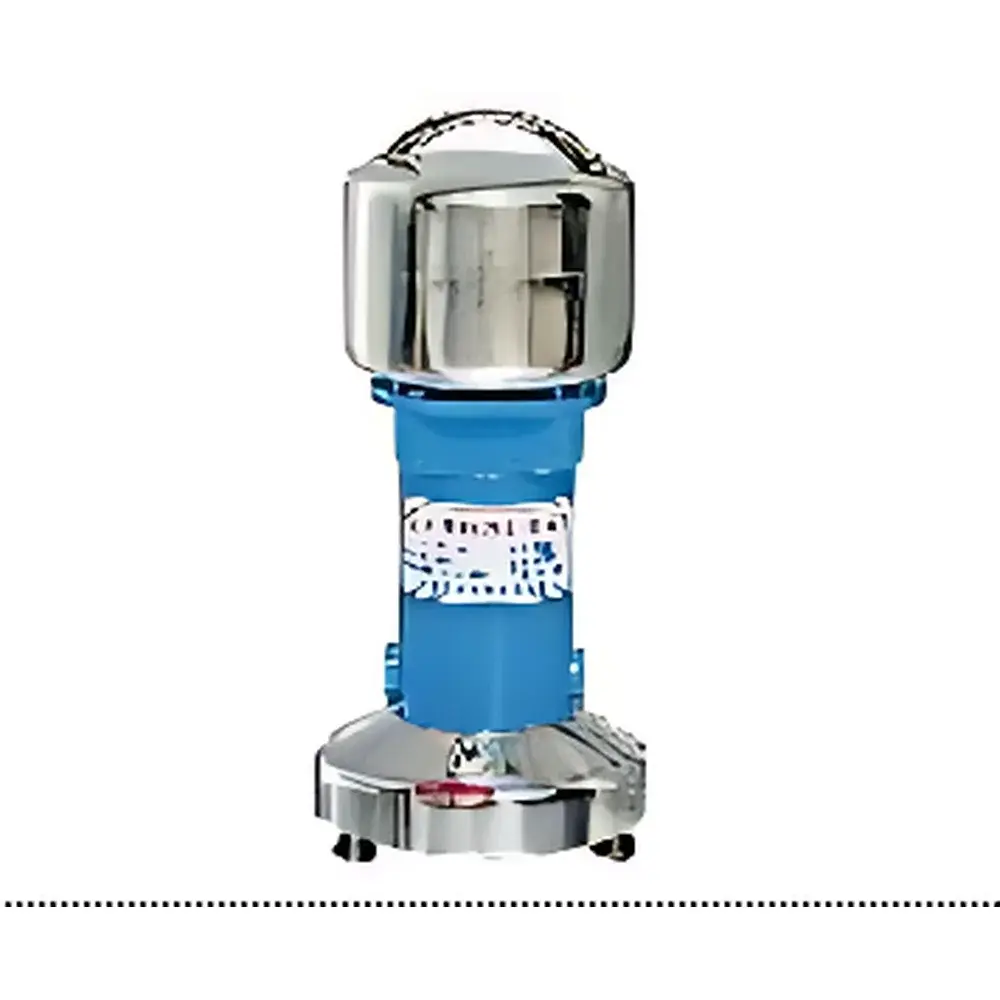
FZ102 Universal High-Speed Laboratory Grinder
| Origin | Shanghai, China |
|---|---|
| Manufacturer Type | Authorized Distributor |
| Origin Category | Domestic (China) |
| Model | FZ102 |
| Price | USD 130 (FOB Shanghai) |
| Power Supply | 180 W, 220 V AC |
| Rated Speed | 1400 rpm |
| Dimensions (L×W×H) | 300 × 185 × 300 mm |
| Particle Size Output | 60–120 mesh (approx. 250–125 µm) |
| Construction | Stainless Steel Grinding Chamber & Cutting Assembly |
| Feed Material Compatibility | Dry botanicals, animal tissues (skin, hair, muscle), cereals, legumes, soil, minerals, pharmaceutical herbs |
Overview
The FZ102 Universal High-Speed Laboratory Grinder is a compact, benchtop mechanical comminution device engineered for reproducible dry-sample size reduction in analytical preparation workflows. It operates on the principle of high-torque rotary shearing—where a dynamically balanced rotating blade engages with an adjustable stationary counter-blade to generate controlled impact, cutting, and attrition forces. Unlike centrifugal or cryogenic grinders, the FZ102 relies on precise mechanical clearance adjustment between fixed and rotating elements to modulate particle size distribution without thermal degradation—making it particularly suitable for heat-sensitive biological matrices such as herbal powders, grain kernels, and soft animal tissues. Its design adheres to fundamental principles of mechanical engineering for laboratory-scale sample homogenization, prioritizing operator safety, ease of cleaning, and compatibility with downstream analytical methods including moisture content determination (AOAC 925.10), proximate analysis (AOAC 984.13), and extraction-based assays (e.g., Soxhlet lipid quantification).
Key Features
- Stainless steel grinding chamber and cutting assembly ensure chemical inertness, corrosion resistance, and compliance with basic hygienic requirements for pharmaceutical and food-grade sample preparation.
- Adjustable blade gap mechanism enables empirical optimization of particle size output across a nominal range of 60–120 mesh (250–125 µm), supporting method-specific reproducibility in routine QC testing.
- Compact footprint (300 × 185 × 300 mm) and low mass (<8 kg) facilitate integration into constrained lab spaces, fume hoods, or mobile field laboratories.
- 180 W induction motor delivers stable 1400 rpm operation under load, minimizing speed droop during intermittent feeding of fibrous or oily materials such as dried roots, animal hides, or oilseed cakes.
- Tool-free disassembly of the grinding chamber allows rapid residue removal and visual inspection—critical for cross-sample contamination control in multi-analyte workflows.
Sample Compatibility & Compliance
The FZ102 accepts dry, non-sticky, non-abrasive organic and inorganic feedstocks with bulk densities ≤1.2 g/cm³ and moisture content <12% (w/w). Validated use cases include pulverization of cereal grains (wheat, rice, soybean), medicinal herbs (e.g., Glycyrrhiza uralensis, Angelica sinensis), freeze-dried animal tissues, mineral soils (A- and B-horizon samples), and coal reference materials. It is not intended for wet, viscous, polymeric, metallic, or highly abrasive substances. While the unit itself carries no CE, UL, or FDA certification, its construction and operational parameters align with general laboratory equipment safety expectations per IEC 61010-1. Users performing regulated analyses (e.g., pharmacopeial testing per USP or ISO 17025-accredited moisture determination) must validate grinding performance—including particle size distribution, homogeneity, and absence of metal leaching—within their own SOPs.
Software & Data Management
The FZ102 is a manually operated, non-instrumented mechanical device with no embedded electronics, connectivity, or digital interface. All operational parameters—including run time, feed mass, blade gap setting, and post-grind sieve analysis—are recorded externally by the user in laboratory notebooks or LIMS-compatible spreadsheets. This analog architecture eliminates cybersecurity concerns, firmware dependencies, or 21 CFR Part 11 compliance overhead. However, laboratories implementing GLP or GMP frameworks are advised to document grinding conditions as critical process parameters within analytical method validation reports and retain raw particle size data (e.g., via ASTM E11 standard test sieves) for audit readiness.
Applications
- Preparation of homogeneous subsamples for moisture, protein, and oil content analysis in agricultural commodities (ISO 6540, AOAC 925.09, AOAC 920.39).
- Routine comminution of traditional Chinese medicinal herbs prior to HPLC fingerprinting or heavy metal screening (GB/T 19618–2004).
- Soil sample homogenization for elemental analysis by ICP-OES or XRF (EPA Method 6010D, ISO 11466).
- Animal tissue pulverization for DNA/RNA extraction protocols requiring mechanical lysis pre-step.
- Particle size standardization in method development for dissolution testing or tablet formulation R&D.
FAQ
Is the FZ102 suitable for cryogenic grinding?
No. The unit lacks liquid nitrogen ports, insulated housing, or low-temperature rated bearings; ambient-temperature operation only.
Can it process wet or frozen samples?
No. Introducing moisture or ice risks motor overload, blade corrosion, and inconsistent particle size due to agglomeration.
What maintenance is required?
Bi-weekly visual inspection of blade edge integrity and chamber weld seams; monthly lubrication of motor bearings per manufacturer’s technical bulletin GM-TB-2023-04.
Does it comply with Good Manufacturing Practice (GMP)?
The device itself is not GMP-certified, but may be qualified as auxiliary equipment within a GMP environment following IQ/OQ protocols specific to the user’s application.
How is particle size verified post-grinding?
Users must employ standardized sieve analysis (e.g., ASTM E11 stainless steel test sieves) or laser diffraction (if sub-100 µm resolution is needed), as the FZ102 provides no real-time size feedback.



