
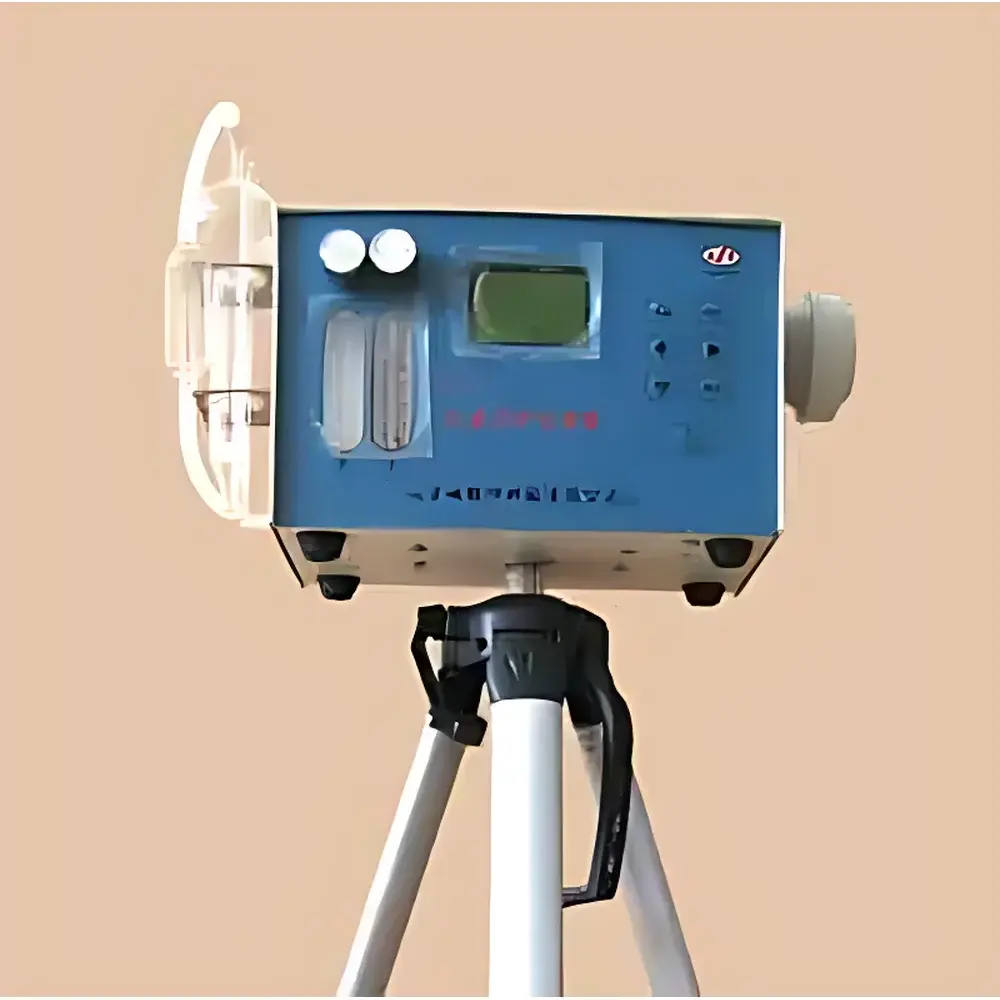
GalaxyTech CDS-B Dual-Channel Air & Dust Sampling Pump
| [Origin | Jiangsu, China |
|---|---|
| Power Supply | AC 220 V ±10 V, 50 Hz / DC 9 V (8×AA Ni-Cd/Ni-MH rechargeable batteries) |
| Flow Range | 0–1.5 L/min (gas channel), 5–30 L/min (dust channel) |
| Maximum Vacuum | 23.5 kPa (gas), 15 kPa (dust) |
| Flow Accuracy | ±2.5% |
| Timing Precision | ±0.01% |
| Stability | ≤5% |
| Noise Level | <80 dB(A) |
| Operating Temperature | –5 to 40 °C |
| Dimensions | 220 × 135 × 150 mm |
| Weight | 2.9 kg |
| Battery Runtime | 4–8 h (continuous or intermittent) |
| Charging Current | 500 mA |
| Charging Time | ~12 h] |
Overview
The GalaxyTech CDS-B Dual-Channel Air & Dust Sampling Pump is a field-deployable, microprocessor-controlled sampling instrument engineered for concurrent collection of airborne particulate matter (PM) and gaseous pollutants from ambient or occupational environments. It operates on the principle of controlled volumetric aspiration—utilizing two physically isolated, independently regulated suction pumps to maintain separate gas-phase and aerosol-phase sampling streams. This dual-path architecture eliminates cross-contamination and enables simultaneous, time-synchronized acquisition of respirable dust (e.g., total suspended particulates, TSP, or PM10) and volatile organic compounds (VOCs), sulfur dioxide (SO2), nitrogen oxides (NOx), or other target gases—each collected onto appropriate media (e.g., quartz fiber filters for dust; sorbent tubes such as Tenax or charcoal for gases). Designed in accordance with core principles of ISO 7708 (airborne particle size fractionation) and aligned with sampling protocols referenced in NIOSH Method 0500 (total dust) and EPA TO-17 (gaseous organics), the CDS-B supports quantitative exposure assessment required under OSHA 29 CFR 1910.1200 (Hazard Communication) and EU Directive 2004/108/EC (EMC compliance for portable instrumentation).
Key Features
- Dual independent pump system: Two sealed, brushless diaphragm pumps operate in parallel—each with dedicated flow control, pressure sensing, and real-time monitoring—ensuring no pneumatic or electronic crosstalk between dust and gas channels.
- Precision mechanical needle-valve regulation: Enables fine-grained manual adjustment of flow rates across both ranges (0–1.5 L/min for sorbent tube sampling; 5–30 L/min for filter-based dust capture), with engraved calibration scales for repeatable setting and long-term stability (≤5% drift over 8 h).
- Intelligent timing and power management: Programmable sampling duration from 0.01 to 99.59 hours per channel; supports asynchronous start/stop, mid-sequence time extension, and auto-termination with audible/visual alert. Integrated battery monitor displays remaining capacity, voltage level, and charging status—including pulse-charging phase detection and maintenance-mode trickle charge activation.
- Robust portable design: Compact housing (220 × 135 × 150 mm), lightweight aluminum alloy chassis (2.9 kg), and IP54-rated ingress protection ensure reliable operation in field conditions ranging from indoor workplace surveys to outdoor ambient monitoring stations.
- Low-noise acoustics: Optimized pump mounting and acoustic damping reduce operational noise to <80 dB(A) at 1 m—meeting requirements for unobtrusive use in laboratories, classrooms, and occupied workspaces.
Sample Compatibility & Compliance
The CDS-B accommodates standard sampling media compliant with international reference methods: 37-mm or 47-mm diameter membrane or glass fiber filters (e.g., Whatman GF/A, Pall TissuQuartz) for gravimetric dust analysis; stainless steel or glass sorbent tubes packed with activated carbon, silica gel, or polymer-based adsorbents (e.g., Tenax TA, Carbopack B) for thermal desorption–GC/MS analysis. Its flow accuracy (±2.5%) and timing precision (±0.01%) meet minimum performance criteria outlined in ISO 16000-2 (indoor air sampling), ASTM D1357 (particulate sampling), and EN 12341 (ambient PM10 measurement). While not certified to ATEX or IECEx standards, its non-sparking pump construction and absence of internal ignition sources permit use in non-classified zones per IEC 60079-0. The device supports GLP-aligned documentation practices through timestamped event logging (start/stop, low-battery warnings, flow deviations) stored internally for post-hoc auditability.
Software & Data Management
The CDS-B features an embedded 128×64 pixel monochrome LCD with intuitive menu navigation driven by a dedicated 8-bit microcontroller. All operational parameters—including set flow rates, elapsed time, remaining battery voltage, and pump status—are displayed simultaneously without requiring mode cycling. No external software or proprietary drivers are required; all configuration and data review occur via front-panel keypad input. Event logs (up to 100 entries) retain timestamps, channel identifiers, and anomaly flags (e.g., “Flow Out of Range”, “Battery Low”) in non-volatile memory. For regulatory traceability, users may manually record log identifiers alongside laboratory notebooks or LIMS entries. While the instrument does not support USB or Bluetooth connectivity, its deterministic timing engine and hardware-based clock circuitry satisfy FDA 21 CFR Part 11 predicate logic for electronic records where handwritten annotations serve as primary source documentation.
Applications
- Occupational hygiene monitoring: Simultaneous collection of respirable crystalline silica (via cyclone + filter) and formaldehyde (via DNPH-coated cartridges) in construction, foundry, and textile manufacturing settings.
- Indoor air quality (IAQ) assessment: Coordinated sampling of airborne endotoxins (on polycarbonate filters) and VOCs (on multi-sorbent tubes) in schools, hospitals, and office buildings per ASHRAE Standard 62.1.
- Environmental baseline studies: Paired deployment with meteorological sensors to correlate PM2.5 mass concentration (gravimetric) and ozone precursor species (e.g., benzene, toluene) across urban transects.
- Educational laboratories: Hands-on instruction in sampling theory, pump hydraulics, and analytical method validation—supporting curricula aligned with AP Environmental Science and university-level environmental engineering programs.
- Regulatory compliance verification: Field validation of fixed-site monitor data under national ambient air quality standards (NAAQS) or EU Air Quality Directive (2008/50/EC) Annex III QA/QC protocols.
FAQ
Can the CDS-B be used for personal (individual) exposure monitoring?
Yes—the compact form factor, battery-powered operation, and belt-mount compatibility make it suitable for worker-worn sampling per NIOSH Manual of Analytical Methods (NMAM) Chapter 2.
Is calibration traceable to national standards?
Field calibration is performed using a primary-standard dry calibrator (e.g., Bios DryCal DC-Lite) traceable to NIST SRM 2810; factory calibration certificates include uncertainty budgets per ISO/IEC 17025 guidelines.
What maintenance is required between sampling campaigns?
Pump membranes should be inspected every 200 operating hours; inlet filters must be cleaned or replaced after each high-dust exposure; battery packs require bi-monthly maintenance charging if stored idle.
Does the instrument comply with GLP or GMP requirements?
While not a regulated GxP instrument per se, its deterministic timing, non-erasable event logging, and stable flow performance support adherence to GLP Principles (OECD Series on Principles of Good Laboratory Practice) when integrated into validated SOPs.
Can flow rates be validated during sampling?
Yes—integrated thermistor-based flow sensors provide continuous analog feedback; users may connect a secondary electronic bubble meter or critical orifice calibrator in-line for real-time verification without interrupting collection.







