
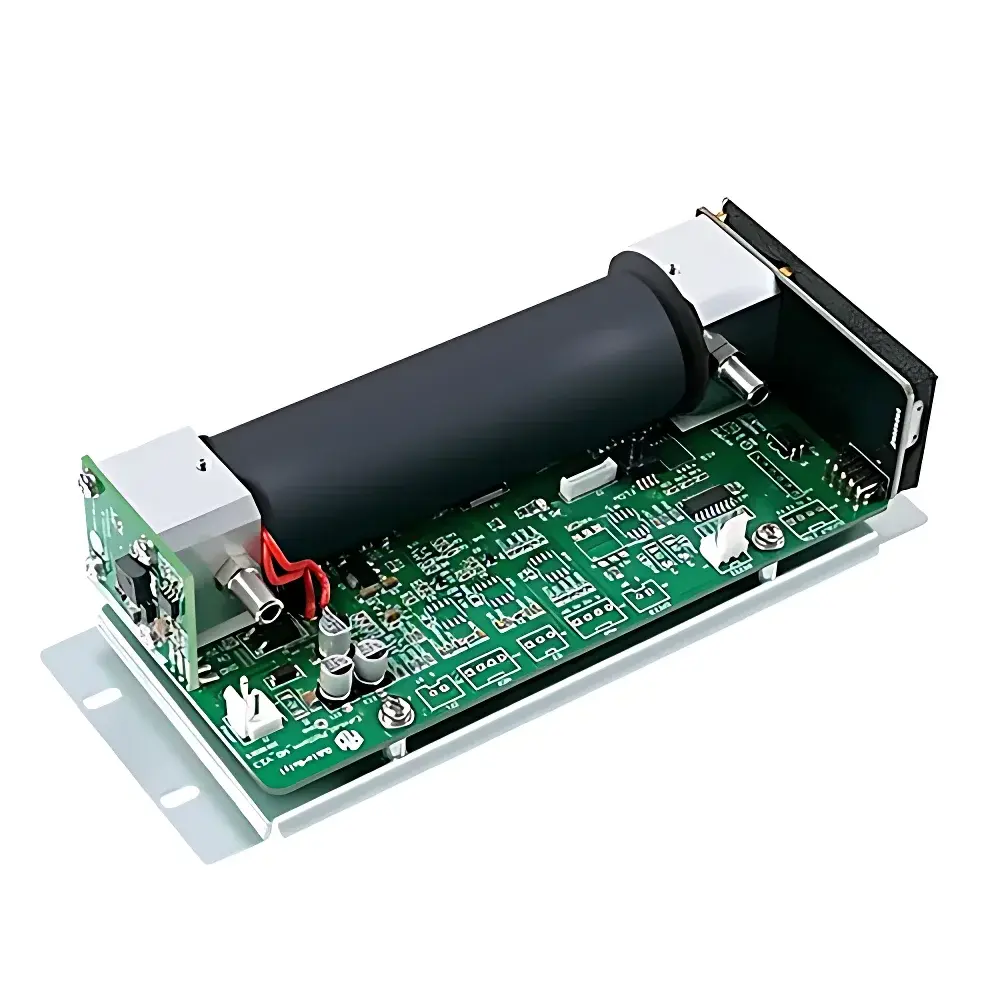
Gasboard-2301 NDUV Ultra-Low-Range Nitrogen Dioxide (NO₂) Gas Sensor by Cubic Instruments
| Brand | Cubic Instruments |
|---|---|
| Origin | Hubei, China |
| Model | Gasboard-2301 |
| Measurement Principle | Non-Dispersive Ultraviolet (NDUV) Absorption |
| Range | 0–500/0–1000 ppm (customizable) |
| Resolution | 1 ppm |
| Accuracy | ±25 ppm or ±4% of reading (whichever is greater) |
| Repeatability | ±20 ppm or ±3% of reading (whichever is greater) |
| Response Time (T₉₀) | ≤4.5 s |
| Operating Temperature Compensation | Integrated PID-controlled heater with real-time temperature & pressure correction |
| Output Interface | Analog (4–20 mA / 0–5 V) and digital (RS485 Modbus RTU) |
| Humidity Immunity | Validated under RH 0–95% non-condensing |
| Direct NO₂ Detection | Yes (no NOₓ converter required) |
Overview
The Gasboard-2301 is a high-stability, ultra-low-range nitrogen dioxide (NO₂) gas sensor engineered for precision environmental and industrial emission monitoring. It employs Non-Dispersive Ultraviolet (NDUV) absorption spectroscopy — a physically robust, interference-resistant optical method that exploits the characteristic absorption band of NO₂ near 410 nm. Unlike differential optical absorption spectroscopy (DOAS), which requires spectral deconvolution and complex baseline correction, NDUV utilizes a narrowband pulsed LED UV source coupled with a dedicated photodetector and optimized optical path length to directly quantify NO₂ concentration via the Lambert–Beer law. This architecture eliminates cross-sensitivity to ozone (O₃), sulfur dioxide (SO₂), and hydrocarbons commonly present in exhaust and ambient air streams. The sensor is calibrated traceably against certified NO₂ reference gases and designed for continuous operation in variable humidity and temperature conditions — critical for roadside monitoring, stack emissions verification, and mobile platform integration.
Key Features
- Stable pulsed UV LED light source with >10,000-hour operational lifetime and minimal spectral drift over time
- Direct NO₂ measurement without catalytic conversion — avoids systematic bias from NO oxidation inefficiency or converter aging
- Integrated thermoelectric (Peltier) heating and closed-loop PID temperature control ensures stable optical cavity temperature (±0.1 °C), minimizing thermal-induced baseline shift
- Real-time pressure and temperature compensation algorithms embedded in firmware, compliant with ISO 12039 and EPA Method 7E requirements for gaseous pollutant reporting
- Humidity-immune optical design validated across 0–95% RH (non-condensing); no desiccant cartridges or external dryers required
- Modular OEM form factor (L × W × H: 120 × 80 × 45 mm) with standardized mounting interface and dual-output capability (4–20 mA analog + RS485 Modbus RTU)
Sample Compatibility & Compliance
The Gasboard-2301 is suitable for sampling gaseous matrices containing NO₂ at ambient or elevated temperatures (up to 60 °C inlet gas), including diluted automotive exhaust, urban ambient air, flue gas (post-SCR/deNOₓ), and indoor industrial process streams. It meets key international performance criteria for fixed and portable NO₂ analyzers: EN 14625:2012 (ambient air quality — performance characteristics), ISO 12039:2000 (stationary source emissions — determination of NOₓ), and ASTM D6522-20 (standard test method for determination of nitrogen oxides in stationary source emissions). Its output data structure supports audit-ready logging per GLP/GMP-aligned QA/QC protocols when integrated into larger monitoring systems.
Software & Data Management
The sensor operates autonomously but interfaces seamlessly with host controllers via Modbus RTU for configuration, diagnostics, and real-time data polling. Firmware supports configurable averaging intervals (1–60 s), zero/span calibration triggers, and diagnostic flags for lamp intensity decay, detector saturation, or thermal fault. When deployed in networked environmental monitoring stations, raw sensor outputs can be ingested into SCADA platforms or cloud-based analytics engines (e.g., AWS IoT Core, Siemens MindSphere) using standard MQTT or HTTP(S) payloads. All calibration events, firmware updates, and error logs are timestamped and stored locally — enabling full traceability for regulatory reporting under EPA 40 CFR Part 60 or EU Directive 2010/75/EU (IED).
Applications
- On-vehicle OBD-II and PEMS (Portable Emissions Measurement Systems) for real-time NO₂ tracking during RDE (Real Driving Emissions) testing
- Urban air quality monitoring networks (AQMS), especially in proximity to traffic corridors and tunnel exits
- Continuous Emission Monitoring Systems (CEMS) for municipal waste incinerators, cement kilns, and power plants equipped with selective catalytic reduction (SCR)
- OEM integration into handheld gas analyzers, drone-mounted environmental sensors, and smart building IAQ (Indoor Air Quality) controllers
- Research-grade validation of low-cost sensor arrays and satellite-derived NO₂ column density products
FAQ
Does the Gasboard-2301 require periodic zero/span calibration?
Yes — recommended every 30 days for regulatory compliance applications; optional automated span-check mode available via Modbus command.
Can it operate in high-humidity environments without signal drift?
Yes — optical path design and algorithmic water vapor compensation eliminate measurable interference up to 95% RH non-condensing.
Is the sensor compatible with existing CEMS hardware interfaces?
Yes — 4–20 mA output meets NAMUR NE43 standards; RS485 Modbus RTU supports interoperability with Siemens Desigo, Honeywell Experion, and ABB Ability platforms.
What is the minimum detectable concentration (MDL) under field conditions?
Based on EN 14625:2012 methodology, MDL is 5 ppm (3σ of blank response) at 1-second integration; improves to 1.2 ppm with 10-second averaging.
Does it comply with FDA 21 CFR Part 11 for electronic records in regulated environments?
The sensor itself does not store user data; however, its Modbus registers support write-protected event logging and timestamped calibration metadata — enabling Part 11-compliant system-level implementation when paired with validated host software.







