
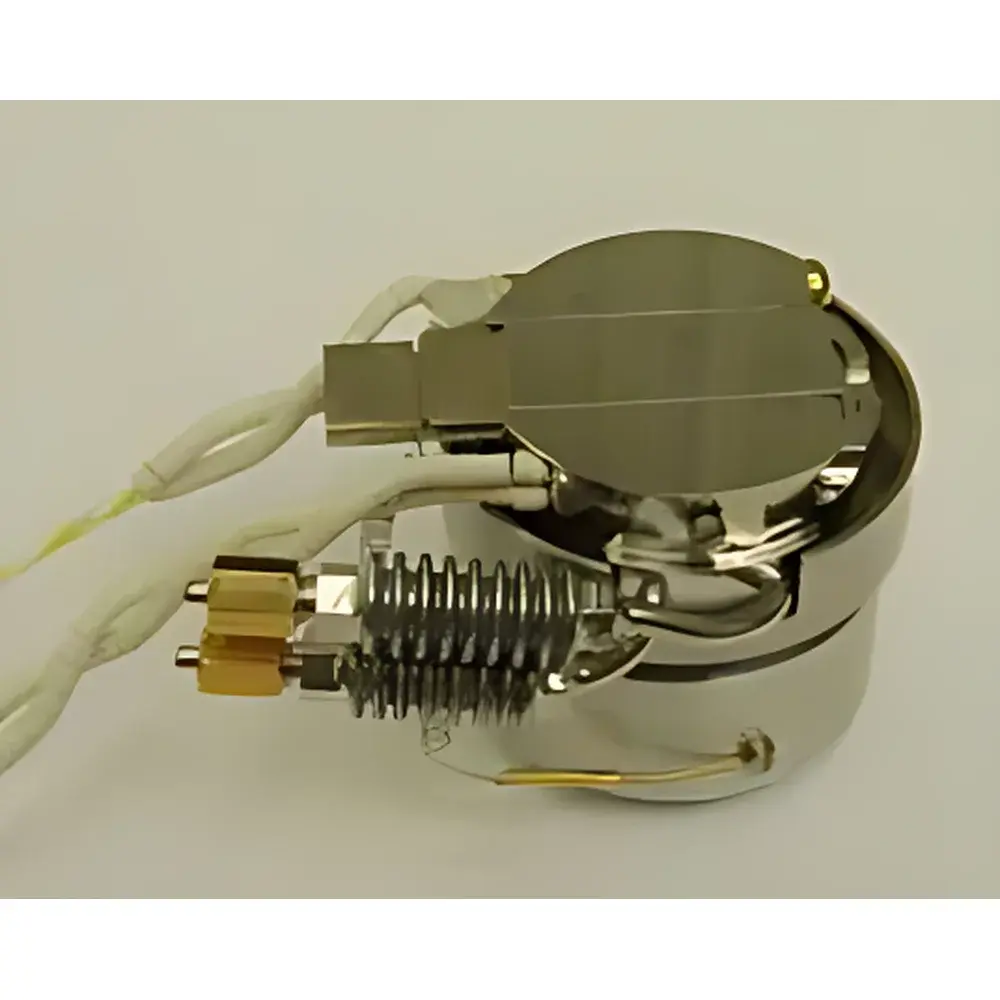
Gatan C1000 Series Cryo Stage for Scanning Electron Microscopy
| Brand | Gatan |
|---|---|
| Origin | USA |
| Model | C1000 |
| Temperature Range | –185 °C to +400 °C (model-dependent) |
| Cooling Medium | Liquid Nitrogen |
| Sample Diameter | 10 mm |
| Cooling Time | <10 min (RT to –185 °C) |
| Temperature Stability | ±0.5 °C |
| Tilt | 45° |
| Rotation | ±5° |
| Compatibility | Field-emission, standard, and environmental SEMs |
Overview
The Gatan C1000 Series Cryo Stage is a high-precision, vacuum-independent cryogenic sample stage engineered specifically for scanning electron microscopy (SEM). Designed using direct liquid nitrogen cooling with an external heat-exchange dewar, the system decouples thermal management from the SEM chamber vacuum integrity—enabling seamless integration across field-emission SEM (FE-SEM), tungsten-filament SEM, and environmental SEM (ESEM) platforms without modification to the column or chamber door. The C1000 operates on the principle of conductive and convective heat transfer via regulated LN₂ flow, combined with integrated resistive heating and real-time PID-controlled temperature feedback. This architecture delivers rapid thermal response (<10 minutes from ambient to –185 °C), exceptional thermal stability (±0.5 °C), and broad operational flexibility across three model variants: C1001 (–185 °C to +50 °C), C1002 (–185 °C to +200 °C), and C1003 (–185 °C to +400 °C). Its modular design allows retrofitted installation onto existing SEM stages, eliminating the need for custom chamber modifications or vendor-specific hardware dependencies.
Key Features
- Vacuum-isolated cryo-dewar: Eliminates LN₂ boil-off-induced pressure fluctuations and thermal drift within the SEM chamber—critical for long-duration imaging and spectroscopy under high-vacuum or low-vacuum conditions.
- Integrated digital temperature controller: Features dual-sensor redundancy, programmable ramp rates, and real-time logging compliant with GLP/GMP audit trail requirements (21 CFR Part 11-ready when paired with validated software environments).
- Thermally optimized mechanical architecture: Precision-machined copper cold finger with low-thermal-resistance interface ensures uniform heat distribution across the 10 mm sample mount; tilt (45°) and rotation (±5°) mechanisms maintain mechanical stability under thermal cycling.
- Modular compatibility: Standardized SEM interface flange supports JEOL, Thermo Fisher Scientific (formerly FEI), Zeiss, Hitachi, and NION systems; no proprietary adapters required.
- Fast cooldown and recovery: Achieves stable base temperature at –185 °C in under 10 minutes and recovers to ambient within 25 minutes—reducing experimental downtime between cryo and room-temperature sessions.
Sample Compatibility & Compliance
The C1000 Series accommodates beam-sensitive, volatile, or hydration-dependent specimens—including polymers, biological tissues, frozen-hydrated cells, geological carbonates, superconducting thin films, and III–V semiconductor heterostructures. Its cryo-stabilization capability mitigates electron-beam-induced mass loss, specimen drift, and phase transformation during extended acquisition—directly supporting ASTM E1558 (standard guide for cryo-SEM of biological specimens) and ISO 21367 (microanalysis of beam-sensitive materials). When used with optional accessories—such as the C1005 anti-contamination trap (LN₂-cooled baffle) or C1010 cryo-transfer airlock—the system meets stringent contamination control thresholds required for cryo-EDS mapping and cathodoluminescence (CL) quantification. All electrical and pneumatic interfaces comply with IEC 61000-6-2 (immunity) and IEC 61000-6-4 (emission) standards for laboratory instrumentation.
Software & Data Management
The C1000 integrates natively with Gatan’s DigitalMicrograph® platform via USB 2.0 or RS-485 serial interface, enabling synchronized temperature logging alongside image acquisition metadata (e.g., dwell time, kV, probe current). Temperature setpoints, ramp profiles, and real-time sensor outputs are exportable in CSV or HDF5 format for post-acquisition correlation with spectral datasets (EDS, CL, EBIC). Optional LabVIEW™ drivers and Python API wrappers support custom automation workflows—particularly valuable for multi-stage cryo-correlative experiments (e.g., sequential cryo-SEM → cryo-FIB → cryo-TEM transfer protocols). Audit trails include timestamped operator ID, parameter changes, and thermal deviation alerts—fully traceable for ISO/IEC 17025-accredited laboratories.
Applications
- Cathodoluminescence (CL) spectroscopy of quantum wells and perovskite photovoltaics: Cryogenic stabilization suppresses thermal broadening of emission peaks, enhancing spectral resolution below 5 meV at 20 K.
- EBIC analysis of p–n junctions in GaN-on-Si power devices: Low-temperature operation reduces carrier diffusion length, improving spatial resolution of depletion region imaging.
- In situ cryo-structural evolution studies: Real-time observation of phase transitions in VO₂ nanowires or YBCO thin films across the metal–insulator transition (Tc ≈ 92 K).
- Beam-sensitive polymer morphology: Imaging of PS-b-PMMA block copolymers without surface melting or carbon deposition artifacts at 5 kV beam energy.
- Geological fluid inclusion analysis: Preservation of volatile phases (H₂O, CO₂, CH₄) in quartz-hosted inclusions during high-resolution BSE imaging and quantitative EDS mapping.
FAQ
Is the C1000 compatible with ESEM systems operating at 1–20 Torr water vapor pressure?
Yes—the vacuum-independent dewar design isolates LN₂ circulation from chamber pressure, allowing stable operation across ESEM pressure ranges without condensation on detectors or apertures.
Can the C1000 be used for in situ heating experiments above 200 °C?
Only the C1003 variant supports up to +400 °C; C1001 and C1002 are limited to +50 °C and +200 °C respectively. All models use the same heater/sensor architecture but differ in thermal insulation and maximum power delivery.
Does the system require liquid nitrogen refilling during extended runs?
A standard 5-liter LN₂ reservoir supports ≥90 minutes of continuous operation at –185 °C; optional automated refill systems integrate with lab-wide LN₂ supply networks.
What calibration standards are recommended for temperature validation?
Gatan provides NIST-traceable Pt100 sensor calibration certificates; users may perform in situ verification using calibrated thermocouple probes inserted into auxiliary sensor ports (optional C1004 accessory kit).
Is the C1000 suitable for correlative light and electron microscopy (CLEM)?
Yes—when combined with the C1010 cryo-airlock and motorized stage controllers, it enables precise coordinate registration between fluorescence cryo-microscopy and subsequent SEM imaging under identical thermal conditions.





