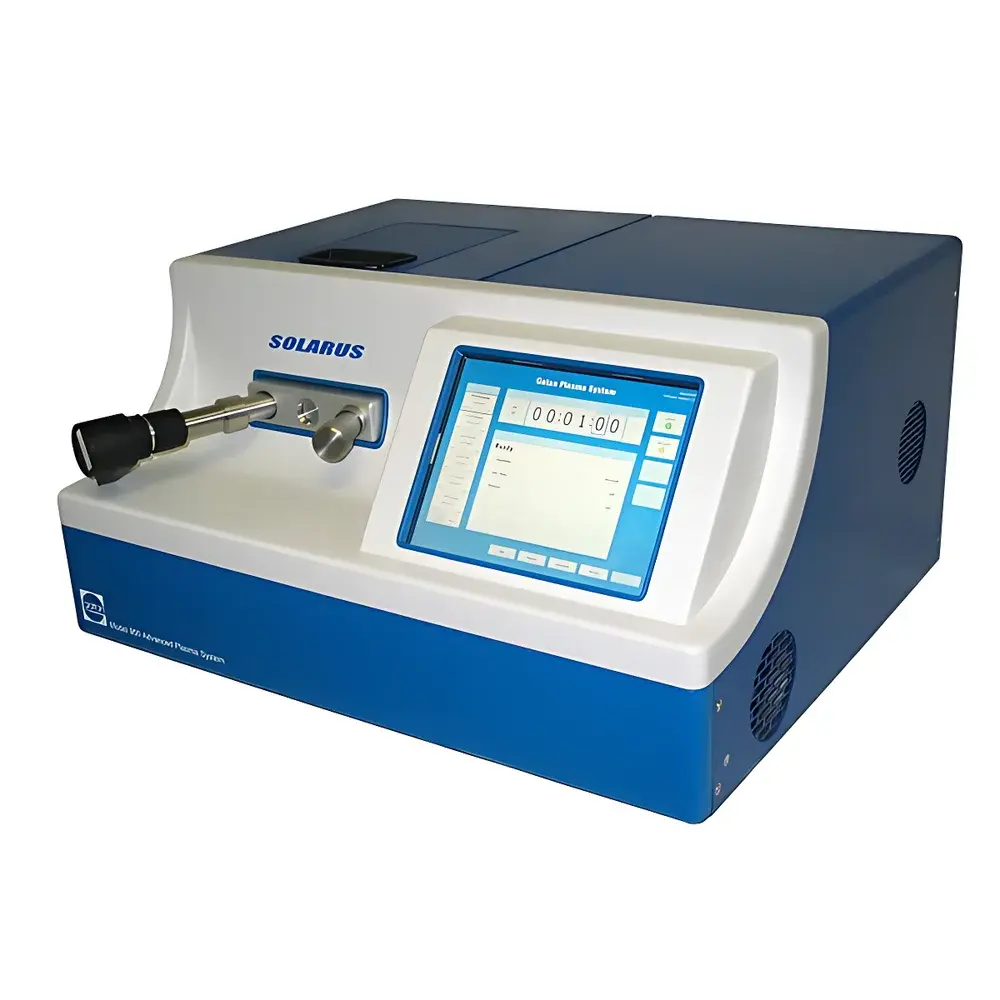
Gatan SOLARUS 950 Plasma Cleaning System
| Brand | GATAN |
|---|---|
| Origin | USA |
| Model | SOLARUS (950) |
| RF Power | 50 W with auto-matching |
| Vacuum System | 70 L/s turbomolecular pump + dual-stage diaphragm pump |
| Base Pressure | 5 × 10⁻⁶ Torr |
| Operating Pressure | 400 mTorr |
| Chamber Dimensions | 3.5" diameter × 2.0" depth |
| Gas Control | Triple independent MFCs (H₂, O₂, Ar) |
| Cleaning Cycle Time | <2 min (pump-down + plasma treatment + vent) |
| Sample Loading | Dual front ports for TEM/SEM sample holders + top port for >25 TEM grids or SEM stages |
| Plasma Observation | Integrated viewport |
| Compliance | Designed for GLP/GMP-aligned lab environments |
Overview
The Gatan SOLARUS 950 Plasma Cleaning System is a high-precision, ultra-high-vacuum-compatible plasma source engineered specifically for the preparation and maintenance of electron microscopy specimens. It operates on the principle of low-power, capacitively coupled radiofrequency (RF) plasma generation in controlled gas environments—primarily H₂/O₂ mixtures—to selectively oxidize and volatilize hydrocarbon contaminants without altering the bulk chemistry or crystalline structure of sensitive samples. Unlike thermal or solvent-based cleaning methods, the SOLARUS 950 delivers non-destructive surface decontamination at the molecular level, making it indispensable for transmission electron microscopy (TEM), scanning transmission electron microscopy (STEM), and energy-filtered TEM (EFTEM) applications where carbon contamination directly compromises image contrast, EELS signal-to-noise ratio, and quantitative EDX accuracy.
Key Features
- 50 W RF generator with real-time impedance matching ensures stable plasma ignition and uniform power coupling across variable chamber conditions and gas compositions.
- Dual-front loading ports accommodate standard side-insertion TEM holders (e.g., Gatan 652, 656) and SEM stubs, enabling rapid, tool-free specimen exchange without breaking vacuum on the main microscope.
- Top-access chamber accepts up to 25+ TEM finder grids or full SEM sample stages—ideal for batch cleaning of support films, holey carbon membranes, and metallized substrates.
- Triple-gas mass flow control (H₂, O₂, Ar) enables precise stoichiometric tuning of reactive species concentration, critical for optimizing removal kinetics while minimizing membrane etching.
- Integrated viewport allows direct visual monitoring of plasma glow characteristics—serving as both an operational diagnostic and a qualitative indicator of process consistency.
- Touchscreen interface supports seven pre-validated cleaning protocols (including H₂/O₂, O₂-only, and Ar sputter modes), with full user programmability for custom gas ratios, power ramping, and dwell times.
- Ultra-fast vacuum cycle: base pressure achieved in <60 s; chamber vented in <5 s—minimizing turnaround time between cleaning sessions and maximizing instrument uptime.
Sample Compatibility & Compliance
The SOLARUS 950 is routinely deployed for cleaning TEM grids coated with ultrathin carbon films (including holey carbon, continuous carbon, and graphene oxide), FIB-prepared lamellae, cryo-EM specimen supports, and SEM stub-mounted biological or inorganic samples. Its low-energy plasma regime preserves delicate nanostructures, amorphous layers, and beam-sensitive organometallic compounds. The system meets essential requirements for regulated laboratory environments: vacuum integrity conforms to ISO 27498 (vacuum equipment performance testing); gas delivery accuracy aligns with ASTM E2913-13 (standard practice for gas flow calibration); and operational logging—when paired with Gatan’s DigitalMicrograph® or third-party LIMS integration—supports traceability under GLP and GMP frameworks. While the hardware itself does not carry CE or UL certification out-of-box, its electrical architecture (100–240 VAC, 50–60 Hz, 1000 W max) complies with IEC 61000-6-3 emission limits for laboratory equipment.
Software & Data Management
Control and monitoring are executed via an embedded ARM-based touchscreen controller running a real-time Linux OS. All cleaning parameters—including gas composition, RF power profile, pressure history, and cycle timestamps—are logged locally with UTC synchronization. Export options include CSV and XML formats for integration into institutional data management systems. When interfaced with Gatan’s Microscopy Suite™ or external ELN platforms, the SOLARUS 950 supports electronic signatures, user-level access controls, and audit trail generation compliant with FDA 21 CFR Part 11 Annex 11 requirements—provided that the host software environment undergoes formal validation per organizational SOPs.
Applications
- Removal of adsorbed hydrocarbons from TEM grids prior to high-resolution imaging or atomic-resolution STEM acquisition.
- Restoration of EELS collection efficiency by eliminating carbon buildup on spectrometer entrance apertures and detector windows.
- Pre-treatment of cryo-EM grids to reduce ice contamination artifacts during vitrification.
- Surface activation of insulating substrates (e.g., SiO₂/Si wafers) to improve metal adhesion in lift-out workflows.
- Decontamination of SEM sample stages and stubs following polymer or biological residue exposure—extending EDX and EBSD acquisition stability.
FAQ
What gases are required for routine operation?
Standard operation uses high-purity hydrogen (H₂) and oxygen (O₂) for hydrocarbon oxidation; argon (Ar) is optional for inert sputtering or plasma stabilization.
Can the SOLARUS 950 clean holey carbon films without damaging the holes?
Yes—the H₂/O₂ low-power plasma protocol has been empirically optimized to remove surface contaminants while preserving nanoscale pore integrity, as verified by pre- and post-cleaning TEM imaging.
Is remote operation supported?
The system includes Ethernet connectivity and Modbus TCP support for integration into facility-wide automation networks; however, full remote control requires custom API development or middleware configuration.
How often does the RF matching network require recalibration?
The auto-matching circuit performs continuous impedance adjustment during operation; no manual recalibration is needed under normal use conditions.
Does the system meet electromagnetic compatibility (EMC) standards for shared lab spaces?
It complies with CISPR 11 Group 1 Class B emissions limits for laboratory equipment operating in non-residential environments.