
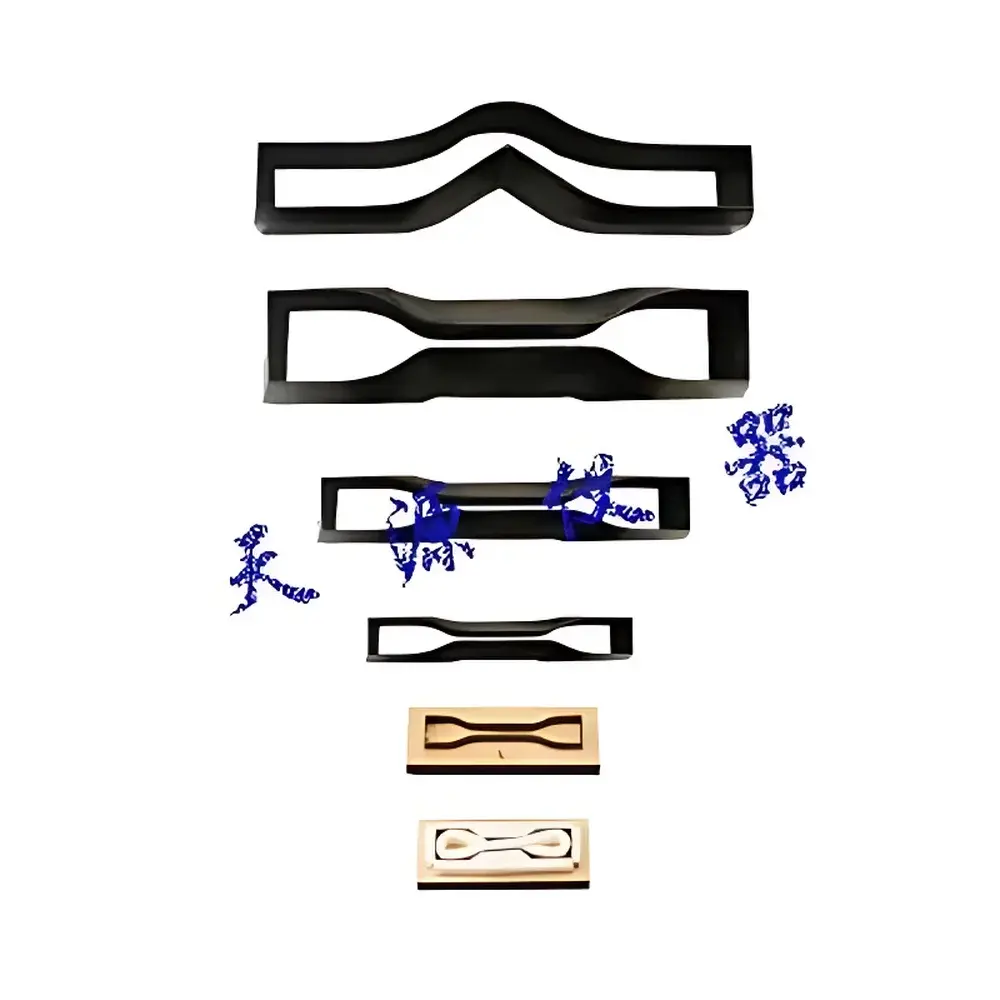
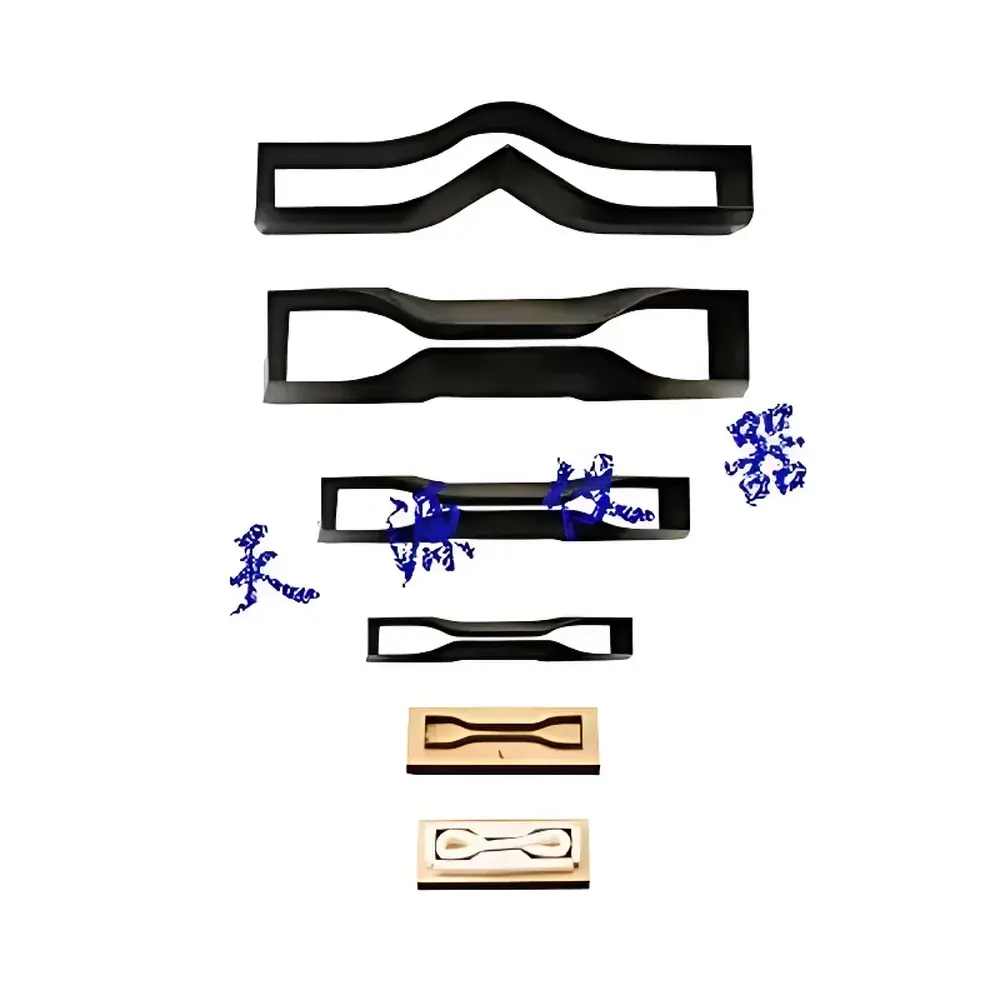
GB/T 529-2008 Compliant TianYuan ASTM-Style Rubber Dumbbell & Right-Angle Tear Specimen Cutter
| Brand | TianYuan |
|---|---|
| Origin | Jiangsu, China |
| Manufacturer Type | Direct Manufacturer |
| Country of Origin | China |
| Model Designation | ASTM-Compliant |
| Pricing | Available Upon Request |
Overview
The GB/T 529-2008 Compliant TianYuan ASTM-Style Rubber Dumbbell & Right-Angle Tear Specimen Cutter is a precision-engineered manual die-cutting tool designed exclusively for standardized specimen preparation in rubber and elastomer mechanical testing. It operates on the principle of controlled, high-tolerance shear cutting using hardened steel blades mounted in rigid, dimensionally stable frames. This instrument ensures strict adherence to ISO 37, ASTM D412 (tensile), ASTM D624 (tear), and GB/T 529-2008 (determination of tear strength of vulcanized rubber and thermoplastic elastomers) — particularly for dumbbell-shaped tensile specimens (Type I, II, III per GB/T 529-2008) and right-angle tear specimens (6 mm × 115 mm × 4 mm, 75 mm × 2 mm × 35 mm configurations). Its mechanical architecture eliminates operator-induced variability in specimen geometry, directly supporting reproducibility-critical applications such as QC release testing, R&D formulation validation, and inter-laboratory round-robin studies.
Key Features
- Calibrated blade geometry conforming to GB/T 529-2008 Annex A (dumbbell dimensions: 6 mm gauge width × 115 mm total length × 4 mm thickness; right-angle tear: 75 mm × 2 mm × 35 mm)
- Through-hardened carbon tool steel blades (HRC 58–62) with micro-ground cutting edges for consistent edge sharpness and extended service life
- Integrated alignment guide rails and fixed-base mounting system to prevent lateral blade drift during manual compression
- Modular frame design accommodating standard 1–6 mm thick sheet stock (vulcanized rubber, TPE, silicone, EPDM, NBR, SBR)
- No electrical or pneumatic components — fully manual operation ensures intrinsic safety in solvent-rich lab environments
- Traceable manufacturing documentation provided per batch, including dimensional verification reports against GB/T 529-2008 tolerances (±0.1 mm linear, ±0.05 mm thickness)
Sample Compatibility & Compliance
This cutter is validated for use with vulcanized rubber sheets, thermoplastic elastomers (TPEs), and silicone compounds within the hardness range of 30–90 Shore A. Specimen thickness must be uniform (±0.1 mm across surface) and free from surface defects (blisters, folds, contamination) prior to cutting. The tool satisfies mandatory requirements for specimen geometry under GB/T 529-2008, ISO 37:2017, and ASTM D624-19 — specifically addressing critical parameters: parallelism of gauge section edges (≤0.02 mm deviation), absence of burrs or micro-tears at cut boundaries, and dimensional fidelity of the 2 mm ligament width in right-angle tear specimens. All units are supplied with a Certificate of Conformance referencing GB/T 529-2008 Clause 5.2 (specimen preparation equipment qualification).
Software & Data Management
This is a purely mechanical, non-electronic specimen preparation device. No embedded firmware, software interface, or digital data output is included. However, its deterministic physical output enables full traceability when integrated into GLP/GMP-compliant workflows: specimen lot numbers, cutter serial ID, operator ID, date/time stamp, and raw material batch code can be recorded manually or via LIMS integration (e.g., LabWare, Thermo Fisher SampleManager). For audit readiness, laboratories may retain cutter calibration logs, blade replacement records, and periodic dimensional verification reports — all aligned with ISO/IEC 17025:2017 Clause 6.4 (equipment management) and FDA 21 CFR Part 11 (where manual records are designated as “original paper records”).
Applications
- Tensile property determination per GB/T 528-2009 and ASTM D412 using Type I/II dumbbell specimens
- Tear resistance evaluation per GB/T 529-2008 (right-angle method), ISO 34-1:2015, and ASTM D624
- Quality control of incoming elastomer stock in tire, hose, seal, and automotive component manufacturing
- Formulation screening during compound development for compression set, fatigue, and adhesion performance
- Preparation of specimens for dynamic mechanical analysis (DMA) and hardness correlation studies
- Standardized sample generation for accredited third-party testing laboratories (CNAS, UKAS, A2LA)
FAQ
Does this cutter meet ASTM D624 requirements for right-angle tear specimens?
Yes — blade geometry, ligament width (2.0 ± 0.05 mm), and overall specimen footprint (75 mm × 35 mm) comply with ASTM D624-19 Figure 1 and Table 1.
Can it cut silicone or fluorosilicone sheets?
Yes, provided material hardness is 30–90 Shore A and thickness is ≤6 mm; pre-conditioning at 23°C/50% RH for ≥16 h is recommended per ISO 23529.
Is recalibration required after blade replacement?
Yes — each new blade installation must be verified using certified gauge blocks and optical comparator per GB/T 529-2008 Section 5.2.3; documentation retained for audit.
What maintenance is required?
Monthly cleaning with isopropyl alcohol, light mineral oil application to blade edges, and annual dimensional verification using traceable CMM or optical measuring system.
Is this tool suitable for ISO 179-1 impact testing specimen preparation?
No — this cutter is not designed for Charpy/Izod bar geometry; it is strictly limited to GB/T 529-2008, ISO 37, and ASTM D412/D624 specimen profiles.
Related Products







