
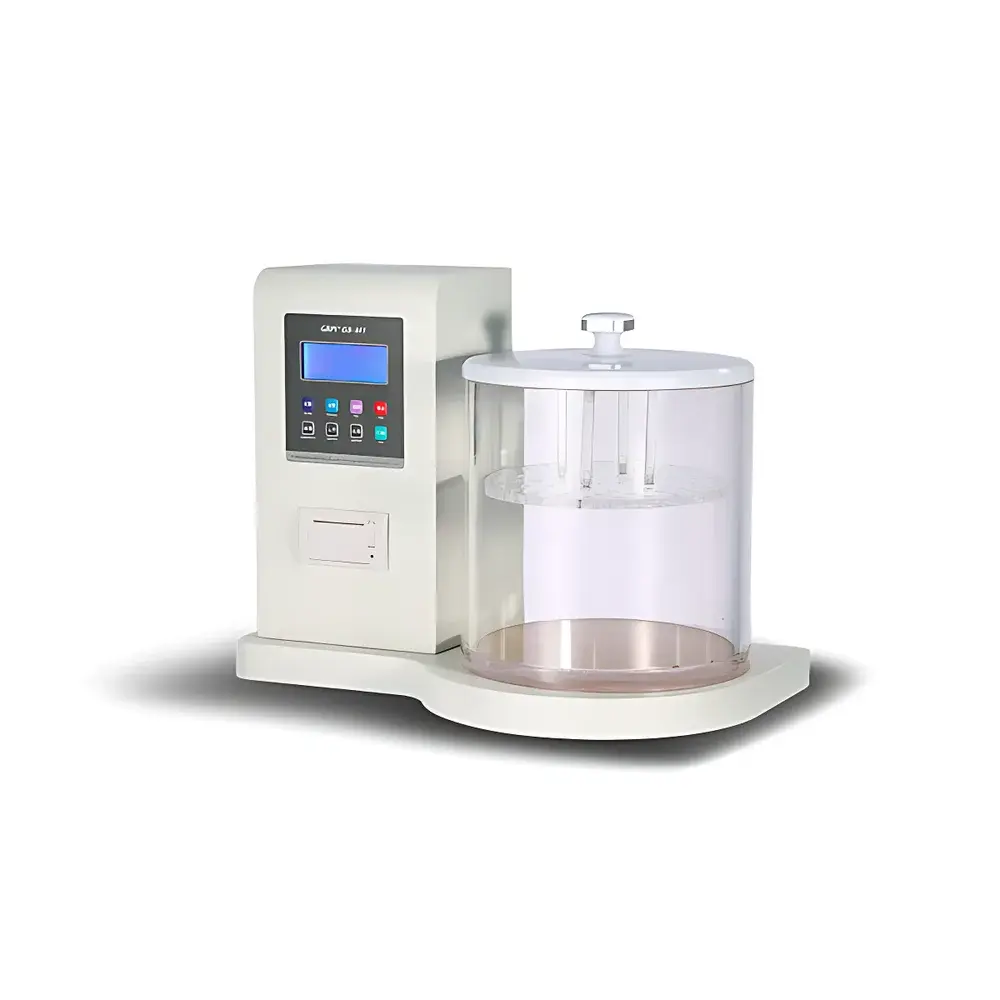
GBPI GB-M1Y1 Vacuum Leak Tester for Packaging Integrity Testing
| Brand | GBPI |
|---|---|
| Model | GB-M1Y1 |
| Origin | Guangdong, China |
| Manufacturer Type | Direct Manufacturer |
| Country of Origin | China |
| Price Range | USD 1,400 – 4,200 (FOB) |
| Vacuum Range | 0 to –90 kPa |
| Vacuum Accuracy | ±1 kPa |
| Vacuum Hold Time | 0.1–9999.9 s |
| Test Chamber Dimensions | Ø270 × 270 mm (effective) |
| Vacuum Chamber Body | Ø300 × 300 mm (standard, customizable) |
| Compressed Air Supply | 0.6–0.8 MPa |
| Air Consumption | 20 L/min |
| Power Supply | 220 V AC, 50 Hz |
| Control Unit Dimensions | 580 × 350 × 440 mm (L×W×H) |
| Net Weight | 10.2 kg |
| Rated Power | 100 W |
Overview
The GBPI GB-M1Y1 Vacuum Leak Tester is an automated, pneumatic-driven instrumentation system engineered for quantitative assessment of seal integrity in flexible and semi-rigid packaging—primarily plastic pouches, laminated sachets, blister packs, and sealed trays used across food, pharmaceutical, personal care, and medical device industries. It operates on the principle of vacuum decay testing: a sealed package is placed inside a calibrated vacuum chamber, evacuated to a user-defined negative pressure (up to –90 kPa), held for a programmable duration, and monitored for pressure rise indicative of leakage pathways. This method conforms to internationally recognized physical test standards including ASTM D3078–2002 (reapproved 2013) for detection of gross leaks in flexible packaging and GB/T 15171–1994, China’s national standard for seal strength and integrity evaluation of plastic composite films and bags. The instrument delivers repeatable, operator-independent results suitable for routine quality control (QC), incoming inspection, and process validation under GLP- and GMP-aligned laboratory environments.
Key Features
- Pneumatically actuated vacuum generation and venting—eliminates reliance on mechanical vacuum pumps, reducing maintenance, noise, and thermal drift.
- Full automation sequence: automatic evacuation to target vacuum level, precise dwell time control (0.1–9999.9 s resolution), automatic pressure hold verification, and controlled atmospheric re-entry with regulated air bleed.
- Integrated high-contrast LCD interface displaying real-time vacuum level, elapsed hold time, status indicators, and pass/fail thresholds.
- Built-in thermal printer producing traceable test reports with date/time stamp, vacuum setpoint, hold duration, observed pressure deviation, and operator ID field (if configured via external login integration).
- Manual override capability: pause/resume function and emergency abort allow operator intervention during active test cycles without system reset.
- Modular vacuum chamber design: standard Ø300 × 300 mm stainless-steel chamber with removable lid; optional custom chambers available for non-standard package geometries or high-throughput fixtures.
Sample Compatibility & Compliance
The GB-M1Y1 accommodates a broad range of package formats—including stand-up pouches, side-gusseted bags, pillow packs, foil-laminated wrappers, and rigid-plastic trays—provided their maximum dimensions fit within the effective test volume (Ø270 × 270 mm). Sealed edges, heat-sealed seams, peel-open closures, and cold-seal adhesives are all assessable. The system supports both qualitative leak detection (e.g., bubble emission observation during submersion post-test) and semi-quantitative interpretation via pressure decay rate analysis. It complies with ASTM D3078 for gross leak screening and aligns with ISO 11607-2:2019 requirements for packaging validation protocols. While not intrinsically 21 CFR Part 11 compliant, its data output format and printed report structure facilitate audit-ready documentation when deployed within validated QC workflows governed by FDA, EU Annex 11, or PIC/S GMP frameworks.
Software & Data Management
The GB-M1Y1 operates as a standalone embedded system with no PC dependency. All test parameters, results, and timestamps are stored locally in non-volatile memory (retains ≥1,000 test records). Export functionality is limited to hardcopy output via the integrated printer; however, the ASCII-formatted printout includes structured fields (Test ID, Date/Time, Vacuum Setpoint, Hold Time, Observed ΔP, Result) compatible with downstream LIMS or ELN ingestion via optical character recognition (OCR) or manual entry. For laboratories requiring electronic data archiving, GBPI offers optional RS-232 serial interface kits (sold separately) enabling ASCII data streaming to host PCs running custom scripts or third-party SCADA-compatible acquisition software. Audit trail functionality (e.g., user logins, parameter change history) is not natively implemented but may be supplemented via external access-control systems interfaced at the facility network layer.
Applications
- Final package integrity verification prior to distribution in snack food, dairy, and ready-to-eat meal production lines.
- Seal strength correlation studies—paired with tensile testers—to establish minimum acceptable vacuum hold times for given seal geometry and material composition.
- In-process monitoring of heat sealer performance: rapid detection of temperature fluctuations, dwell time deviations, or jaw contamination affecting seal continuity.
- Supplier qualification testing for contract packaging organizations (CPOs) delivering sterile barrier systems to medical device manufacturers.
- Stability study support: periodic retesting of aged packages to evaluate seal degradation under accelerated or real-time storage conditions.
- Root cause analysis of field complaints related to moisture ingress, oxidation, or microbial contamination traced to compromised seals.
FAQ
What compressed air specifications are required for reliable operation?
A clean, dry, oil-free air supply at 0.6–0.8 MPa (6–8 bar) is mandatory. Users must install a three-stage filtration unit (particulate, coalescing, adsorption) upstream of the instrument. Minimum recommended compressor capacity: 2.5 HP with 8 kg/cm² output pressure and ≥20 L/min free air delivery at operating pressure.
Can the GB-M1Y1 detect micro-leaks smaller than 100 µm?
No. As a vacuum decay tester per ASTM D3078, it is designed for gross leak detection (typically >150–200 µm equivalent hole diameter). For sub-100 µm leak quantification, helium mass spectrometry or pressure decay with higher-resolution transducers (e.g., ±0.01 kPa) is required.
Is calibration certification included with shipment?
A factory-issued calibration certificate (traceable to NIM, China) is available as a paid option (not standard). Users are advised to perform annual verification using a certified reference manometer and documented SOP per ISO/IEC 17025 guidelines.
What safety certifications does the instrument carry?
The GB-M1Y1 meets GB 4793.1–2019 (equivalent to IEC 61010-1:2010) for electrical safety of laboratory equipment and carries CCC mark for domestic China market compliance. CE marking is not applicable as it is not CE-declared for EU use.
How is maintenance performed on the pneumatic system?
Primary maintenance involves quarterly inspection of O-rings on the chamber lid and vacuum chamber base, replacement every 12 months or after 5,000 cycles, and biannual cleaning of the air inlet filter. No lubrication or internal valve servicing is required under normal operating conditions.
Related Products





