
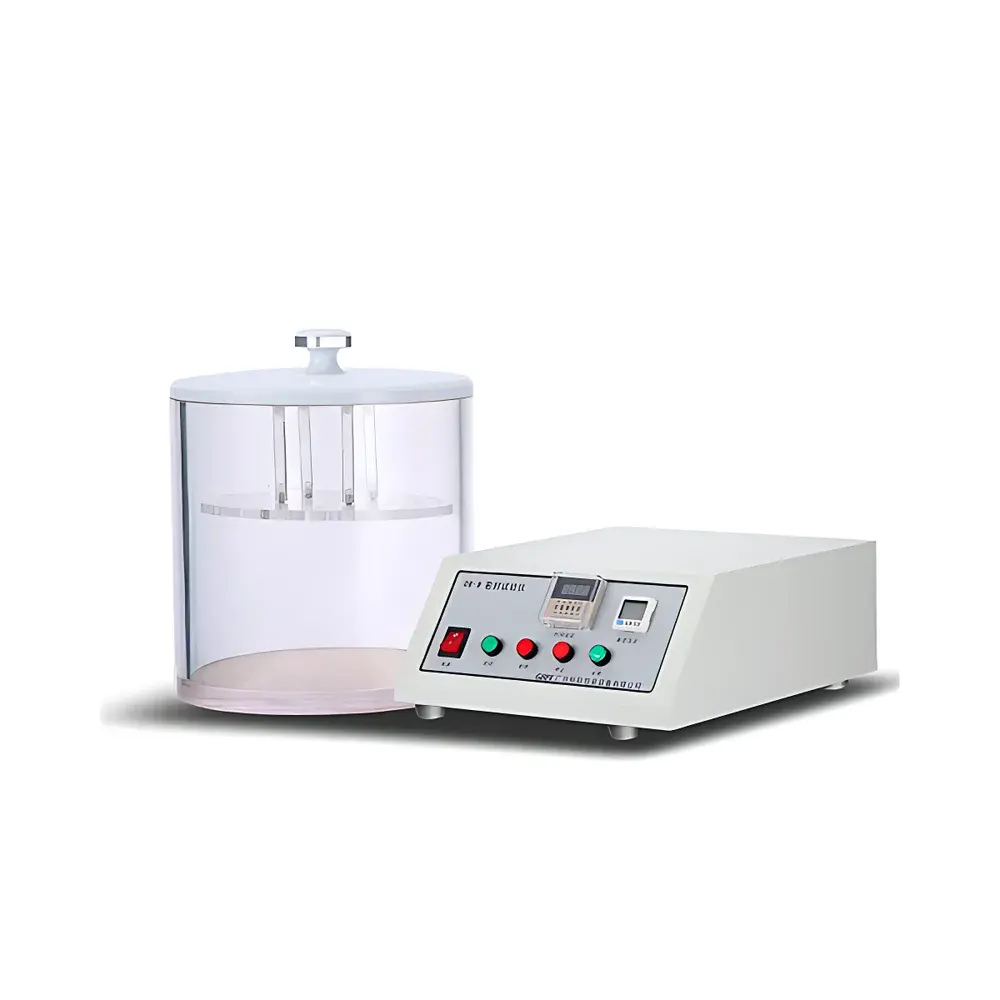
GBPI GB-MA Sealing Tester for Package Integrity Verification
| Brand | GBPI |
|---|---|
| Model | GB-MA |
| Origin | Guangdong, China |
| Manufacturer Type | Direct Manufacturer |
| Country of Origin | China |
| Price Range | USD 1,400 – 4,200 (FOB) |
| Vacuum Range | 0 to −80 kPa |
| Vacuum Accuracy | ±1% FS |
| Vacuum Hold Time | 0.1–99.99 h |
| Test Chamber Dimensions | Ø300 × 350 mm |
| Vacuum Chamber Effective Size | Ø270 × 270 mm |
| Inlet Air Pressure | 0.7–0.8 MPa |
| Compressed Air Consumption | 20 L/min |
| Power Supply | 220 V, 50 Hz |
| Control Unit Dimensions | 300 × 380 × 500 mm |
| Net Weight | 20 kg |
| Rated Power | 100 W |
| Operating Ambient Temperature | 10–40 °C |
Overview
The GBPI GB-MA Sealing Tester is an automated vacuum-based integrity verification instrument engineered for quantitative assessment of seal integrity in flexible and semi-rigid packaging—particularly heat-sealed plastic pouches, blister packs, sachets, and rigid containers used across pharmaceutical, food, personal care, and medical device industries. It operates on the principle of vacuum decay testing: a sealed package is placed inside a calibrated vacuum chamber; upon evacuation to a user-defined negative pressure (up to −80 kPa), the system monitors pressure stability over a programmable dwell time (0.1–99.99 hours). Any detectable pressure rise above the specified tolerance (±1% full scale) indicates micro-leakage at the seal interface or material defect. This method aligns with deterministic physical principles described in ISO 11607-2, ASTM D3078-2002 (reapproved 2013), and GB/T 15171-1994, making it suitable for routine QC release testing as well as process validation under GLP and GMP frameworks.
Key Features
- Electro-pneumatic architecture with integrated solenoid valves and high-stability vacuum transducer for repeatable pressure control and measurement.
- Full automation cycle: automatic vacuum draw, precise hold timing, controlled venting, and mechanical return to atmospheric pressure—minimizing operator dependency and inter-test variability.
- Manual override capability: pause/resume function and emergency stop allow real-time intervention during test execution for troubleshooting or sample inspection.
- Modular vacuum chamber design featuring a removable lid and standardized Ø270 × 270 mm effective internal volume—optimized for rapid loading/unloading and compatibility with common retail- and clinical-scale packaging formats.
- Low-power operation (100 W rated) and compact footprint (control unit: 300 × 380 × 500 mm) enable seamless integration into QC labs with constrained bench space and standard 220 V/50 Hz infrastructure.
- Compressed air-driven actuation eliminates need for oil-lubricated vacuum pumps—reducing maintenance, contamination risk, and long-term TCO.
Sample Compatibility & Compliance
The GB-MA accommodates flat, stand-up, gusseted, and tray-sealed packages up to 300 mm in diameter and 350 mm in height. Its chamber geometry supports both pouch-on-tray and free-standing configurations without fixture tooling. The instrument complies with the physical test requirements of ISO 11607-2:2019 (Packaging for terminally sterilized medical devices), ASTM D3078-2002 (Standard Test Method for Determination of Leaks in Flexible Packaging by Bubble Emission), and China’s national standard GB/T 15171-1994 (Method for Testing Seal Strength of Flexible Packaging). While not inherently compliant with FDA 21 CFR Part 11, its digital control logic supports audit-ready event logging when paired with validated external data acquisition software meeting ALCOA+ principles.
Software & Data Management
The GB-MA features an embedded microcontroller-based interface with LED display and tactile membrane keypad for local parameter entry (target vacuum, hold duration, pass/fail thresholds). All test events—including start time, vacuum setpoint, actual achieved vacuum, hold duration, final pressure drift, and pass/fail status—are timestamped and stored in non-volatile memory (capacity: ≥1,000 records). Data export is supported via RS-232 serial interface to external PCs running GBPI’s optional GB-DataLink software (Windows-compatible), enabling CSV report generation, statistical process control (SPC) charting, and traceable electronic records aligned with ISO/IEC 17025 documentation requirements.
Applications
- Pharmaceutical: Verification of peel seal integrity in aluminum-laminated blister cards and child-resistant pouches prior to stability storage.
- Food & Beverage: Detection of channel leaks in retort pouches, vacuum-packed meat trays, and nitrogen-flushed snack bags.
- Medical Devices: Final container closure integrity testing (CCIT) for sterile barrier systems per AAMI TIR17 guidance.
- Consumer Health: Routine incoming inspection of contract-manufactured OTC product packaging across CMO supply chains.
- R&D Labs: Comparative evaluation of sealant formulations, heat-seal temperature profiles, and substrate compatibility under accelerated aging conditions.
FAQ
What compressed air specifications are required for reliable operation?
A clean, dry, oil-free air source delivering 0.7–0.8 MPa (7–8 bar) at ≥20 L/min is mandatory. Users must install an inline three-stage filter (particulate, coalescing, adsorption) upstream of the instrument inlet.
Can the GB-MA be used for quantitative leak rate calculation?
No—it performs pass/fail vacuum hold testing only. Quantitative leak rate determination requires differential pressure decay or mass spectrometry-based CCIT methods per ASTM F2338-22.
Is calibration certification included with shipment?
A factory-issued calibration report (traceable to NIM, China) is provided. Optional third-party accredited calibration (e.g., CNAS) is available at additional cost.
What maintenance is recommended for long-term accuracy?
Quarterly verification of vacuum transducer linearity using a certified reference manometer and annual replacement of the chamber O-ring seal are advised.
Does the system support network connectivity or LIMS integration?
Native Ethernet or Wi-Fi is not supported; however, RS-232 output enables middleware-based integration with LIMS via serial-to-TCP/IP gateways compliant with ASTM E1384 data exchange standards.






